
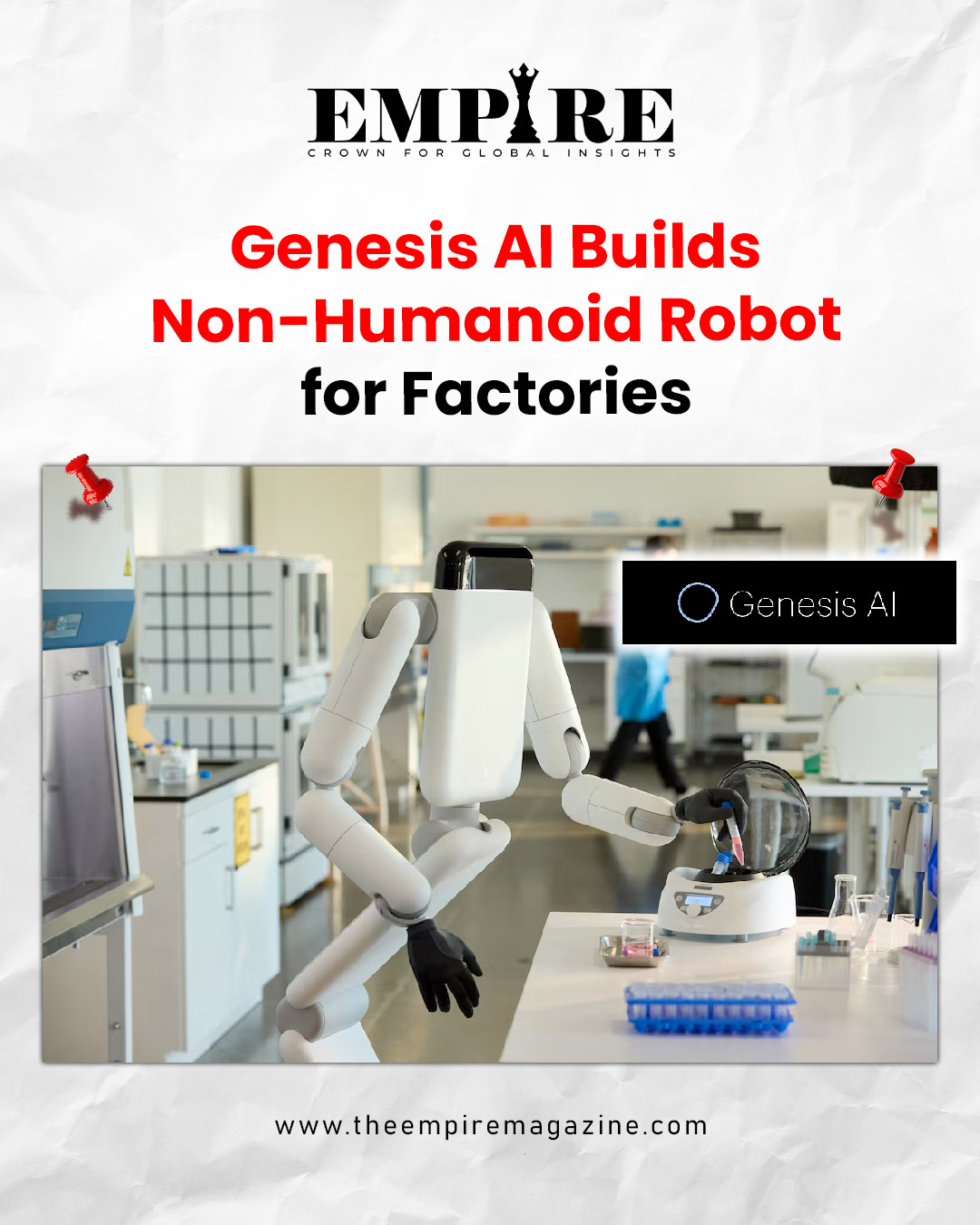
Genesis AI Builds Non-Humanoid Robot for Factories: Why the Future of Industrial Automation May Not Look Human
For decades, science fiction has shaped our imagination of robots. Whether in movies, television shows, or books, the machines of the future almost always resembled humans walking on two legs, speaking in familiar voices, and performing everyday tasks just as people do. That same vision has heavily influenced today’s robotics industry, where companies across the world are investing billions of dollars to create humanoid robots capable of replacing or assisting humans in factories, homes, hospitals, and offices. From Silicon Valley startups to Chinese technology giants, the race to build the world’s most capable humanoid machine has become one of artificial intelligence’s biggest competitions.
But while the spotlight remains fixed on human-like robots, one startup believes the industry may be chasing the wrong goal.
French robotics startup Genesis AI has unveiled Eno, a non-humanoid robot designed specifically for industrial environments. Instead of trying to imitate the human body, Eno has been engineered around one simple philosophy: robots should be designed for the work they need to perform, not for the way humans look. Equipped with a wheeled base, advanced robotic arms, dexterous hands and an AI-powered foundation model, Eno is built to move materials, operate equipment and perform repetitive industrial tasks with speed and precision.
The announcement comes at a crucial moment for global manufacturing. Labour shortages, rising operational costs and increasing pressure to improve productivity have forced industries to rethink automation. Businesses are no longer looking for futuristic demonstrations they want practical machines that can deliver measurable value from day one. Genesis AI believes that means abandoning unnecessary complexity in favour of intelligent engineering.
Backed by an impressive $105 million seed funding round led by Eclipse Ventures and Khosla Ventures, with support from former Google CEO Eric Schmidt, Genesis AI has immediately positioned itself among the most closely watched robotics startups in the world. Rather than competing to build the most human-looking robot, the company is attempting to redefine what the next generation of industrial automation should actually look like. If successful, its strategy could reshape not only robotics but also the broader future of artificial intelligence in physical workplaces.
Why Genesis AI Chose Function Over Form
The robotics industry has long assumed that the closer a machine resembles a human, the more useful it will become. Genesis AI fundamentally disagrees with that assumption. According to the company’s founders, most industrial customers never asked for robots that could walk on two legs, they asked for robots that could reliably complete difficult tasks while keeping costs low and operations efficient.
That thinking became the foundation for Eno’s design.
Instead of balancing on complex mechanical legs, Eno moves on a stable wheeled platform. While this may seem less futuristic, it is considerably more practical for factories, warehouses and laboratories where smooth floors eliminate the need for walking. Wheels consume less energy, require fewer moving parts, reduce maintenance costs and allow robots to move faster while carrying heavier loads. By eliminating unnecessary engineering challenges, Genesis AI has focused its resources on improving intelligence rather than appearance.
The robot’s true innovation lies in its AI capabilities. Powered by Genesis AI’s proprietary robotic foundation model, known as GENE-26.5, Eno can understand its surroundings, manipulate objects with remarkable precision and adapt to multiple industrial tasks without requiring extensive reprogramming. Unlike traditional industrial robots that are typically fixed to one workstation and programmed for a single repetitive activity, Eno has been designed to work across different environments while learning new tasks over time.
Its dexterous robotic hands are capable of handling tools originally designed for human workers, allowing businesses to integrate the robot into existing workflows without redesigning their production facilities. The company has also incorporated a display that communicates the robot’s intentions to nearby workers, improving transparency and helping build trust between humans and machines.
Perhaps the biggest message behind Eno’s design is philosophical rather than technological. Genesis AI argues that businesses should evaluate robots based on productivity, reliability and adaptability, not on whether they resemble people. In an industry often driven by spectacle, that practical mindset may become one of the company’s greatest competitive advantages.
How Eno Could Change the Future of Manufacturing
The launch of Eno comes at a time when manufacturers across the world are facing a perfect storm of challenges. Skilled labour shortages are becoming more common, production costs continue to rise, and supply chains remain under pressure following years of global disruption. At the same time, businesses are under increasing pressure to improve efficiency while maintaining consistent product quality. Traditional automation has certainly helped industries over the past few decades, but most industrial robots remain highly specialised. They are fixed to a single location, programmed for one repetitive task, and often require expensive reconfiguration whenever production requirements change. Genesis AI believes the next generation of automation must be far more flexible, and Eno has been designed with exactly that objective in mind.
Unlike conventional robotic systems, Eno is intended to move freely between workstations and perform multiple tasks throughout a facility. Whether transporting materials, operating machinery, handling laboratory equipment, organising inventory or assisting with repetitive assembly processes, the robot is built to adapt instead of remaining confined to a single production line. Its AI foundation model enables it to understand its surroundings, identify objects and improve its performance through continuous learning, making it significantly more versatile than many of today’s industrial robots. This adaptability could reduce the time and cost businesses spend on reprogramming machines whenever manufacturing processes evolve.
Another major advantage lies in affordability. Humanoid robots often require complex balance systems, sophisticated leg mechanisms and advanced control software, making them expensive to manufacture and maintain. By using a wheeled platform, Genesis AI has simplified the hardware while preserving advanced manipulation capabilities through highly dexterous robotic hands. Lower mechanical complexity translates into lower operating costs, greater reliability and easier maintenance three factors that matter far more to factory owners than whether a robot can climb stairs.
Genesis AI plans to begin commercial deployments before the end of 2026, initially targeting manufacturing plants, logistics centres and scientific laboratories where workflows are structured and automation can deliver immediate value. As the robot gains real-world experience, the company intends to expand into healthcare facilities, hotels and eventually even domestic environments. If Eno performs as promised, it could demonstrate that the future of industrial robotics belongs not to the machines that look the most human, but to those that solve business problems most effectively.
The AI Robotics Race Is Entering a New Phase
Genesis AI’s announcement reflects a much larger transformation taking place across the artificial intelligence industry. Until recently, conversations around AI focused primarily on software, chatbots, virtual assistants and large language models capable of generating text, images and code. Today, however, the industry’s attention is rapidly shifting towards physical AI, where intelligent software is combined with robotics to perform tasks in the real world. The race is no longer just about creating smarter algorithms; it is about building machines capable of interacting safely and efficiently with physical environments.
Several companies, including Tesla, Figure AI, Apptronik, Agility Robotics and numerous Chinese startups, continue to pursue humanoid robots as the future of automation. Their vision is based on the belief that human-shaped robots can naturally fit into environments designed for people. Genesis AI is taking a different approach. The company argues that intelligence, rather than appearance, will ultimately determine commercial success. A robot that performs tasks faster, costs less to operate and delivers a stronger return on investment will almost always outperform one designed primarily to resemble a human being.
This philosophy extends beyond hardware. Genesis AI is developing an integrated robotics ecosystem that combines proprietary AI models, simulation environments, robotic hands and autonomous control systems. By controlling the entire technology stack, the company hopes to accelerate learning, improve performance and reduce dependence on third-party software providers. Such vertical integration mirrors strategies successfully adopted by leading AI companies, where ownership of both hardware and software has become a significant competitive advantage.
Industry experts believe the opportunity could be enormous. Global spending on AI-powered robotics is expected to grow rapidly over the coming decade as manufacturers seek solutions to labour shortages and ageing workforces. Warehouses require faster order fulfilment, factories need greater flexibility, and research laboratories increasingly rely on automation for repetitive experiments. In each of these environments, adaptable robots capable of performing multiple tasks may become indispensable assets rather than optional investments.
The robotics race, therefore, is evolving beyond a competition over engineering achievements. It is becoming a contest over practicality, scalability and economic value. Companies that successfully balance advanced artificial intelligence with affordable hardware are likely to define the next era of industrial automation, and Genesis AI has positioned itself firmly within that conversation.
A Smarter Future for Factories and Workers
While humanoid robots often dominate headlines because of their futuristic appearance, the real measure of success in robotics has always been commercial adoption. Businesses invest in technology to improve productivity, reduce costs and solve operational challenges, not simply to own the most advanced-looking machine. Genesis AI appears to understand this distinction better than many of its competitors. By focusing on practical engineering rather than visual resemblance, the company is attempting to build robots that industries will actually deploy at scale.
That does not mean concerns about automation will disappear. As AI-powered robots become more capable, questions surrounding workforce displacement, employee training and ethical implementation will become increasingly important. Genesis AI has repeatedly emphasised that Eno is designed to work alongside people rather than replace them entirely. The robot is expected to take over repetitive, physically demanding and potentially hazardous tasks, allowing human workers to concentrate on supervision, decision-making, quality control and other responsibilities that require creativity and critical thinking. History suggests that automation often changes the nature of work rather than eliminating it completely, but ensuring workers can adapt through reskilling and education will remain essential.
Eno also represents a broader shift in how society views robotics. For years, technological progress was measured by how closely machines could imitate humans. Genesis AI is challenging that narrative by arguing that usefulness should matter more than appearance. If businesses embrace this philosophy, the next generation of robots may not have faces, legs or human-like movements. Instead, they will be judged by how effectively they integrate into workplaces, improve efficiency and support economic growth.
The success of Genesis AI is far from guaranteed. Commercial deployments, customer adoption and long-term reliability will ultimately determine whether the company’s bold strategy pays off. Yet its decision to reject conventional thinking has already sparked an important conversation within the robotics industry. As artificial intelligence continues to move from digital applications into physical environments, the companies that prioritise practical innovation over spectacle may ultimately shape the future of automation.
In many ways, Eno is more than just another industrial robot. It symbolises a changing philosophy within one of technology’s fastest-growing sectors, a belief that the smartest machines are not necessarily the ones that look most human, but the ones that quietly and efficiently solve real-world problems. If that vision becomes reality, Genesis AI may have done more than build a successful robot; it may have redefined the direction of the global robotics industry.
For more insights, navigate on The Empire Magazine
Previous article: Luxury brands target America’s Rich
Magazine Feautures | Podcasts: Empire Global Talks
Follow The Empire Magazine on Facebook | Instagram | LinkedIn
The Empire Magazine | Crown for Global Insights