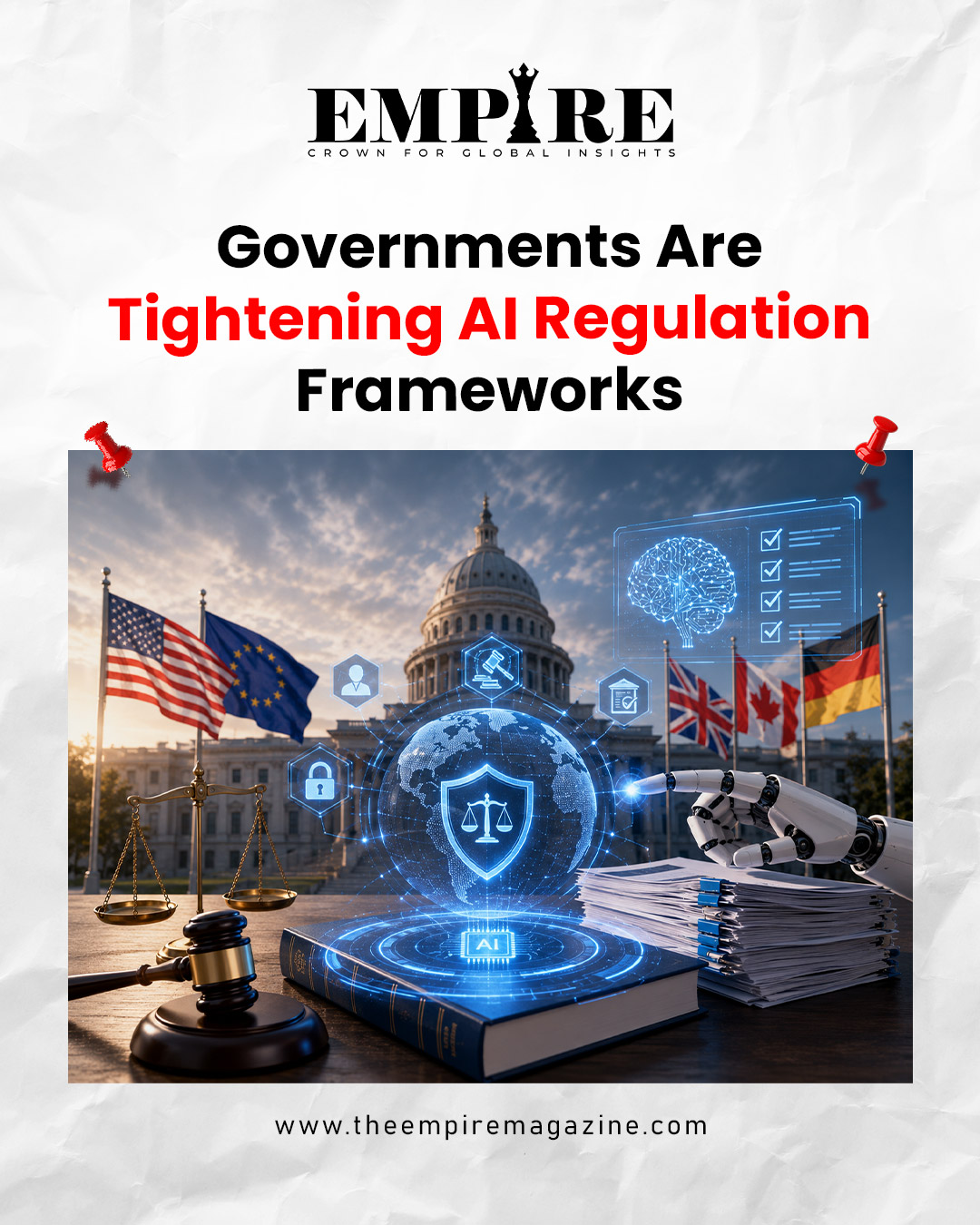
AI regulation frameworks are rapidly evolving as governments introduce new laws to govern artificial intelligence, data privacy, transparency, cybersecurity, and responsible innovation. AI regulation frameworks are becoming a global priority as governments introduce new laws to regulate artificial intelligence. From transparency and data privacy to accountability and cybersecurity, these frameworks aim to encourage innovation while reducing the risks associated with rapidly advancing AI technologies.
Governments Tighten AI Regulation Frameworks as AI Enters a New Era
Artificial intelligence has quickly evolved from an emerging technology into one of the most influential forces shaping economies, businesses, governments, and societies. From healthcare diagnostics and financial services to manufacturing, education, defence, and customer service, AI is transforming decision-making at an unprecedented pace. However, as AI capabilities continue to expand, governments worldwide are increasingly recognizing that innovation cannot progress without accountability. As a result, AI Regulation Frameworks have become one of the defining policy priorities of 2026.
Over the past year, lawmakers across Europe, North America, Asia-Pacific, and the Middle East have accelerated efforts to introduce comprehensive AI legislation aimed at ensuring transparency, ethical deployment, cybersecurity, privacy protection, and responsible innovation. Rather than restricting technological advancement, policymakers are attempting to create predictable legal environments where businesses can innovate while protecting citizens from misuse, discrimination, misinformation, and security threats.
For enterprises, investors, technology companies, and startups alike, understanding AI Regulation Frameworks is no longer optional. Compliance is rapidly becoming a competitive advantage, influencing investment decisions, cross-border partnerships, product development, and customer trust. As artificial intelligence becomes deeply integrated into daily life, governments are sending a clear message: AI must evolve responsibly.
Why AI Regulation Frameworks Are Becoming Essential
The rapid commercialization of generative AI has exposed both extraordinary opportunities and significant risks. AI systems can now generate realistic images, produce human-like conversations, automate software development, predict diseases, assist legal professionals, and optimize global supply chains. Yet these same technologies can also spread misinformation, reinforce algorithmic bias, violate intellectual property rights, manipulate elections, create deepfakes, and expose confidential data. Governments have therefore concluded that relying solely on voluntary industry commitments is insufficient. AI Regulation Frameworks are increasingly designed to establish clear legal responsibilities for developers, technology providers, and organizations deploying AI systems. These regulations often classify AI applications according to risk levels, with stricter obligations imposed on systems used in healthcare, finance, public services, law enforcement, education, and critical infrastructure. The objective is not to slow innovation but to create a trusted ecosystem where artificial intelligence delivers long-term societal benefits while minimizing unintended consequences.
AI Regulation Frameworks Focus on Transparency
Transparency has emerged as one of the central pillars of modern AI Regulation Frameworks because trust depends on understanding how AI systems reach their conclusions. Governments increasingly expect organizations to document training datasets, explain automated decision-making processes, disclose AI-generated content, and establish mechanisms for human oversight. Businesses developing advanced AI models are investing heavily in governance structures, internal audit systems, and explainability tools to satisfy these expectations. Transparency also extends to consumers, who increasingly want to know when they are interacting with AI rather than humans. Clear disclosure requirements, accountability standards, and independent testing are becoming standard components of emerging regulations. Organizations that embrace transparency are discovering that regulatory compliance often strengthens customer confidence, improves investor perception, and enhances corporate reputation rather than acting merely as a legal obligation.
AI Regulation Frameworks Protect Data and Privacy
Data has become the foundation upon which artificial intelligence is built, making privacy protection an essential element of AI Regulation Frameworks. Governments are strengthening rules surrounding data collection, consent, storage, cross-border transfers, and algorithmic processing to ensure that personal information is handled responsibly. Organizations are increasingly required to implement privacy-by-design principles, conduct impact assessments, secure sensitive datasets, and establish governance policies before deploying AI-powered solutions. Cybersecurity is also becoming inseparable from AI regulation as sophisticated AI models introduce new attack surfaces for malicious actors. Businesses are therefore investing in stronger encryption, secure infrastructure, continuous monitoring, and AI-specific cybersecurity controls. Responsible data governance not only supports regulatory compliance but also reinforces consumer trust, which has become a critical factor influencing digital adoption and long-term business growth.
AI Regulation Frameworks Create Global Business Challenges
While governments broadly agree on the importance of regulating artificial intelligence, differences between national AI Regulation Frameworks are creating complex compliance challenges for multinational organizations. Companies operating across multiple jurisdictions must now navigate varying requirements relating to risk classification, documentation, transparency, copyright obligations, cybersecurity standards, data localization, and sector-specific oversight. This fragmented regulatory landscape increases compliance costs and requires businesses to develop flexible governance strategies capable of adapting to multiple legal systems simultaneously. Large technology firms are expanding dedicated AI governance teams, while startups increasingly seek legal expertise much earlier in their growth journey. Investors are also evaluating regulatory readiness alongside technological innovation when assessing AI companies, recognizing that strong governance can reduce long-term operational and reputational risks. Consequently, regulatory preparedness is emerging as a strategic differentiator in the global AI economy.
AI Regulation Frameworks Will Shape Future Innovation
Contrary to early concerns that regulation would hinder innovation, many industry leaders now believe well-designed AI Regulation Frameworks can actually accelerate responsible technological progress. Clear legal expectations reduce uncertainty for businesses, encourage greater investment, and create more predictable markets for AI adoption. Organizations gain confidence to deploy advanced AI systems when compliance requirements are clearly defined, while customers become more willing to embrace AI-powered services when adequate safeguards exist. Universities, research institutions, startups, and established technology companies are increasingly incorporating responsible AI principles into product development from the earliest stages. Ethical design, fairness testing, bias mitigation, continuous monitoring, and governance reviews are becoming integral parts of AI development rather than afterthoughts. This shift reflects a growing recognition that sustainable innovation depends not only on technological capability but also on public trust and regulatory confidence.
The Future of AI Regulation Frameworks
The evolution of AI Regulation Frameworks is likely to remain one of the defining trends of the global technology industry throughout the coming decade. As artificial intelligence becomes more capable and autonomous, governments will continue refining regulations to address emerging challenges surrounding intellectual property, autonomous decision-making, national security, workforce transformation, synthetic media, robotics, and international AI governance. Businesses that proactively invest in responsible AI, robust compliance systems, transparent governance, and ethical innovation will be better positioned to compete in increasingly regulated markets. Rather than viewing regulation as an obstacle, forward-looking organizations are beginning to recognize it as a foundation for sustainable growth, stronger customer relationships, and greater investor confidence. The future of artificial intelligence will not be determined solely by technological breakthroughs but equally by the quality of the AI Regulation Frameworks that govern their responsible deployment across societies worldwide.
AI Regulation Frameworks
Artificial intelligence is entering a defining phase where innovation and regulation must advance together. Governments are no longer asking whether AI should be regulated, they are determining how quickly comprehensive AI Regulation Frameworks can be implemented without slowing economic growth or technological progress. For businesses, compliance is evolving into a strategic necessity rather than a legal requirement. Companies that prioritize transparency, privacy, accountability, and responsible AI governance will be better equipped to earn customer trust, attract investment, and expand globally. As governments continue refining AI Regulation Frameworks, the organizations that integrate ethical innovation with regulatory readiness will lead the next generation of digital transformation.
AI Regulation Frameworks Build Trust in Artificial Intelligence
One of the biggest advantages of strong AI Regulation Frameworks is their ability to build public trust in artificial intelligence. Consumers are becoming increasingly aware of how AI systems collect personal data, influence purchasing decisions, generate content, and automate important processes. As a result, governments are introducing AI Regulation Frameworks that require greater transparency, accountability, and human oversight across industries. Businesses that align their AI strategies with these AI Regulation Frameworks demonstrate a commitment to ethical innovation, helping strengthen customer confidence while reducing legal and reputational risks. In an increasingly digital economy, trust has become one of the most valuable competitive advantages, making AI Regulation Frameworks essential not only for compliance but also for long-term business success.
AI Regulation Frameworks Drive Responsible Business Growth
Modern enterprises are increasingly recognizing that AI Regulation Frameworks support sustainable innovation rather than restrict it. By establishing clear legal standards for data governance, cybersecurity, algorithmic fairness, and AI accountability, AI Regulation Frameworks provide businesses with greater certainty when investing in artificial intelligence solutions. Organizations that integrate AI Regulation Frameworks into their corporate governance models are better prepared to expand into global markets, attract institutional investors, and build long-lasting customer relationships. As AI adoption accelerates across finance, healthcare, manufacturing, retail, education, and public services, AI Regulation Frameworks are becoming a critical pillar of responsible business growth and digital transformation.
The Global Future of AI Regulation Frameworks
The future of artificial intelligence will be shaped as much by policy as by technology, making AI Regulation Frameworks one of the most influential trends of the coming decade. Governments are expected to continuously update AI Regulation Frameworks to address emerging technologies such as autonomous AI agents, advanced robotics, synthetic media, quantum computing, and next-generation generative AI models. Businesses that proactively adapt to evolving AI Regulation Frameworks will be better positioned to innovate responsibly while maintaining regulatory compliance across multiple jurisdictions. As international collaboration on AI governance grows, AI Regulation Frameworks will increasingly serve as the foundation for secure, ethical, and globally trusted artificial intelligence ecosystems.
For more business and retail insights, read more on The Empire Magazine
Previous article: https://theempiremagazine.com/startup-funding/
Magazine Feautures | Podcasts: Empire Global Talks
Follow The Empire Magazine on Facebook | Instagram | LinkedIn | YouTube
The Empire Magazine | Crown for Global Insights