By The Empire Magazine | 17 November 2026
JAPAN — Liqutenna, a wireless antenna that uses ordinary tap water, has successfully connected to mobile devices during indoor testing, offering a new approach to integrating communication equipment into buildings.
Mitsubishi Electric announced the development on 10 November 2026, following tests conducted with KDDI’s cooperation. The company said its prototype delivered connection performance comparable to a conventional metal antenna under the conditions evaluated.
The research combines an unusual antenna material with a practical design objective: making wireless equipment easier to install in places where appearance matters.
How Liqutenna Uses Ordinary Tap Water
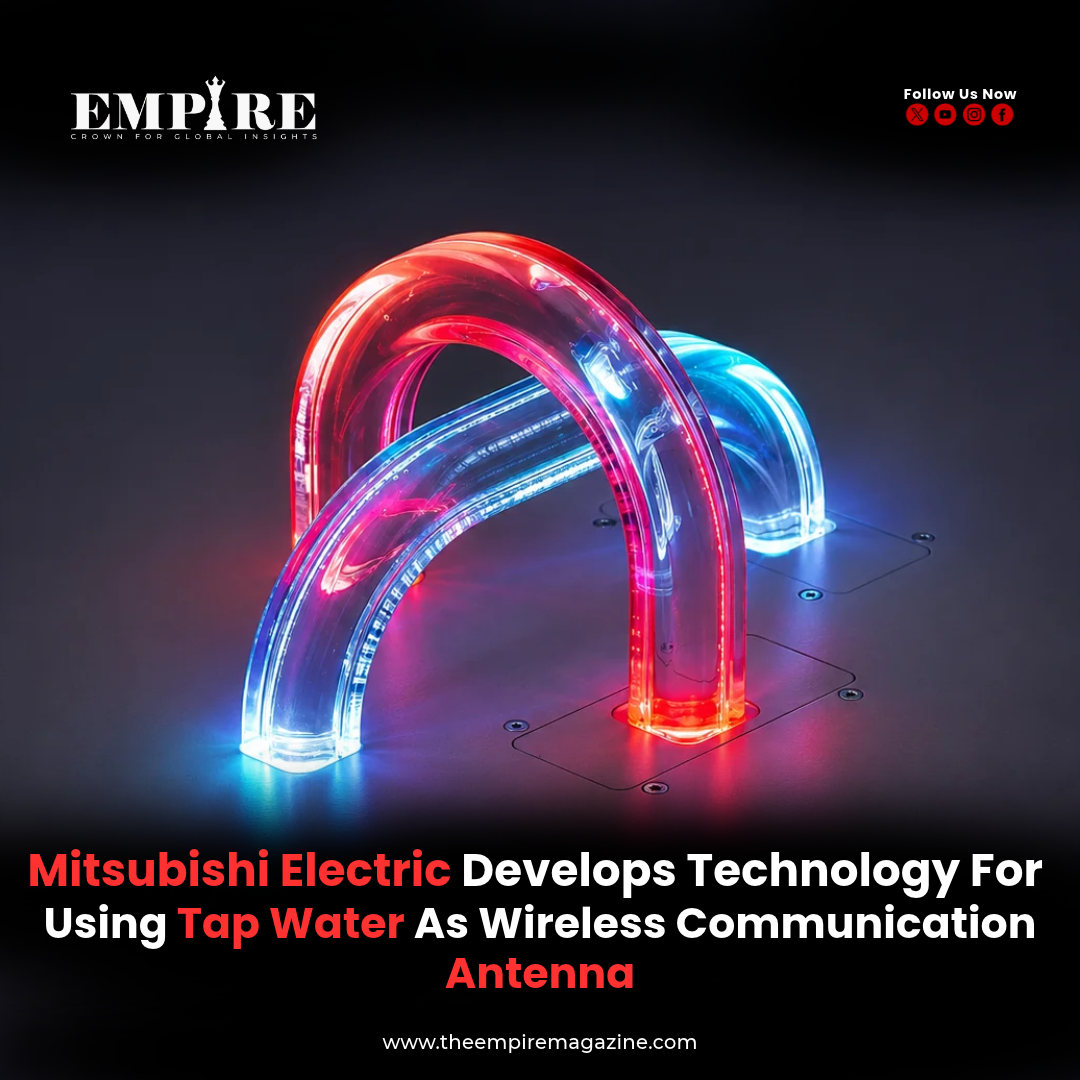
The antenna contains tap water inside transparent acrylic pipes. The water serves as the radiating element, the part of an antenna involved in transmitting and receiving radio waves.
Tap water has much lower electrical conductivity than seawater, creating an engineering challenge. Mitsubishi Electric addressed this by adjusting the pipes’ inner diameter and shape to achieve the required behaviour at radio frequencies.
In Liqutenna, the dimensions of the container are therefore central to how the antenna works. The announcement describes a deliberately engineered structure that allows an everyday liquid to perform a specialised communications function.
One configuration uses two crossed, arch-shaped pipes to support two different polarisations, referring to the orientation of radio waves. The company says this arrangement helps stabilise communication. An arch positioned against a wall is also designed to radiate across a broad area in front of it.
Mobile Tests Demonstrate Connection Performance
Engineers tested an 800 MHz Liqutenna prototype in KDDI’s indoor environment for evaluating wireless communication equipment.
According to Mitsubishi Electric, the prototype connected to mobile terminals with no observed difference in connection performance compared with a conventional metal antenna. Communication also remained possible under several conditions involving changes to the antenna’s orientation and water volume.
These findings establish a working prototype within the tested mobile frequency band and environment. Broader claims about speed, coverage or performance across other frequencies would require additional evidence.
The comparison is particularly relevant because it connects the material experiment to a recognisable task: supporting communication with a mobile device. Future evaluations will show how well that performance carries into actual installations.
Transparent Antennas Could Become Part of Interior Design
The potential appeal of Liqutenna extends to its appearance. Water and clear acrylic allow designers to explore installations that blend with lighting, furnishings and architectural features.
Mitsubishi Electric identifies restaurants, commercial facilities, entertainment venues and historic buildings as possible settings. These are places where equipment placement may need to satisfy both communication requirements and visual considerations.
Concepts include arches installed along walls and cylindrical units placed on desks. Decorative examples use glitter or model aquatic creatures inside a transparent cylinder to create an aquarium-like appearance.
For a venue operator, the potential benefit would be greater freedom to position an antenna where it supports communication while fitting the surrounding space. Whether a particular design delivers that benefit will depend on testing in the intended location.
The company sees possible applications for antennas associated with repeaters and access points. Connected radio equipment would still provide the wider communication functions.
Earlier Seawater Research Helped Shape the Development
The development of Liqutenna builds on Mitsubishi Electric’s earlier work with liquid antennas.
On 27 January 2016, the company announced SeaAerial, a system that used a column of seawater as an antenna. A pump projected the water into the air, while an insulated nozzle enabled the structure to transmit and receive radio waves.
That research explored a movable antenna suitable for coastal or offshore use. It also examined the relationship between the water column’s dimensions and antenna efficiency.
The newer project applies knowledge from that work to ordinary tap water contained in acrylic pipes. Its intended settings bring the research into buildings, where installation flexibility and appearance can be important considerations.
Field Trials Will Examine Everyday Performance
Mitsubishi Electric plans to evaluate Liqutenna with KDDI in locations where radio reception is difficult.
The planned work will assess communication quality in real environments, installation practicality and how well the equipment fits its surroundings. These evaluations will help determine suitable locations and configurations for future use.
For building owners, practical evidence would include dependable coverage in the occupied space and an installation that works with the building’s layout. An indoor prototype test provides a starting point for assessing those requirements.
Mitsubishi Electric also plans to present the technology at Microwave Workshops & Exhibition 2026, scheduled for 25–27 November at Pacifico Yokohama.
Commercial Availability Remains Undisclosed
The announcement positions Liqutenna as a development progressing towards further evaluation. It does not provide a commercial launch date, retail price or confirmed deployment schedule.
The next stage will be important for understanding how the prototype can become a usable component of wireless infrastructure. Installation requirements, repeatable performance and compatibility with its intended equipment will influence that transition.
For now, Liqutenna demonstrates a specific achievement: ordinary tap water, placed inside a carefully designed structure, can support a connection with mobile devices. Its longer-term significance will depend on whether that capability offers a practical advantage in the places where conventional antennas are difficult to accommodate.
Explore more global business, technology and innovation coverage in The Empire Magazine’s article archive.
Read our related coverage: us-china-russia-summit-shenzhen-november-19/
Follow The Empire Magazine:
Facebook | Instagram
The Empire Magazine | Crown For Global Insights