
China | Aviation & Technology
By The Empire Magazine | 16 November 2026
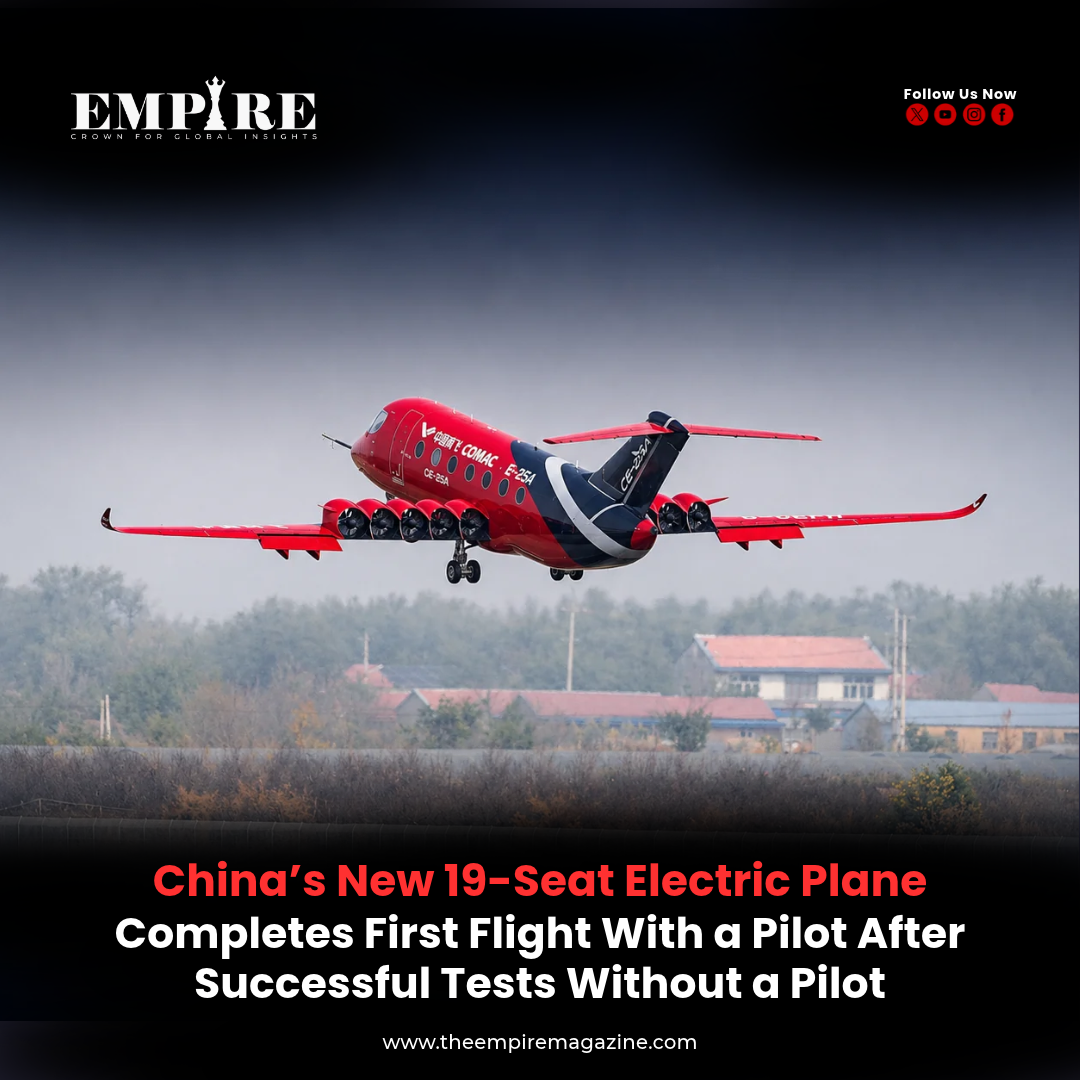
The CE-25A electric plane has completed its first flight with a crew aboard, marking a new stage in COMAC’s development of a 19-passenger aircraft for travel between cities.
The flight took place on 14 November 2026 in Binzhou, Shandong Province, with two pilots and one flight-test engineer on board. COMAC said the aircraft operated normally and its performance indicators met expectations.
The milestone follows a series of autonomous flights without people aboard. Commercial passenger service remains a future objective, with certification work still ahead.
CE-25A electric plane completes first piloted test
The aircraft remained airborne for 16 minutes and 38 seconds, covering 60.4 kilometres, according to flight details released through China News Service.
The broader test lasted 57 minutes and 46 seconds, including activities beyond the airborne portion. These figures describe the test conducted that day, rather than a demonstration of the aircraft’s full stated range.
COMAC, formally the Commercial Aircraft Corporation of China, describes the model as its first electric commercial aircraft. The latest flight added an onboard crew to a programme that had already accumulated experience through uncrewed testing.
From autonomous flights to an onboard crew
The CE-25A electric plane completed its first autonomous uncrewed flight on 2 February 2026. Before the November crewed milestone, the programme had completed 19 autonomous flight validations without people aboard.
The sequence matters because the November flight was the aircraft’s first with a crew, rather than its first flight of any kind.
It also does not establish that future passenger services will operate without pilots. The confirmed development is the progression from uncrewed validation to testing with pilots and an engineer on board.
Aircraft specifications and intended routes
The CE-25A electric plane is designed for short-distance commercial flights between cities. COMAC’s published specifications describe a relatively small passenger aircraft with a stated range of 400 kilometres.
| Specification | Announced figure |
|---|---|
| Passenger capacity | 19 |
| Maximum takeoff weight | 10 tonnes |
| Cruising speed | 300 km/h |
| Cruising altitude | 2,400 metres |
| Stated range | 400 kilometres |
| Intended use | Intercity commercial flights |
These are the manufacturer’s stated specifications. The recent flight carried three crew members and covered 60.4 kilometres; it was not a full-capacity, 400-kilometre passenger demonstration.
For future operators, the practical question will be how the aircraft performs on proposed routes while meeting payload, weather and reserve requirements. The headline range alone cannot answer that question.
How the electric propulsion system works
The CE-25A electric plane uses a distributed electric ducted-fan propulsion system positioned above its wings.
In simple terms, electric motors drive fans enclosed within ducts. Placing multiple propulsion units along the wings creates a different arrangement from the conventional engines familiar on most passenger aircraft.
The aircraft was developed by COMAC with battery manufacturer CATL, Shanghai Jiao Tong University and other partners.
CATL’s involvement reflects a broader programme of aviation battery development. The company had already announced work with electric passenger-aircraft partners in 2023, including testing against aviation safety and quality requirements.
However, the flight announcements reviewed do not provide a complete aircraft-specific battery specification. They do not establish its pack capacity, charging time or replacement cost. Figures associated with CATL’s other battery announcements should therefore not be presented as confirmed specifications for this aircraft.
Ground communications supported the test
Development of the CE-25A electric plane also involves the systems used to monitor flight performance.
China Electronics Technology Group Corporation said its communications research institute supplied a data-link system that maintained stable communications and clear image transmission during the crewed flight.
The system connects equipment aboard the aircraft with a ground control station. It supports the exchange of telemetry, control information and other mission data, allowing teams on the ground to monitor the aircraft and the communications link.
The institute said further work would include testing link stability under different weather conditions and aircraft attitudes. This provides a specific example of the validation still continuing beyond the first crewed flight.
Certification remains a major next step
The CE-25A electric plane has reached the application stage of the certification process. China’s Civil Aviation Administration has accepted COMAC’s application for a type certificate.
Acceptance allows the application to proceed through regulatory review. It does not mean that the aircraft has received its type certificate or permission to begin scheduled passenger services.
A type certificate concerns whether an aircraft design meets applicable airworthiness requirements. The wider process also distinguishes design approval, production approval and the airworthiness of individual aircraft.
COMAC says the “25” in the model’s name refers to China’s CCAR-25 transport-category airworthiness standards. That identifies the intended certification framework; it is not evidence that certification has already been completed.
What the milestone could mean for regional travel
The CE-25A electric plane gives COMAC a platform for exploring electric propulsion in a 19-passenger intercity aircraft.
If the programme completes certification and demonstrates dependable operation, aircraft of this size could offer another option for selected regional routes. That possibility depends on much more than completing an initial flight.
Potential operators would need information about charging infrastructure, time between flights, maintenance, battery life and the number of services an aircraft could reliably complete each day.
Those are commercial questions still to be answered. The first crewed test does not establish cheaper tickets, lower operating costs or a timetable for widespread adoption.
The next useful milestones will be further flight results, progress through certification and detailed plans for actual operations.
Explore more global business, technology and innovation coverage in The Empire Magazine’s article archive.
Read our related coverage: vulcan-rocket-failure-amazon-satellites/
Follow The Empire Magazine:
Facebook | Instagram
The Empire Magazine | Crown For Global Insights