United States | Space & Technology
By The Empire Magazine | 16 November 2026
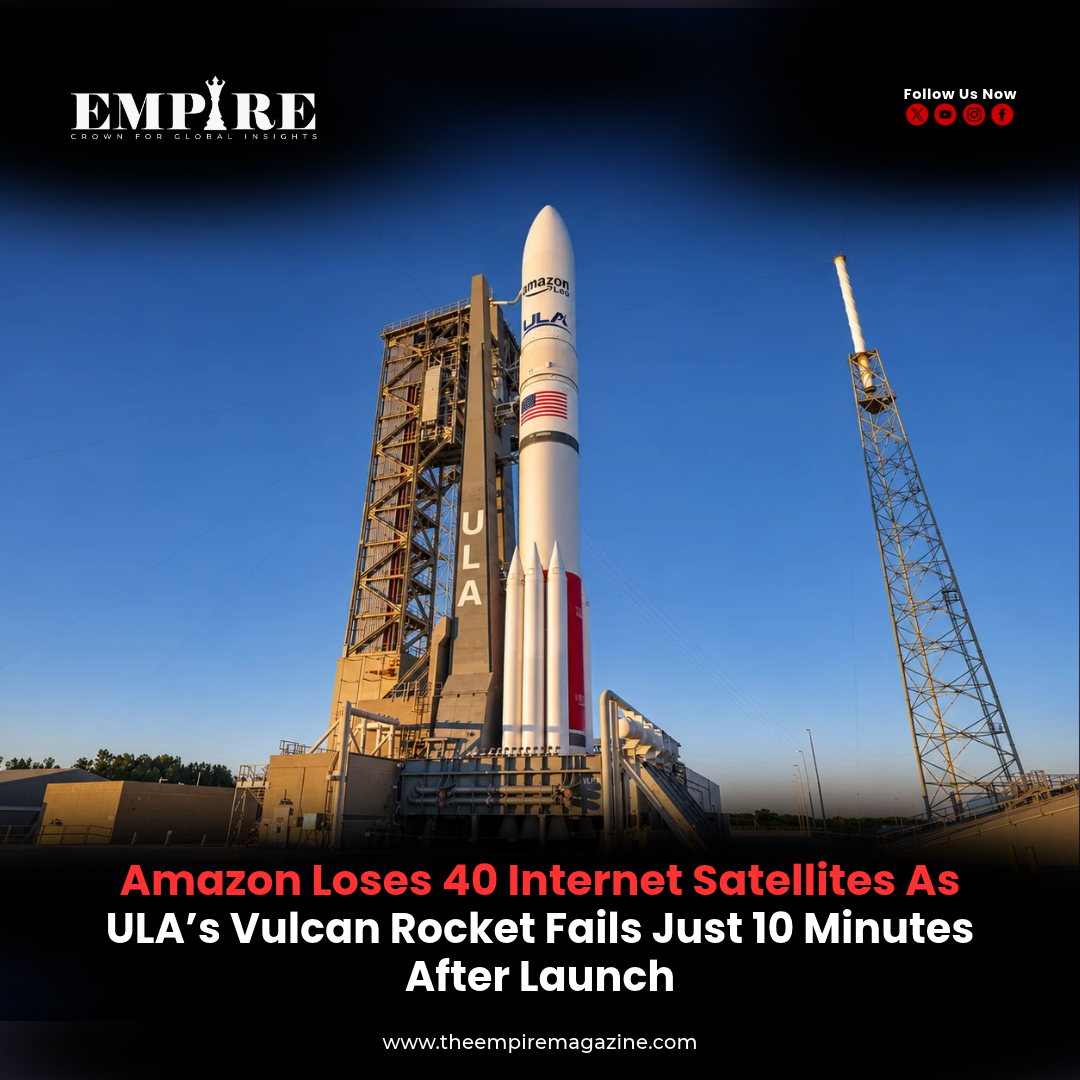
The Vulcan rocket failure on 15 November destroyed 40 Amazon Leo internet satellites after a United Launch Alliance mission encountered an anomaly approximately ten minutes after liftoff. The spacecraft failed to reach orbit, dealing a setback to Amazon’s expanding satellite broadband programme.
The mission, designated LV-01, launched from Cape Canaveral Space Force Station in Florida at 12:40 p.m. Eastern Standard Time. ULA confirmed the failure and said it would investigate with its customer and other appropriate organisations.
As of 16 November, the cause had not been publicly established.
Mission details
| Detail | Confirmed information |
|---|---|
| Mission | LV-01, also called Leo Vulcan 1 |
| Launch date | 15 November 2026 |
| Liftoff | 12:40 p.m. EST |
| Launch site | Space Launch Complex-41, Cape Canaveral, Florida |
| Payload | 40 Amazon Leo broadband satellites |
| Outcome | Satellites lost; intended orbit not reached |
What happened during the Vulcan rocket failure?
ULA said launch data showed an anomaly about ten minutes into the flight. Its initial announcement established that the rocket had failed to deliver Amazon’s payload to orbit, but did not identify a specific component or technical cause.
The vehicle used the VC6L configuration, featuring six solid rocket boosters, a long payload fairing and a Centaur V upper stage adapted for low Earth orbit missions.
ULA designed this version of Centaur V to carry less propellant and weigh less than its standard configuration, allowing more satellite payload on missions to lower orbits. Those specifications describe the vehicle’s design; they do not establish why this flight failed.
Why this launch mattered to Amazon
The Vulcan rocket failure interrupted the opening mission in a substantial launch agreement. Amazon has contracted 38 Vulcan flights intended to deploy more than 1,500 first-generation satellites.
This was Amazon’s first launch aboard Vulcan. The two companies already had an operational relationship: ULA had completed eight successful satellite deployment missions for Amazon using Atlas V rockets.
Amazon also invested in additional launch infrastructure, including a dedicated integration building and mobile launch platform. The facilities allow ULA to prepare two missions in parallel, supporting the higher launch frequency Amazon wants for its constellation.
Before the flight, Amazon said it had completed its 1,000th satellite in early September and had hundreds ready for launch. Satellite production and deployment remain separate milestones: spacecraft cannot contribute to the network until they reach orbit and complete commissioning.
What Amazon Leo is designed to deliver
The Vulcan rocket failure affects a programme intended to extend broadband access to communities and organisations beyond the reach of existing networks.
Amazon Leo, formerly known as Project Kuiper, received its permanent name in November 2025. Its planned initial constellation includes more than 3,000 satellites in low Earth orbit.
The network combines satellites, optical connections between spacecraft, ground infrastructure and customer terminals. Its intended users include households, businesses and public services in locations where reliable connectivity is limited.
Amazon’s launch update reported nearly 400 satellites deployed across 14 earlier production missions. The lost spacecraft were a new batch intended to expand that constellation.
A major setback for ULA
The Vulcan rocket failure occurred on the vehicle’s fifth flight since its January 2024 debut. It was also ULA’s first total mission failure since the company was formed in 2006.
That distinction matters when assessing the rocket’s history. Previous Vulcan flights had experienced solid rocket booster nozzle anomalies, but still delivered their payloads to their intended destinations.
Before this mission, ULA described testing and design changes made after a February booster anomaly. The November loss now requires its own investigation. No confirmed finding has connected the latest failure to those earlier nozzle problems.
For ULA, resolving the problem is important both for Amazon’s deployment plans and for confidence in future Vulcan missions.
Amazon’s response and its next scheduled launch
Following the Vulcan rocket failure, Amazon acknowledged the loss and expressed continued confidence in ULA’s ability to learn from the mission and deliver on its longer-term plans.
Amazon’s updated launch schedule also listed a separate mission, LE-04, targeting no earlier than 23 November 2026. That flight is intended to carry 36 satellites aboard an Arianespace Ariane 64 rocket from French Guiana.
The date remains a target. The mission should not be described as a confirmed replacement for the 40 spacecraft lost on Vulcan.
Amazon has launch agreements with multiple providers, including Arianespace, Blue Origin, SpaceX and ULA. This provides different deployment routes, although moving payloads between vehicles depends on scheduling and technical compatibility.
What the loss could mean for deployment
The immediate consequence of the Vulcan rocket failure is clear: 40 spacecraft intended to add capacity to Amazon’s constellation are unavailable.
The wider effect depends on how quickly ULA identifies the cause and demonstrates that corrective measures are effective. Any resulting changes to Vulcan’s schedule could affect the pace at which Amazon adds satellites.
This is a potential consequence, rather than a confirmed service delay. The available announcements do not establish a precise financial loss, insurance settlement or revised customer rollout date.
Amazon’s stock of manufactured spacecraft may help sustain future missions, but it does not remove the need for launch capacity. Restoring a dependable flight schedule will matter alongside replacing the lost hardware.
What happens next?
ULA said the Vulcan rocket failure would be investigated with Amazon and relevant organisations to determine the cause, identify corrective action and support a return to flight.
The company also committed to keeping customers informed about the investigation. A firm return date had not been established in the announcements reviewed.
The next meaningful updates will be evidence about the failure mechanism, any required changes to the vehicle or procedures, and a revised mission schedule.
Explore more global business, technology and innovation coverage in The Empire Magazine’s article archive.
Read our related coverage: starship-catch-14-earth-orbits/
Follow The Empire Magazine:
Facebook | Instagram
The Empire Magazine | Crown For Global Insights