United States | Artificial Intelligence, Technology & Innovation
Information checked on 3 October 2026.
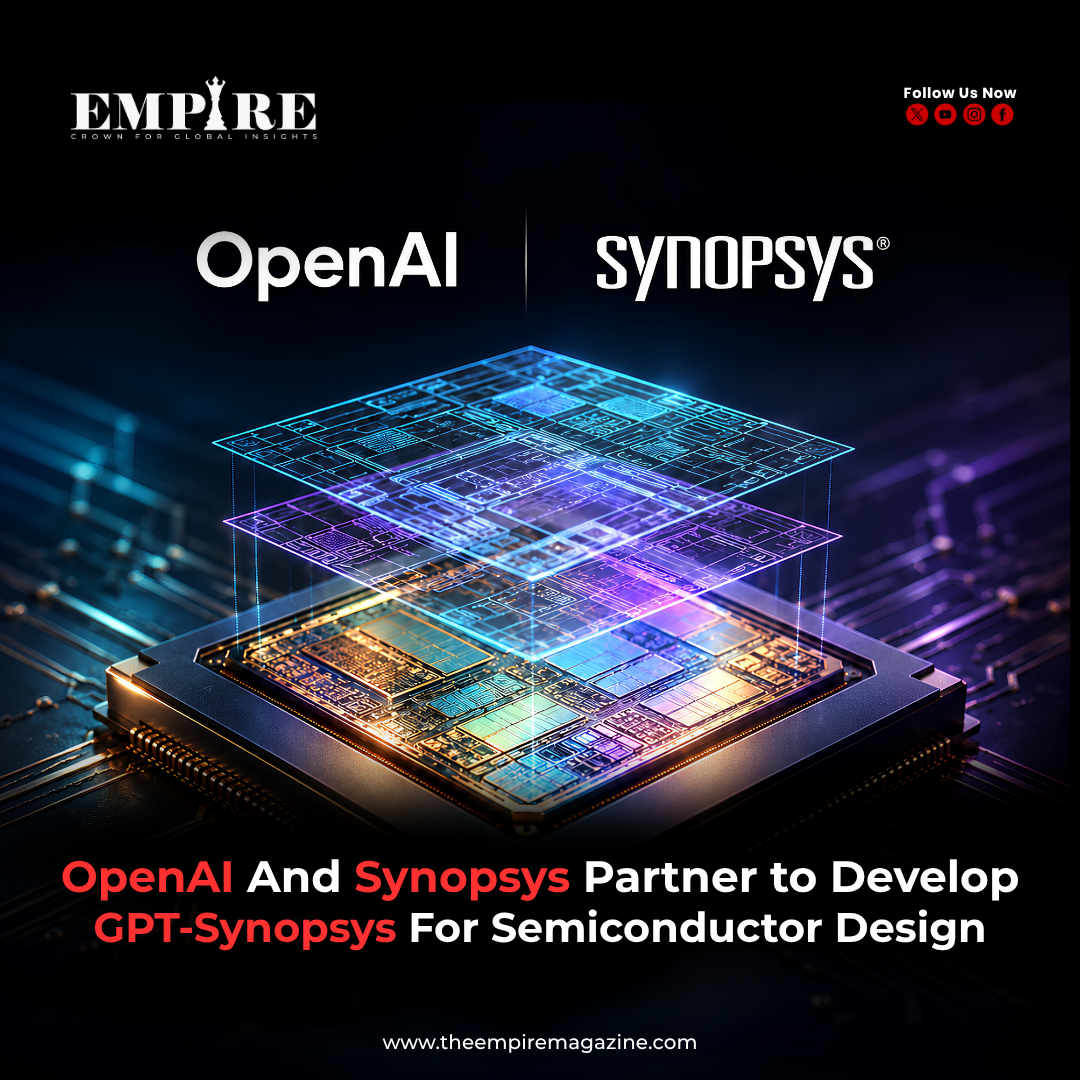
GPT-Synopsys, a specialised artificial intelligence model for semiconductor design, is the focus of a new partnership between OpenAI and Synopsys, announced on 30 September 2026. The companies plan to train the model to use the engineering software involved in developing computer chips.
For chipmakers, the potential value lies in reducing the work between identifying a design problem, testing possible changes and checking whether those changes improve the result. That makes the partnership relevant to both semiconductor engineering and the wider effort to apply AI to specialised industrial work.
What GPT-Synopsys Is Designed to Do
Synopsys describes a system in which engineers set design objectives and AI agents operate its tools, interpret results and refine designs for human review.
The announcement outlines these plans:
| Area | Planned approach |
|---|---|
| Hosting | OpenAI infrastructure |
| Integration | Synopsys.ai, Synopsys Autopilot and customer agent frameworks |
| Service package | Computing resources, model access and software licences |
| Customer data | Excluded from model training |
| Security controls | Encryption, permissions, audit and retention controls |
| Development status | Early customer engagements; no general release date stated |
These are the companies’ stated plans. The announcement does not publish product pricing or independent performance benchmarks.
Why Semiconductor Design Needs Specialised Engineering Tools
Before a chip can be manufactured, its intended behaviour must be translated into a detailed design and checked against numerous requirements.
Electronic design automation, usually shortened to EDA, covers the software and hardware tools used for this work. These tools support activities such as converting hardware descriptions into logic circuits, simulating behaviour, checking designs and preparing them for manufacturing.
Physical layout adds another set of constraints. In a stage known as placement and routing, tools determine where circuit elements sit and how they connect. The layout must satisfy timing and electrical requirements while respecting manufacturing rules supplied by the foundry.
There can be many possible layouts for the same logical design. Engineers must assess which arrangement best meets their objectives within the available space and other constraints.
This helps explain the appeal of AI that can work with engineering software. A useful assistant needs to connect proposed changes with measurable design results.
Understanding Power, Performance and Area
Chip designers commonly assess trade-offs through three measures known together as PPA:
| Measure | What it means | Why it matters |
|---|---|---|
| Power | The electrical power a chip consumes | Influences energy use and heat generation |
| Performance | How quickly the chip completes its work | Affects speed, throughput and responsiveness |
| Area | The silicon space occupied by the design | Influences manufacturing cost and integration |
Improving one measure can affect another. A design change that increases speed may also increase power consumption or require additional silicon area. The preferred balance depends on the product’s requirements.
An AI-assisted workflow therefore needs a clear objective. Asking for a faster chip leaves important questions unanswered: how much additional power is acceptable, which timing requirements must hold, and what physical limits apply?
How AI Agents Could Support a Design Workflow
In EDA, an AI agent is intended to plan and execute a sequence of engineering tasks. Synopsys describes agentic systems that analyse objectives, coordinate tool use and manage activities such as generating hardware descriptions or organising verification runs, while engineers retain oversight.
As an illustrative example, an engineer might ask a system to reduce power consumption while maintaining an agreed performance target. The workflow could examine reports, identify candidate changes, run engineering tools and compare the resulting designs.
The result would be useful if the engineer could see what changed, which tests were performed and why a candidate was selected. A faster sequence of experiments has limited value if its results are difficult to inspect or reproduce.
This example explains the intended workflow concept; it is not a reported GPT-Synopsys customer result.
Why Verification and Engineer Review Remain Essential
Verification checks whether a digital design behaves according to its specifications. It uses complementary methods, including simulation, formal techniques and hardware-assisted emulation.
Simulation exercises a design under selected conditions. Formal methods can prove particular properties under defined assumptions. Coverage analysis helps teams assess how thoroughly their planned tests have examined the design. These methods serve different purposes within a broader verification process.
Synopsys CEO Sassine Ghazi told Reuters that conventional Synopsys tools would continue checking the model’s work.
For an engineering team, a convincing explanation from an AI system is only one part of the process. Acceptance depends on the design meeting the required checks. Faster development becomes commercially valuable when it preserves the evidence needed to approve a design for its next stage.
How the Partnership Fits GPT-Synopsys’ Wider AI Strategy
The announcement follows Synopsys’ 28 September 2026 introduction of its AgentEngineer solutions and Autopilot Platform.
That earlier announcement described agents capable of coordinating extended engineering workflows across areas including verification, implementation, manufacturing, and simulation. Autopilot provides functions such as workflow coordination, reusable skills, memory and governance.
Viewed together, the announcements suggest a strategy built around several connected parts: engineering tools that perform calculations and checks, agents that coordinate work, and specialised models that help decide what to do next.
For customers evaluating such systems, integration matters. Teams need to understand how an AI-driven task fits existing project files, permissions, review procedures and approval responsibilities.
The Business Model Behind the Agreement
Reuters reported that OpenAI will pay a training subscription fee and that the companies will share customer revenue, with the arrangement linked to improvements in chip design.
From a business perspective, this connects AI development to the use of established engineering software. Its commercial value will depend on whether customers can achieve useful outcomes at an acceptable overall cost.
Relevant questions include how charges are calculated, how software licences are handled and how improvements are measured. A workflow that reduces manual effort may still require substantial computing resources. Buyers will need to assess the combined cost of computation, software and engineering review.
Customer governance will also matter. A semiconductor project can involve several teams, suppliers and contractual boundaries. Procurement teams will need a clear account of which project information enters the service, who can access it and how the activity is recorded.
What Will Show Whether GPT-Synopsys Delivers Value?
The most useful evidence will come from clearly defined engineering tasks with disclosed starting conditions and comparable results.
A credible evaluation would explain the design objective GPT-Synopsys, the baseline workflow, the computing resources used and the amount of human intervention required. It would also show whether any improvement survived the necessary verification checks.
For prospective customers, future disclosures about availability, supported tools, pricing and completed evaluations will make the offering easier to assess.
The partnership establishes a direction for applying AI to chip development. Its practical significance will emerge through engineering work that produces inspectable results and helps teams reach their design targets with less time or effort.
Explore more global business, technology and innovation coverage in The Empire Magazine’s article archive.
Read our related technology coverage: Microsoft’s experimental Quine AI research system for biology.
Follow The Empire Magazine:
Facebook: The Empire Magazine
Instagram: @the_empire_magazine
The Empire Magazine | Crown For Global Insights