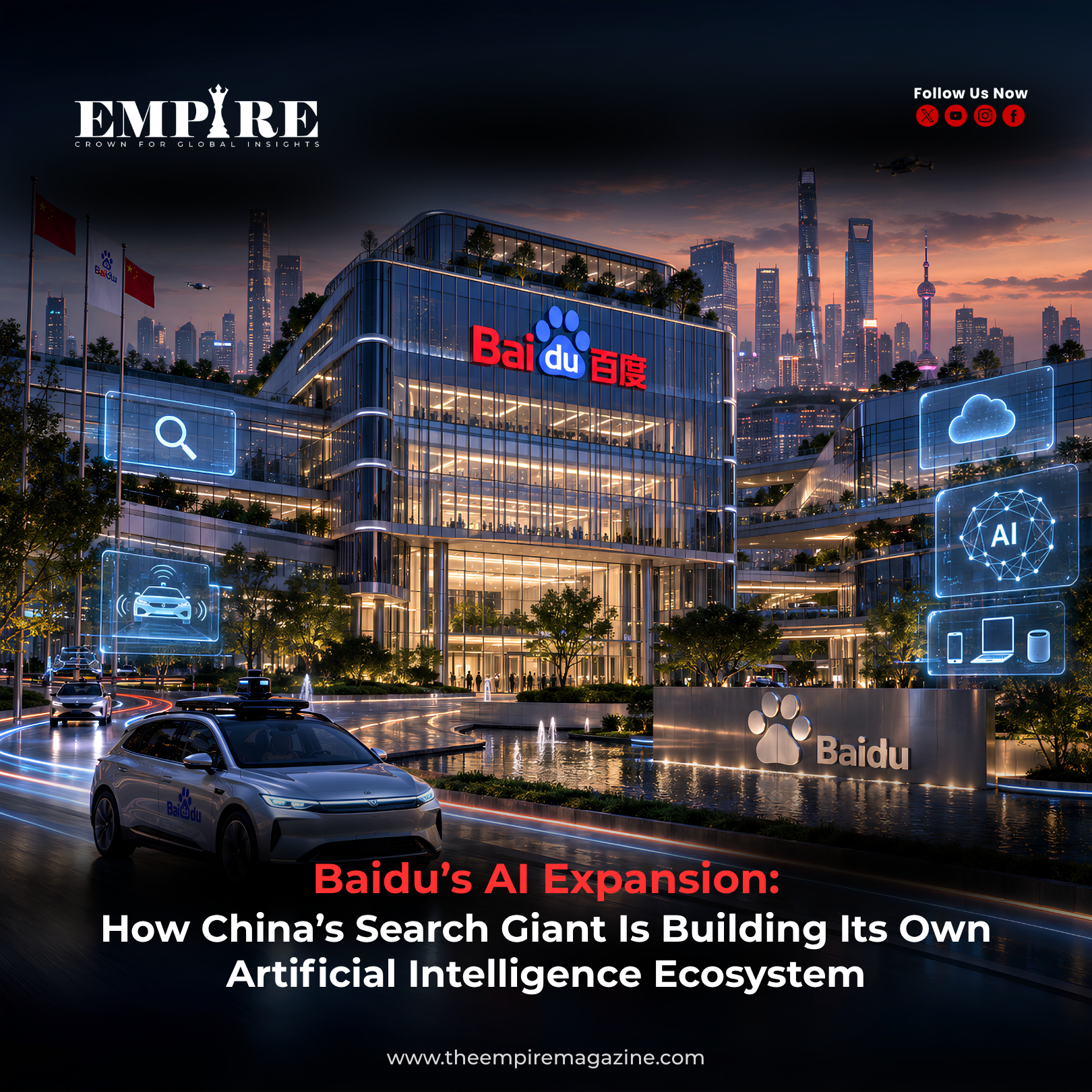
Baidu AI Expansion is reshaping the company from a traditional search engine provider into a major artificial intelligence technology company. As artificial intelligence becomes one of the most important areas of global technology competition, Baidu is investing in large language models, AI applications, cloud computing, and autonomous technologies to build a complete AI ecosystem.
Founded in 2000, Baidu became one of China’s leading internet companies through its search engine business. Over the years, the company expanded into multiple technology areas, including artificial intelligence research, natural language processing, machine learning, and autonomous driving.
Today, Baidu is positioning artificial intelligence as a central part of its long-term strategy. Through technologies such as Ernie AI models, Baidu AI Cloud, and Apollo autonomous driving platforms, the company is working to integrate AI across consumer, enterprise, and industrial applications.
Baidu AI Expansion Is Transforming China’s Technology Landscape
Baidu AI Expansion reflects the growing importance of artificial intelligence in China’s technology sector.
China has identified AI as a strategic technology area, with companies investing heavily in research, infrastructure, and commercial applications. Baidu is among the companies competing to develop advanced AI capabilities alongside other Chinese technology firms.
The company’s AI strategy focuses on creating technologies that can support:
- Intelligent search experiences
- Enterprise automation
- AI-powered content creation
- Cloud computing services
- Autonomous transportation
- Industry-specific AI solutions
Baidu transformation demonstrates how traditional internet companies are adapting to the AI era.
Baidu AI Expansion Through Ernie AI Models
A major part of Baidu artificial intelligence strategy is its Ernie family of large language models.
Ernie, which stands for Enhanced Representation through Knowledge Integration, is a series of AI models developed by Baidu for natural language understanding and generation.
Baidu introduced Ernie Bot in 2023 as a generative AI chatbot designed to compete with global AI systems. The technology is based on Baidu large language model research and is designed to understand questions, generate responses, and assist users with different tasks.
The development of Ernie models represents Baidu’s effort to build its own AI foundation technology rather than relying on external systems.
Large language models have become a major focus of the global AI industry because they support applications including:
AI Assistants
AI models can help users access information, create content, and complete digital tasks.
Enterprise Solutions
Businesses can use AI systems for automation, customer service, and data analysis.
Developer Platforms
AI models can provide tools for developers building new applications.
Baidu AI Expansion Builds an Integrated Artificial Intelligence Ecosystem
Baidu approach to AI goes beyond developing individual models.
The company is building a broader ecosystem that connects AI software, cloud infrastructure, and industry applications.
Baidu AI Cloud plays an important role by providing businesses with AI-powered computing and technology services.
The platform supports companies using artificial intelligence for areas such as:
- Data processing
- Machine learning applications
- Business automation
- Digital transformation
By combining AI models with cloud infrastructure, Baidu aims to make artificial intelligence more accessible for businesses.
Baidu AI Expansion and the Growth of Autonomous Driving Technology
Another important area of Baidu AI development is autonomous driving.
Through its Apollo platform, Baidu has invested in self-driving technology, smart transportation systems, and autonomous vehicle solutions.
Apollo provides technology platforms designed to support autonomous driving research and commercial applications.
Baidu has conducted autonomous driving tests and expanded robotaxi services in selected Chinese cities.
Artificial intelligence plays a critical role in autonomous vehicles by helping systems:
- Understand road environments
- Identify objects
- Make driving decisions
- Improve navigation
The development of autonomous driving demonstrates how Baidu is applying AI beyond online services.
Baidu AI Expansion Supports AI Applications Across Industries
Baidu is focusing on bringing artificial intelligence into multiple industries.
AI adoption is increasing across sectors such as:
Healthcare
AI can support medical research, information processing, and healthcare services.
Education
AI tools can help create personalised learning experiences.
Manufacturing
Companies can use AI for automation and operational improvements.
Transportation
AI technologies can improve mobility and logistics systems.
Baidu’s strategy reflects a wider trend where technology companies are moving AI from research environments into practical business applications.
Baidu AI Expansion Faces Competition in the Global AI Race
The artificial intelligence industry has become highly competitive, with companies around the world investing in advanced AI technologies.
Baidu competes with major global technology companies developing their own AI systems, including organisations in the United States and China.
The company faces challenges such as:
Rapid AI Development
AI technology is evolving quickly, requiring continuous research and investment.
Computing Requirements
Advanced AI models require significant computing resources and infrastructure.
Commercial Adoption
Companies must demonstrate practical value from AI technologies.
Despite these challenges, Baidu continues expanding its AI capabilities through research and partnerships.
Baidu AI Expansion Shows China’s Growing Artificial Intelligence Ambition
Baidu AI Expansion represents China’s broader effort to strengthen its position in artificial intelligence innovation.
The company’s investments in AI models, cloud services, and autonomous systems demonstrate how artificial intelligence is becoming central to future technology development.
AI competition is no longer limited to software companies. It now involves infrastructure, hardware, research capabilities, and real-world applications.
The development of AI ecosystems by companies like Baidu shows the increasing importance of creating complete technology platforms.
Read more technology and innovation insights here: https://theempiremagazine.com/world-largest-electric-aircraft-flight/
Baidu AI Expansion and the Future of Artificial Intelligence
Baidu continued investment in artificial intelligence highlights how the company is evolving beyond its original search engine identity.
By combining AI models, cloud computing, autonomous driving, and industry applications, Baidu is building a technology ecosystem designed for the next generation of digital transformation.
The future of artificial intelligence will depend on companies that can successfully combine research innovation with practical applications.
Baidu AI journey represents one example of how technology companies worldwide are adapting to the growing influence of artificial intelligence.
Follow The Empire Magazine for global business, technology, innovation, and leadership insights:
Facebook: https://www.facebook.com/profile.php?id=61573749076160
Instagram: https://www.instagram.com/the_empire_magazine/
The Empire Magazine | Crown For Global Insights