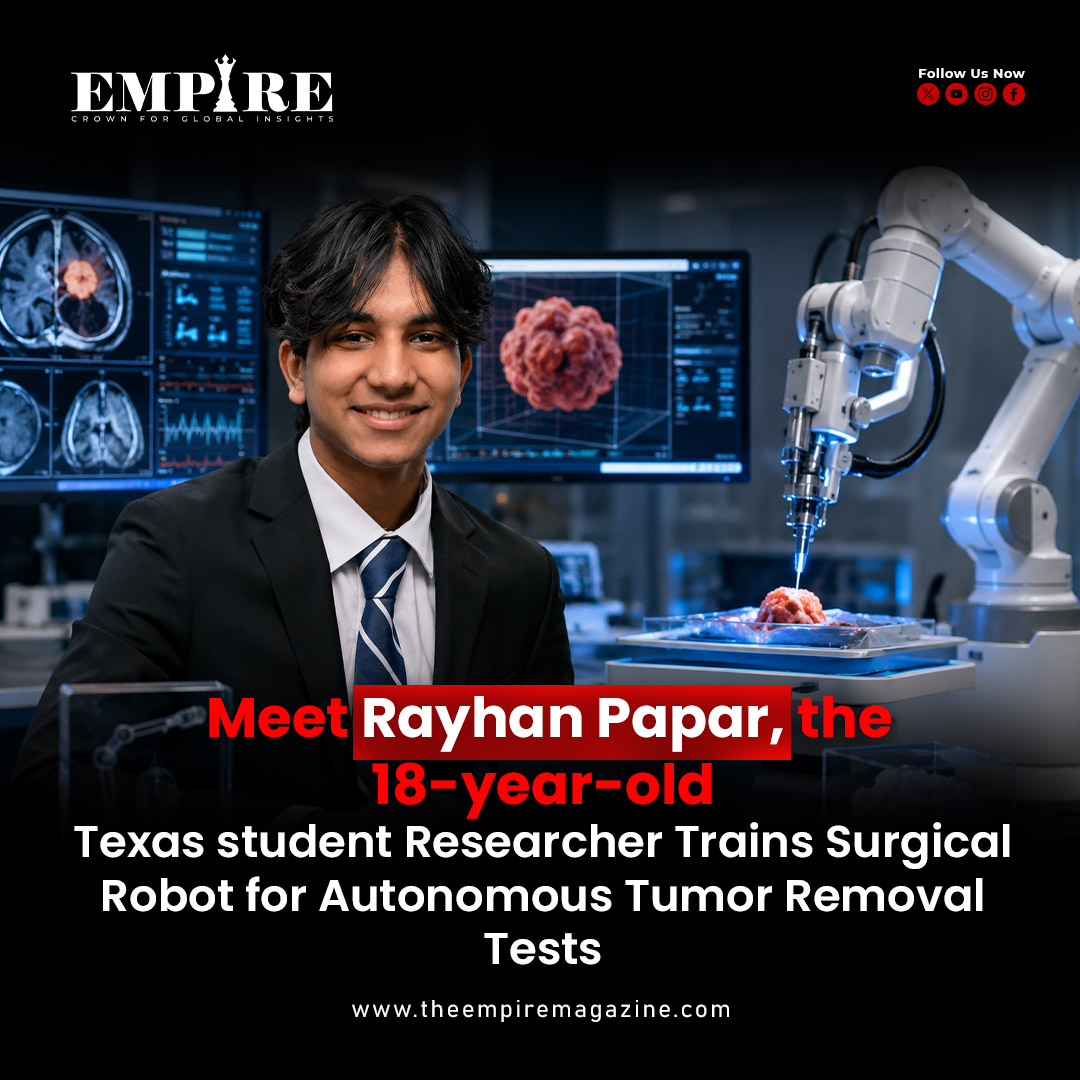
Meet Rayhan Papar, the 18-year-old Texas researcher training a surgical robot to autonomously remove tumors using AI and simulation technology. Rayhan Papar is an 18-year-old Texas student researcher who developed a framework to train surgical robots for autonomous tumor removal. His simulation-to-real system was tested on a da Vinci research platform, successfully removing complete tumors in three of four gel-model trials. His work explores how AI and robotics could eventually support surgeons during complex procedures.
Who Is Rayhan Papar?
At just 18, Rayhan Papar is already working on a problem that sits at the intersection of artificial intelligence, medical robotics and surgery. A student at The Woodlands College Park High School in Texas, Papar developed a research framework designed to help surgical robots learn how to remove tumors with greater autonomy. His project, titled “Sim-to-Real for Autonomous Tumor Resection via Minimally Invasive Robotics,” was selected as a finalist for the 2026 Regeneron Science Talent Search.
What makes Rayhan Papar’s research particularly interesting is that it does not simply focus on making a surgical robot move. Instead, his work explores how a robot can learn a complicated sequence of surgical decisions and transfer that knowledge from a simulated environment to a physical robotic system. It is a significant distinction because modern surgical robots are generally controlled by human surgeons rather than operating independently.
Papar’s research reflects a broader shift in medical technology. AI is increasingly being explored not merely as a diagnostic tool but as a system capable of assisting with physical procedures. His work offers an early glimpse into what that future could look like.
Rayhan Papar Surgical Robot Project
The central idea behind the Rayhan Papar surgical robot project is known as “sim-to-real.” In simple terms, the robot first learns inside a computer-generated environment before being tested on physical hardware. Papar created a physics-based simulation using medical imaging to reconstruct anatomy and provide the robotic system with a realistic environment in which to learn.
This approach addresses one of the biggest problems in autonomous surgical robotics: robots cannot simply be trained on a handful of identical procedures and expected to perform perfectly on every patient. Human anatomy varies considerably, while tissues can deform, move and change during an operation. A surgical robot must therefore be capable of responding to changing conditions rather than following a rigid sequence of instructions.
Papar’s framework combines machine learning techniques with simulation to help the robot make decisions before transferring those capabilities to a physical surgical system. The objective is not to eliminate the surgeon, but to investigate whether robots can eventually handle specific complex tasks with consistent precision.
How Autonomous Tumor Removal Works
Autonomous tumor removal is considerably more complicated than simply identifying a tumor and cutting it away. A robot would need to understand where the tumor is located, determine its boundaries, navigate surrounding structures and execute a sequence of movements without damaging healthy tissue. In real surgery, those decisions can become even more difficult as tissue shifts and the visual field changes.
Papar’s system attempts to address this challenge by giving the robot information from preoperative medical imaging. Rather than relying exclusively on what the robot sees through a surgical camera during an operation, the system can use reconstructed anatomical information to improve planning and decision-making. Society for Science says the framework allows the robot to make better decisions and conduct a preoperative check of the surgical plan.
This is one of the most important ideas behind the Rayhan Papar surgical robot research. Better surgical autonomy may depend not only on better cameras or robotic arms, but also on giving AI a deeper understanding of the patient’s anatomy before an operation begins.
Why Surgical Robot Training Is Difficult
Training an autonomous surgical robot presents challenges that are very different from training a conventional industrial robot. A factory robot usually works in a controlled environment where objects, distances and movements can remain predictable. The human body is not predictable in the same way.
Every patient has different anatomy. Soft tissue can stretch, compress or move. Blood and other fluids can affect visibility. Surgical instruments operate through small openings, creating a restricted visual field. Even a small error in movement could potentially have serious consequences.
Society for Science notes that these variations make autonomous surgical robotics particularly challenging. Surgical robots can offer significant precision and dexterity, but translating that capability into independent decision-making remains difficult.
This is why simulation is important in Papar’s work. A virtual environment allows an AI system to encounter different conditions repeatedly without putting patients at risk. The robot can learn, fail, adjust and learn again before researchers consider moving toward more advanced physical testing.
The Role of AI in Surgical Robotics
Artificial intelligence is becoming an increasingly important part of surgical robotics because robots need more than mechanical precision to operate autonomously. They need systems capable of perception, planning, learning and decision-making.
Papar has explored both imitation learning and reinforcement learning in his broader work. According to Society for Science, his system uses a simulation-to-real approach in which a robot is trained in a physics-based virtual environment created from medical imaging before being deployed on a da Vinci research robot.
The distinction matters. Imitation learning can help a machine learn from examples of desired behavior, while reinforcement learning allows a system to improve by receiving feedback from its actions. Combining such methods could help robots handle longer and more complicated sequences of surgical tasks.
For AI surgical robotics, the ultimate challenge is not simply achieving movement accuracy. It is building systems that can recognize uncertainty, respond to unexpected conditions and operate within strict safety limits.
Rayhan Papar’s Three Successful Tests
The physical testing of Papar’s framework produced one of the clearest demonstrations of its potential. His system was tested on a da Vinci surgical system using gel models designed to represent tumors. The robot successfully removed complete tumors in three out of four tests.
A three-out-of-four result does not mean autonomous tumor surgery is ready for hospitals. The experiments were performed using gel models rather than human patients, and the testing environment was controlled. However, the result is important because it demonstrates a transition from computer simulation to physical robotic performance.
That transition is often one of the hardest steps in robotics. A system can perform impressively in a digital environment but struggle when confronted with the imperfections of physical hardware. Papar’s work therefore stands out because it attempts to bridge that gap.
The results suggest that simulation-based training could become a valuable research pathway for developing future autonomous surgical systems.
From Simulation to Real Surgery
The phrase “autonomous surgery” can easily create an exaggerated picture of machines independently performing complete operations. The reality is much more cautious. Papar’s work remains experimental, and the tests conducted so far do not demonstrate that a robot can safely perform tumor surgery on human patients.
The significance lies instead in the underlying technology. A robot that can learn specific surgical tasks in simulation and successfully execute them on physical hardware represents a step toward more sophisticated robotic assistance.
Papar has emphasized that autonomous robots should enhance human potential rather than simply replace people. Society for Science reports his view that autonomous robots can enhance surgical precision, safety and access rather than making surgeons irrelevant.
That human-centered approach may become essential as medical AI develops. Surgery involves judgment, communication, ethics and responsibility that extend far beyond mechanical movement.
Rayhan Papar’s Earlier Medical Innovation
The surgical robot project is not Papar’s first attempt to apply advanced technology to medicine. He also holds a patent for a surgical aid designed to assist with brain tumor resection. The patent describes an augmented reality system that uses medical scans, cameras and neural networks to identify tumors, nearby blood vessels and other anatomical structures.
His earlier work provides useful context for understanding his interest in autonomous tumor removal. Instead of approaching medicine from a single technological angle, Papar has explored augmented reality, deep learning, medical imaging and robotics as connected tools.
His work has also received recognition outside the laboratory. In 2025, Papar was named the winner of the Congressional App Challenge for Texas’ Second District for NeuroLens, a project focused on using mixed reality and machine learning in medical applications.
The progression from augmented reality to autonomous robotics shows a consistent interest in using computing technology to improve surgical decision-making.
What Autonomous Surgery Could Mean
If autonomous surgical robots eventually become reliable enough for clinical use, their impact could extend beyond speed and precision. They could potentially help surgeons perform repetitive or highly precise tasks, provide additional decision support and make advanced surgical capabilities more accessible in settings where specialist expertise is limited.
However, significant barriers remain. Autonomous systems would need extensive validation, safety testing, regulatory approval and clinical evidence before they could be trusted with real patients. Researchers would also need to determine how robots should respond when something unexpected happens.
The Rayhan Papar surgical robot project is therefore best understood as research into a possible future rather than a finished medical product. Its importance comes from demonstrating how AI, medical imaging and robotics can work together to address one of medicine’s most demanding technical challenges.
The future of surgery may not be about choosing between doctors and machines. It may instead involve building systems in which surgeons remain responsible for critical decisions while intelligent robots provide increasingly sophisticated assistance.
The Road Ahead for Surgical Robots
The next stage of autonomous surgical robotics will require researchers to move beyond controlled models and test systems under increasingly realistic conditions. That means dealing with changing tissue, imperfect visibility, anatomical variation and unexpected events.
Papar’s work provides a useful foundation for that conversation because it focuses on the connection between simulation and physical robotic performance. His research shows that training a robot does not necessarily have to begin inside an operating room. Digital environments can provide a safer place for machines to learn before their capabilities are evaluated on physical systems.
At 18, Rayhan Papar is still at the beginning of his scientific journey. Yet his research has already placed him among young researchers exploring some of the most ambitious questions in medical technology. His work also highlights an important lesson for the next generation of innovators: major advances can begin with the willingness to rethink how an existing technology is trained.
Rayhan Papar’s research into an autonomous surgical robot
Rayhan Papar’s research into an autonomous surgical robot represents an intriguing intersection of AI, robotics and medicine. By using medical imaging, physics-based simulation and machine learning, the Texas student developed a framework that helped a da Vinci research system complete tumor removal in three of four gel-model trials.
The achievement should not be mistaken for autonomous surgery being ready for routine clinical use. There is still a long road involving realistic testing, safety validation, regulation and human clinical trials. But the research demonstrates how quickly the boundaries of medical robotics are moving.
For Rayhan Papar, the question is not simply whether a robot can operate without a human hand controlling every movement. It is whether technology can be designed to give surgeons greater precision, better information and new capabilities.
That question could shape the next chapter of surgical innovation. And for an 18-year-old researcher already working at that frontier, the journey has only just begun.
Previous article: https://theempiremagazine.com/superliving-healthcare/
Magazine Feautures | Podcasts: Empire Global Talks
Follow The Empire Magazine on Facebook | Instagram | LinkedIn | YouTube
The Empire Magazine | Crown for Global Insights