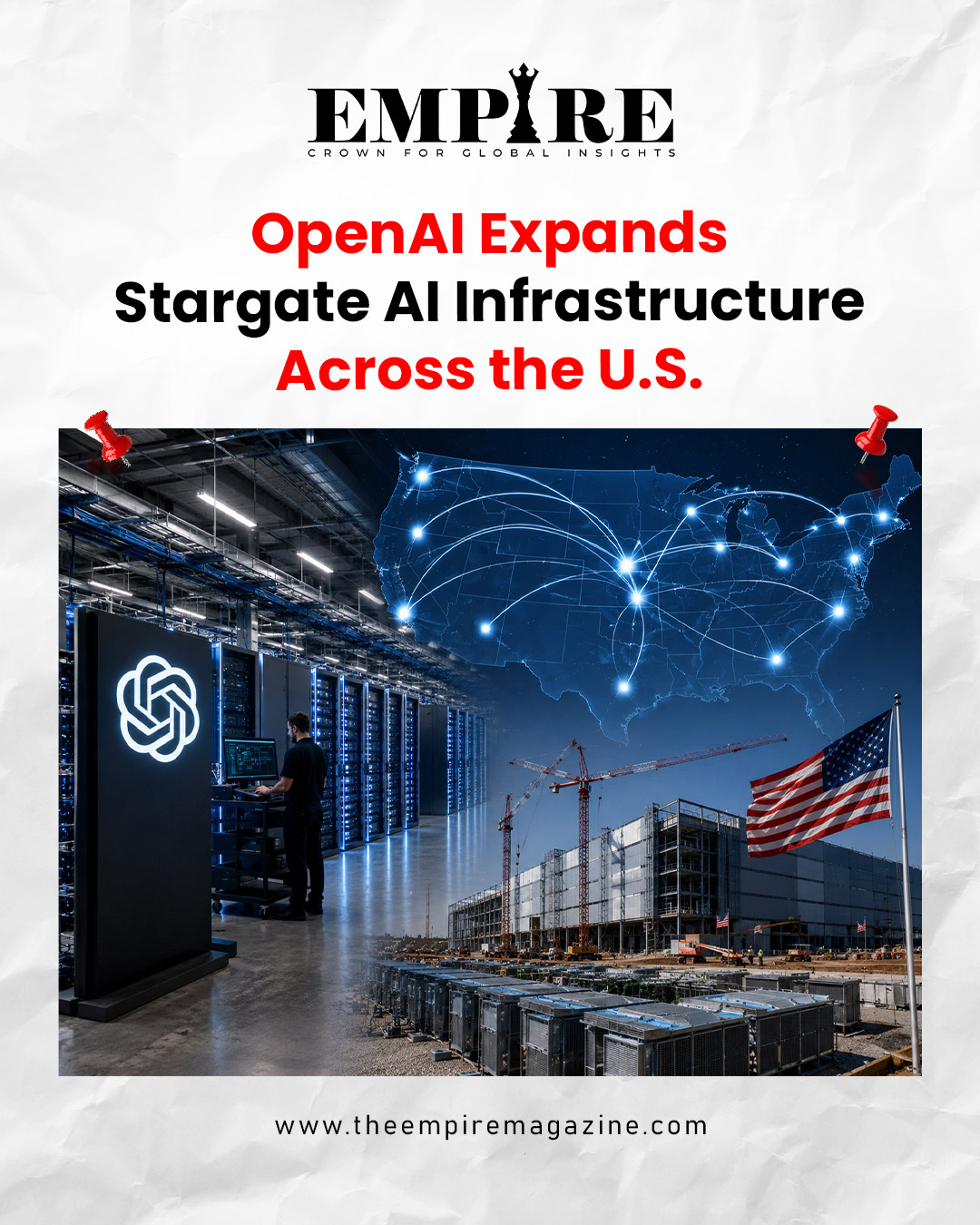
OpenAI expands Stargate AI infrastructure across the U.S., targeting massive computing capacity, new data centers, jobs, energy and AI leadership. OpenAI is rapidly expanding its Stargate AI infrastructure across the United States to secure the computing power needed for advanced AI. The project began with a $500 billion, 10-gigawatt commitment and now spans major sites across Texas, New Mexico, Wisconsin, Michigan and Ohio, positioning AI infrastructure as a critical part of America’s technology and industrial future.
What Is OpenAI Stargate AI Infrastructure?
OpenAI Stargate AI infrastructure is becoming one of the most ambitious technology infrastructure programmes in the United States. Announced in January 2025, the Stargate Project was created with a plan to invest up to $500 billion over four years to build AI infrastructure in America. OpenAI, SoftBank, Oracle and MGX were announced as the initial equity funders, with SoftBank taking financial responsibility and OpenAI handling operations.
The idea behind Stargate is straightforward but enormous: advanced artificial intelligence requires enormous computing power. Training frontier AI models, operating them for millions of users and developing increasingly capable systems all depend on specialised chips, data centers, electricity, cooling systems and high-speed networks.
That makes AI infrastructure just as important as the models themselves. OpenAI has increasingly treated computing capacity as a strategic resource, and Stargate represents its attempt to build that resource at unprecedented scale inside the United States.
What began as a single flagship project in Abilene, Texas, has developed into a broader network of planned campuses across several American states. The expansion reflects a simple reality of the AI race: whoever can build and operate the largest and most efficient computing infrastructure may have a significant advantage in developing the next generation of artificial intelligence.
Why OpenAI Is Expanding Stargate
The rapid expansion of OpenAI Stargate AI infrastructure is being driven by the explosive demand for AI computing. ChatGPT, enterprise AI applications, developers and increasingly sophisticated models all require substantial computing resources. OpenAI has therefore been working to increase capacity while reducing the risk of infrastructure shortages.
In April 2026, OpenAI said it had already surpassed its original 10-gigawatt U.S. infrastructure target for 2029, with more than 3 gigawatts added during the preceding 90 days. The company described compute as the critical input required to train better models, serve users reliably, improve performance and reduce costs over time.
The strategy also reflects a broader shift in the technology industry. AI companies are no longer competing only through algorithms and software. They are competing for access to chips, electricity, land, data centers and engineering talent.
For OpenAI, Stargate is therefore more than a collection of buildings. It is an infrastructure strategy designed to create a reliable foundation for future AI development.
OpenAI Stargate AI Infrastructure Reaches New States
The geographic expansion of OpenAI Stargate AI infrastructure demonstrates how quickly AI data center development is spreading across the United States. The initial Abilene campus in Texas was followed by projects in other parts of Texas, New Mexico, Wisconsin and Michigan, while Ohio has now emerged as another major destination.
OpenAI’s 2025 expansion with Oracle added 4.5 gigawatts of planned U.S. data center capacity. The company said this partnership, together with the Abilene site, would bring more than 5 gigawatts of Stargate capacity under development and involve more than two million chips.
Later in 2025, OpenAI, Oracle and SoftBank announced five additional U.S. sites, taking planned Stargate capacity to nearly 7 gigawatts and investment to more than $400 billion over three years. The company said more than 300 proposals from over 30 states had been reviewed during the site-selection process.
The projects are being developed through different partnerships and infrastructure models. This allows OpenAI to diversify its physical footprint rather than relying on a single data center or power market.
Ohio Becomes a Major Stargate AI Hub
The latest development has placed Ohio at the center of OpenAI’s expanding AI infrastructure strategy. OpenAI has signed a 20-year lease for a major data center campus at the PORTS-Pike Technology Campus in Pike County, Ohio, with SoftBank subsidiary SB Energy developing, owning and operating the facility.
The planned campus is expected to reach approximately 8 gigawatts of computing capacity, with an initial 800 megawatts targeted for 2028. The project is expected to support around 35,000 construction jobs and approximately 2,500 permanent operational positions.
The location itself is significant. The campus is planned on a former uranium-enrichment site, transforming an area associated with America’s Cold War industrial history into a potential center for next-generation computing.
The Ohio project illustrates how AI infrastructure is beginning to reshape industrial geography. Large computing campuses need land, electricity, skilled workers and transportation infrastructure. As a result, regions that once competed for factories and manufacturing plants are increasingly competing for AI data centers.
For Ohio, Stargate could bring a major investment and employment opportunity while giving the state a larger role in America’s emerging AI economy.
Nvidia Strengthens OpenAI Data Center Expansion
The Ohio project also highlights the increasingly interconnected relationship between OpenAI, SoftBank and Nvidia. Nvidia has agreed to provide up to $105 billion in guarantees connected to the Ohio data center project and plans to invest $1.5 billion in SB Energy. Nvidia is also expected to serve as the exclusive AI computing supplier for the facility.
The arrangement demonstrates how financing and hardware supply are becoming closely linked in the AI infrastructure race. Building a giant AI data center requires enormous upfront capital, while developers need confidence that sufficient computing hardware will be available once the facilities are ready.
For Nvidia, supporting infrastructure creates another route to long-term demand for its AI chips. For OpenAI, the arrangement helps secure access to computing capacity without requiring the company to own every physical component of the data center itself.
At the same time, such relationships have attracted scrutiny because AI infrastructure increasingly involves overlapping investors, suppliers and customers. Nvidia CEO Jensen Huang has rejected concerns that the Ohio arrangement represents a circular financing model.
Regardless of the financial debate, the partnership shows that the AI industry is evolving into a highly interconnected infrastructure ecosystem.
AI Infrastructure Is Becoming a National Priority
The rise of OpenAI Stargate AI infrastructure also reflects a larger transformation in U.S. technology policy. AI data centers are increasingly viewed not simply as private technology facilities but as strategic infrastructure connected to economic competitiveness, manufacturing and national security.
OpenAI has explicitly linked Stargate to American AI leadership and domestic reindustrialisation. Its original announcement said the project was intended to create hundreds of thousands of American jobs while strengthening the country’s strategic capabilities.
This ambition goes beyond software development. Large-scale AI campuses require construction companies, electrical engineers, chip suppliers, cooling specialists, energy developers, network operators and maintenance teams.
That creates an ecosystem around AI infrastructure. The benefits could therefore extend well beyond OpenAI itself, potentially strengthening domestic supply chains and encouraging investment in supporting industries.
OpenAI has also stated that its infrastructure strategy is intended to strengthen U.S. manufacturing and modernise the energy grid. In January 2026, the company launched a request for proposals focused on expanding domestic manufacturing and the infrastructure required to power advanced AI.
The Energy Challenge Behind Stargate
The biggest challenge facing OpenAI Stargate AI infrastructure may not be computing hardware. It may be electricity.
AI data centers consume enormous amounts of power, particularly as operators deploy increasingly dense clusters of advanced processors. A campus measured in gigawatts is effectively an industrial-scale energy consumer, creating pressure on local electricity generation and transmission networks.
The Ohio project, for example, is planned around approximately 8 gigawatts of computing capacity and up to 10 gigawatts of new energy infrastructure, according to reporting on the project.
This creates difficult questions for communities and policymakers. How quickly can new generation be built? How will transmission infrastructure be upgraded? Who pays for grid improvements? And how can states accommodate AI growth without creating excessive pressure on electricity prices or water resources?
OpenAI has said its Stargate campuses use cooling approaches designed to reduce water consumption and that the company is working with local communities on infrastructure and environmental measures.
The future of AI therefore depends not only on better chips and smarter algorithms, but also on the ability to build a reliable and sustainable energy system.
Jobs and Economic Impact of Stargate
One of the strongest arguments for OpenAI Stargate AI infrastructure is its potential economic impact. AI data centers require substantial construction activity before they become operational, creating demand for electricians, builders, engineers, equipment suppliers and other skilled workers.
The Ohio project alone is expected to generate approximately 35,000 construction jobs and 2,500 permanent jobs. Michigan’s Stargate campus in Saline Township is another example of the economic scale involved. Project partners said more than 700 Michigan tradespeople were already working on the campus when construction milestones were marked in June 2026.
The economic effect can extend further through local tax revenue, infrastructure improvements and demand for services.
For communities that have experienced industrial decline, large AI campuses can represent a new form of economic development. But the long-term benefit will depend on whether these projects create sustainable employment and infrastructure improvements rather than simply placing enormous demands on local resources.
That balance will become increasingly important as more states compete to attract AI infrastructure investment.
Challenges Facing OpenAI Stargate AI Infrastructure
Despite its scale, OpenAI Stargate AI infrastructure faces significant challenges. Building multiple massive data centers simultaneously requires coordination across land acquisition, construction, energy supply, financing, chip availability and local regulations.
The financial structure is another consideration. Stargate involves hundreds of billions of dollars in planned investment, making the economics of AI infrastructure closely tied to expectations about future demand. If AI usage grows as projected, the capacity could become essential. If demand or technology changes unexpectedly, developers could face difficult questions about utilisation and returns.
Technology itself introduces another uncertainty. AI chips are improving rapidly, meaning infrastructure designed today must remain useful as processor generations change. Data centers therefore need flexible architectures that can accommodate new hardware without requiring complete reconstruction.
There are also environmental and community concerns surrounding power consumption, water use, land and local infrastructure.
OpenAI has acknowledged the need to work with communities as Stargate expands. The company’s stated approach is to ensure that campuses create local economic opportunities while addressing infrastructure and environmental concerns.
What Stargate Means for the Future of AI
OpenAI Stargate AI infrastructure represents a fundamental shift in how the artificial intelligence industry is being built. The competition is moving beyond models and applications toward physical infrastructure capable of supporting them at enormous scale.
From Abilene to Ohio, Texas to Michigan, Stargate is creating a network of AI campuses that could become part of the physical foundation of the next generation of computing. The project’s original $500 billion ambition was already extraordinary, but its evolution shows that the appetite for AI infrastructure continues to grow.
The most important question now is not whether AI will require more computing power. It almost certainly will. The bigger question is how efficiently, sustainably and responsibly that computing capacity can be built.
If OpenAI and its partners succeed, Stargate could help establish a new American industrial ecosystem around artificial intelligence, combining software, semiconductors, energy and infrastructure at unprecedented scale.
The story of AI is therefore no longer confined to screens and servers. It is increasingly being written in construction sites, power plants, semiconductor supply chains and communities across America.
Previous article: https://theempiremagazine.com/semiconductor-mission/
Magazine Feautures | Podcasts: Empire Global Talks
Follow The Empire Magazine on Facebook | Instagram | LinkedIn | YouTube
The Empire Magazine | Crown for Global Insights