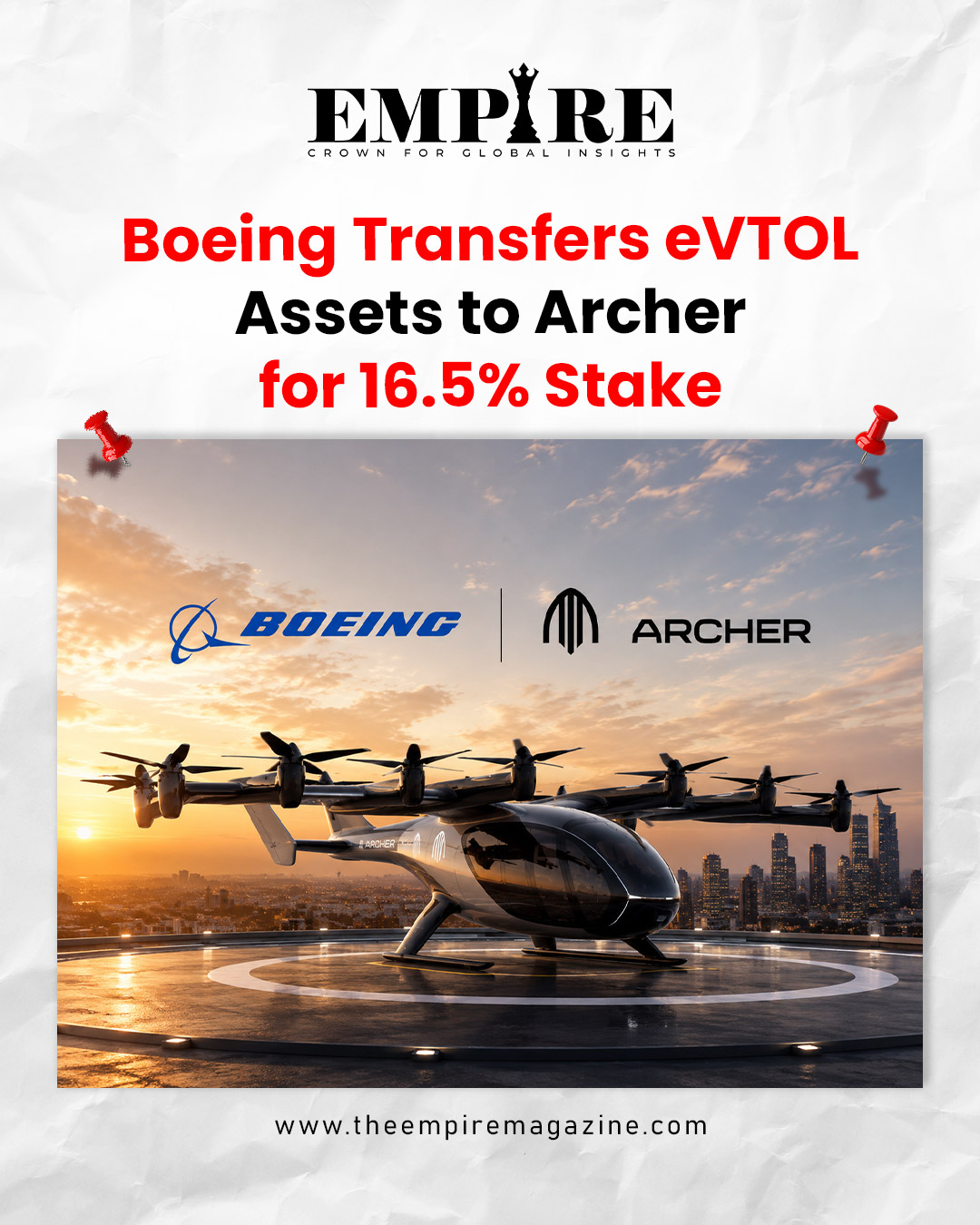
Boeing transfers eVTOL assets to Archer for a major equity stake, marking a significant shift in the global electric aviation and advanced air mobility industry. The agreement brings Boeing’s Wisk Aero, Insitu and SkyGrid businesses under Archer Aviation while giving Boeing a substantial ownership position in Archer.
The transaction represents more than a corporate asset transfer. It signals Boeing’s decision to step back from directly operating parts of the emerging flying-taxi business while retaining strategic exposure to autonomous flight, electric aviation and next-generation aerospace technology.
For Archer, the deal could accelerate its ambitions in electric vertical takeoff and landing (eVTOL) aircraft, autonomous aviation and defense technology. For Boeing, it offers a way to preserve access to promising technologies while concentrating management attention on its core commercial aircraft, defense and space businesses.
Boeing Archer eVTOL Deal Changes Aviation
The Boeing Archer eVTOL deal is significant because it combines three different areas of next-generation aerospace technology under one company. Archer will acquire Wisk Aero, Boeing’s electric aircraft business, along with Insitu, a manufacturer of unmanned aircraft systems, and SkyGrid, an airspace-services technology company. In exchange, Boeing will receive a 19.75% equity interest in Archer on the announced transaction basis, with the stake expected to represent approximately 16.5% after dilution. Boeing will also receive a seat on Archer’s board. The agreement creates a relationship in which Archer obtains assets that could accelerate its commercial and defense ambitions, while Boeing maintains an important financial interest in Archer and continued access to Wisk’s autonomous-flight technology.
Why Boeing Is Selling Its eVTOL Assets
The Boeing Archer eVTOL deal reflects Boeing’s wider effort to concentrate on its core aerospace operations. Under CEO Kelly Ortberg, Boeing has been reviewing its portfolio and looking for ways to simplify the business and improve operational focus. The company has faced major challenges across commercial aircraft production, certification and financial performance, making management attention increasingly valuable. The sale of Wisk, Insitu and SkyGrid allows Boeing to reduce direct responsibility for businesses outside its principal commercial aircraft, defense and space operations. At the same time, Boeing does not completely abandon the technology. Its equity position in Archer gives it exposure to the future growth of electric aviation, while the technology-sharing arrangement allows Boeing to continue accessing autonomous-flight capabilities for future commercial and defense applications.
Boeing Archer eVTOL Deal Brings Wisk
Wisk Aero is arguably the most closely connected asset to the Boeing Archer eVTOL deal because of its focus on electric vertical takeoff and landing aircraft. Wisk has developed self-flying electric aircraft designed for advanced air mobility and has accumulated significant testing and engineering experience. The company has conducted more than 1,600 test flights, according to SkyGrid’s current company information, while Boeing has previously described Wisk as a business developing a full-electric self-flying passenger aircraft for urban, suburban and rural environments. Bringing Wisk into Archer gives Archer access to years of research, testing, engineering knowledge and autonomous-flight development. For a company attempting to commercialize eVTOL aircraft, acquiring this accumulated knowledge could potentially shorten development timelines and strengthen its technological position.
Boeing Archer eVTOL deal gives Archer greater capabilities
Autonomous flight is becoming one of the most important elements of the advanced air mobility industry, and the Boeing Archer eVTOL deal gives Archer greater capabilities in this area. Wisk has been developing autonomous aircraft technology that could complement Archer’s own work in electric aviation and artificial intelligence. The agreement also allows Boeing to retain access to Wisk’s autonomous-flight technology, creating a technology-sharing relationship rather than a complete separation. This is strategically important because autonomous systems can eventually serve multiple markets, including passenger aircraft, cargo transportation, drones and defense platforms. Archer can therefore use the acquisition to strengthen its broader aviation technology portfolio, while Boeing retains a pathway to benefit from autonomous aviation developments without directly operating Wisk as a standalone business.
Boeing Archer Deal Expands Defense Capabilities
The Boeing Archer deal is not limited to passenger air taxis. Archer’s acquisition of Insitu gives the company a significant entry into unmanned aircraft and defense technology. Insitu has long developed unmanned aerial systems for government and defense applications, and the company has demonstrated capabilities in long-endurance operations, intelligence and AI-enabled battle management. In June 2026, Insitu demonstrated its Integrator VTOL unmanned aircraft during Exercise Balikatan in the Philippines, including a 22.4-hour sortie under demanding conditions. Reuters has reported that Insitu generates more than $200 million in annual revenue, giving Archer access to an established business alongside its emerging eVTOL operations. This could make Archer a more diversified aerospace technology company rather than an eVTOL manufacturer dependent solely on future passenger air-taxi revenues.
SkyGrid Strengthens Archer Airspace Technology
Another important component of the Boeing Archer eVTOL deal is SkyGrid, which focuses on digital airspace management and the integration of unmanned aircraft into increasingly complex airspace environments. As electric air taxis, drones and autonomous aircraft become more common, managing their movement safely will require sophisticated digital infrastructure. Aircraft alone cannot create an advanced air mobility network. Operators will also need systems capable of coordinating routes, monitoring traffic and supporting safe integration with existing aviation infrastructure. SkyGrid therefore gives Archer technology that could complement its aircraft development. The combination of eVTOL aircraft, autonomous systems, unmanned aviation and airspace-management technology could help Archer develop a broader advanced air mobility ecosystem rather than relying exclusively on the sale or operation of individual aircraft.
Boeing Archer eVTOL deal
Archer has been building its business around the development and commercialization of electric vertical takeoff and landing aircraft, with its Midnight aircraft positioned as a key part of its urban air mobility strategy. The Boeing Archer eVTOL deal significantly expands that strategy by adding autonomous flight, unmanned aircraft and airspace technology to Archer’s existing capabilities. The company can now potentially serve several aviation markets at once, including passenger transportation, defense, logistics and autonomous flight. This diversification matters because the commercial air-taxi industry remains in development and regulatory approval is still a major hurdle. By adding businesses with existing technology, customers and revenue potential, Archer may be better positioned to build a broader aerospace platform while continuing to pursue the long-term goal of commercial eVTOL operations.
Boeing Refocuses on Core Aerospace Business
For Boeing, the transaction represents a deliberate decision to refocus rather than an outright rejection of future aviation technology. Boeing has invested heavily in Wisk, including a reported $450 million investment in 2022, before acquiring full control of the company in 2023. Now, instead of continuing to fund and manage Wisk directly, Boeing is exchanging the business and other assets for a significant position in Archer. The strategy allows Boeing to retain exposure to an emerging market while directing greater attention toward its commercial aircraft, defense and space businesses. Reuters reported that analysts view the transaction primarily as a portfolio-refocusing decision rather than the beginning of another major wave of Boeing divestments. The move demonstrates how established aerospace companies may increasingly choose strategic ownership over direct operational control of emerging technologies.
Boeing Archer eVTOL Deal Faces Challenges
Despite its scale, the Boeing Archer eVTOL deal does not eliminate the challenges facing the electric aviation industry. eVTOL manufacturers still need to achieve regulatory certification, demonstrate operational safety and establish commercially sustainable business models. Infrastructure will also be critical, as electric aircraft require suitable charging systems, vertiports, maintenance networks and airspace integration. The industry has attracted billions of dollars in investment, but commercial-scale passenger operations have yet to become routine. This makes the Boeing Archer transaction both an opportunity and a test. Archer now has access to more technology and aerospace expertise, but it must successfully integrate those assets and convert them into commercially viable products. The ultimate success of the deal will depend not simply on the number of companies acquired but on how effectively Archer combines their technologies, people and capabilities.
What the Boeing Archer Deal Means
The Boeing Archer deal could accelerate consolidation across the advanced air mobility industry. Instead of developing aircraft, autonomy, airspace systems and defense capabilities separately, Archer is bringing multiple technologies together under one corporate structure. This creates the possibility of a more integrated aerospace platform capable of addressing several markets simultaneously. For Boeing, the arrangement provides a financial interest in Archer and continued access to autonomous-flight technology without requiring Boeing to operate these businesses independently. For Archer, the deal brings the credibility, technology and experience associated with Boeing while giving it a stronger position in defense and autonomous aviation. The transaction also sends a wider message to the eVTOL industry: the next phase of electric aviation may be shaped not only by aircraft innovation but also by partnerships, acquisitions, technology integration and strategic capital.
The Future of Boeing Archer eVTOL and Electric Aviation
The Boeing Archer eVTOL deal arrives at a defining moment for electric aviation. The promise of eVTOL aircraft is built around a simple idea: shorter, faster and potentially cleaner journeys that can bypass congested roads and connect airports, cities and communities in new ways. Turning that vision into a reliable transportation network, however, requires much more than an aircraft. It requires certification, infrastructure, autonomous technology, digital airspace systems, manufacturing expertise and sustainable economics. Archer’s acquisition of Wisk, Insitu and SkyGrid gives the company access to many of those building blocks. Boeing, meanwhile, retains a substantial interest in the company it is helping create. Whether the partnership becomes a model for the future of aviation will depend on execution, but the direction is clear: electric aircraft, autonomous flight and intelligent airspace management are increasingly becoming interconnected parts of the aerospace industry.
Boeing Archer eVTOL deal
The Boeing Archer eVTOL deal is more than a transfer of Wisk Aero, Insitu and SkyGrid. It represents a strategic reshaping of the electric aviation and advanced air mobility landscape. Boeing is choosing to reduce its direct operational involvement in emerging businesses while maintaining an important financial and technological relationship with Archer. Archer, meanwhile, gains access to eVTOL expertise, autonomous flight systems, unmanned aircraft capabilities and airspace technology that could significantly broaden its ambitions.
The reported 16.5% post-dilution stake for Boeing gives the aerospace giant a meaningful position in Archer’s future, while Archer gains a powerful strategic partner and a larger technology base. The road to commercial electric aviation remains challenging, but this transaction demonstrates that the future of flight is increasingly being built through collaboration, consolidation and technological integration.
Previous article: https://theempiremagazine.com/frida/
Magazine Feautures | Podcasts: Empire Global Talks
Follow The Empire Magazine on Facebook | Instagram | LinkedIn | YouTube
The Empire Magazine | Crown for Global Insights