
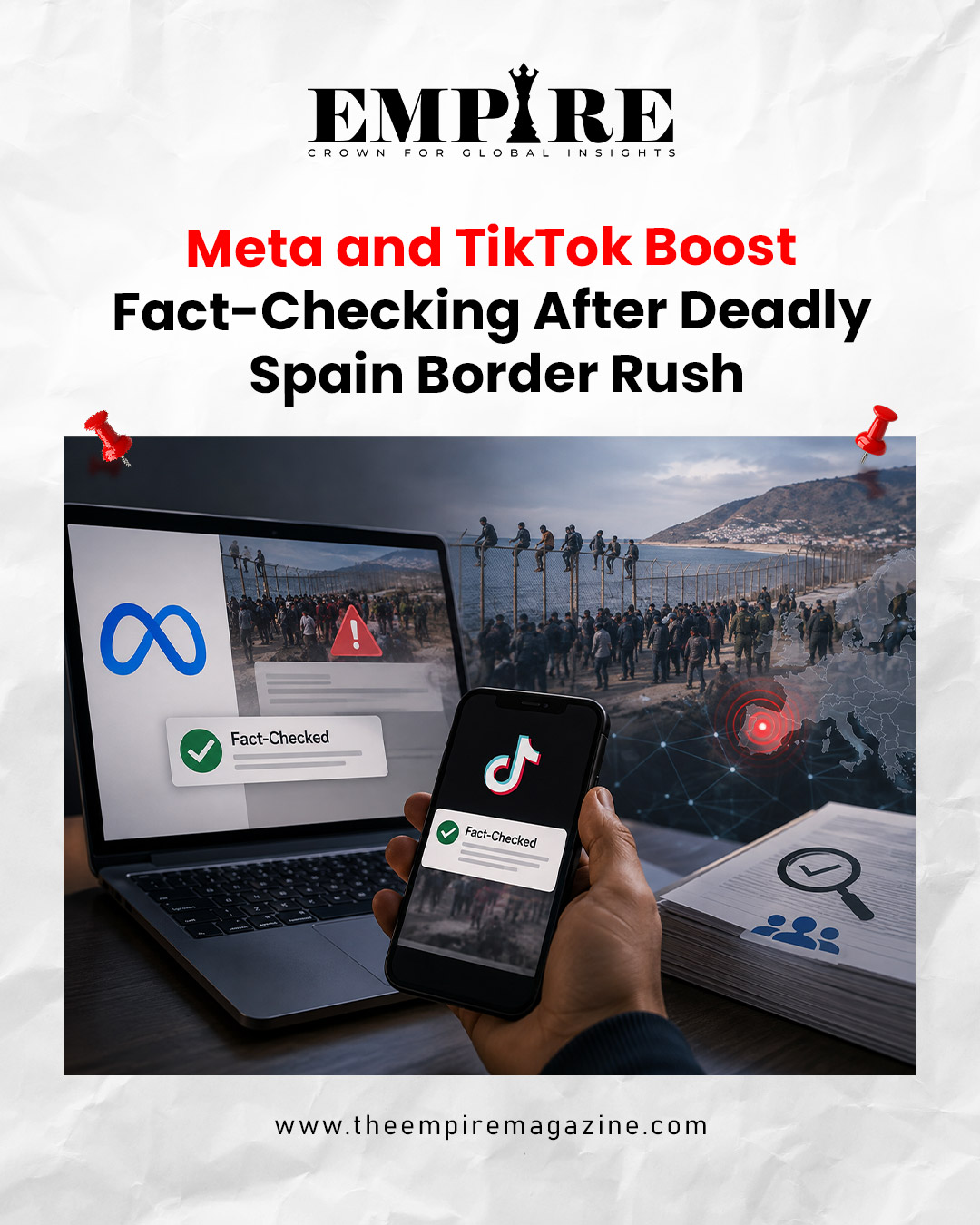
Meta and TikTok strengthen fact-checking after a deadly Spain border rush, targeting false migration claims and dangerous social media misinformation.
Meta and TikTok Fact-Checking After Spain Border Rush
Social media can move information across borders within seconds. But when that information is false, the consequences can be far more serious than a misleading post or viral video. The recent Spain border rush into the Spanish enclave of Ceuta has brought that danger into sharp focus, prompting Meta and TikTok to strengthen fact-checking measures for content linked to border crossings.
The decision follows a deadly migration crisis that unfolded at the Spain-Morocco border in late July. Thousands of people attempted to reach Ceuta, with many entering the water and trying to swim around border barriers. The rush overwhelmed local resources and resulted in a significant loss of life. Spanish authorities are still working to identify victims.
The latest move by Meta and TikTok fact-checking teams reflects a growing concern: online misinformation is no longer simply a digital problem. False promises about open borders, misleading videos and manipulated narratives can influence real-world decisions, particularly when people are already desperate for better economic opportunities or a safer future.
How the Spain Border Rush Turned Deadly
The Ceuta migrant crisis developed rapidly in the final days of July. Ceuta, a Spanish enclave on the North African coast, shares a land border with Morocco and is one of the European Union’s two land borders with Africa. As migration pressure increased, hundreds and eventually thousands of people attempted to cross by sea and land.
Early reports showed more than 1,500 migrants had reached Ceuta by sea over several days before the situation escalated. On July 30, the scale of the movement increased sharply, with migrants attempting to swim from the Moroccan coast toward Ceuta. Spanish authorities deployed additional forces as the border system struggled to cope.
The human cost was devastating. Reuters reported that authorities were working to identify dozens of people who died during the mass crossing, with many believed to have suffered drowning-related cardiopulmonary arrest. Families were left waiting for information about missing relatives as forensic teams worked to identify the victims.
The crisis demonstrated how quickly a border emergency can become a humanitarian tragedy when large numbers of people respond to the same information at the same time.
Social Media Misinformation Fueled the Ceuta Crisis
One of the most important elements of the Spain border rush was the role of online information. European officials said criminal networks had used social media and false information to encourage people to attempt dangerous crossings. The claims reportedly created the impression that crossing into Ceuta could be easier than it actually was.
This is where social media misinformation becomes particularly dangerous. A short video showing people reaching a destination can remove the difficult parts of the journey from view. A message claiming that a border is open can spread faster than an official warning explaining that it is not. For someone making a life-changing decision, that difference can be enormous.
There is also a long history of misleading migration videos circulating online. Fact-checkers have previously found old footage from the Spain-Morocco border being presented as recent events or even as incidents occurring in completely different countries. Such examples show how easily images can be stripped of their original context and reused to support a new narrative.
In a crisis, misinformation does not need to convince everyone. It only needs to convince enough people to act.
Why Meta and TikTok Are Strengthening Fact-Checking
The latest Meta and TikTok fact-checking measures are intended to address precisely this problem. EU tech chief Henna Virkkunen said the platforms had agreed to introduce stronger fact-checking measures for content concerning crossings into Spain. The goal is to limit false narratives that could be used by criminal networks to encourage dangerous migration attempts.
For Meta, the issue is particularly significant because its platforms can rapidly distribute information across Facebook, Instagram and other connected digital communities. TikTok presents a different but equally important challenge because short-form videos can become influential very quickly, especially among younger audiences.
The platforms are therefore being asked to do more than simply remove obviously false posts. Effective fact-checking on social media also requires identifying misleading context, checking old footage, understanding coordinated narratives and making reliable information easier for users to find.
The challenge is enormous because misinformation often looks convincing. A real photograph can be paired with a false caption. A genuine video can be presented as a new event. A legitimate border announcement can be selectively edited to create a completely different impression.
False Border Claims Can Cost Human Lives, hence, this check by Meta and TikTok
The most disturbing lesson from the Ceuta migrant crisis is that misinformation can have physical consequences. People who believe that a border is open may make decisions they would not otherwise consider. In the case of Ceuta, some attempted dangerous sea crossings in crowded conditions.
The journey itself can be hazardous. The waters around Ceuta are not simply another route across a normal border. People attempting to swim from Morocco can face exhaustion, currents, overcrowding and panic. When hundreds or thousands of people move simultaneously, even a small mistake can quickly become fatal.
The tragedy also highlights the responsibility of platforms that operate at enormous scale. Social media companies cannot control every decision made by users, and fact-checking alone cannot solve the broader migration crisis. Economic hardship, unemployment, family pressures and political conditions all influence migration decisions.
But platforms can reduce the spread of false information that exploits those circumstances. That is why the latest Meta and TikTok fact-checking effort matters. Preventing a dangerous lie from reaching thousands of people can sometimes be as important as correcting it after the damage has already been done.
The Bigger Challenge of Social Media Misinformation; Meta TikTok
The problem extends well beyond the Spain-Morocco border. Social media misinformation has become a recurring feature of major crises around the world. Natural disasters, wars, elections, migration emergencies and public-health events can all generate an enormous volume of misleading content.
Videos are particularly powerful because they appear to provide direct evidence. Research on online misinformation has found that video has become a dominant format among fact-checked media claims, while AI-generated content has also increased sharply in recent years.
This makes verification increasingly important. Users need to ask basic questions before sharing dramatic content: When was the video recorded? Where was it filmed? Who originally posted it? Does an independent news organisation confirm the claim? Has the footage appeared online before?
These questions may seem simple, but they can prevent misinformation from becoming a chain reaction.
The responsibility also cannot rest entirely with users. Platforms must build systems that identify suspicious content, provide context and connect users with credible information before misleading claims gain enormous reach.
What Meta and TikTok Fact-Checking Means for Users
For ordinary social media users, the new approach could mean seeing more warnings, context or fact-checking information alongside posts related to migration and border crossings. It could also mean that content identified as misleading is given less visibility or connected with information from trusted sources.
However, Meta and TikTok fact-checking should not be viewed as a complete solution. Fact-checkers can only respond to claims they identify, while misinformation can evolve rapidly. A false post may disappear and return in a slightly altered form within minutes.
Users therefore remain an important part of the information ecosystem. Sharing a dramatic video without checking its origin can unintentionally amplify a false claim. The same applies to screenshots, anonymous messages and posts that promise extraordinary opportunities.
In the context of migration, the stakes are even higher. Someone sitting thousands of kilometres away may see a short video and believe it represents an easy route into Europe. The reality can be very different.
The Road Ahead for Safer Social Media by Meta and TikTok
The decision by Meta and TikTok to strengthen fact-checking after the Spain border rush signals a broader shift in how governments and technology companies view online misinformation. Social platforms are increasingly being treated as part of the infrastructure through which real-world events develop, rather than simply as places where people exchange opinions.
The Ceuta crisis shows why that shift matters. A border emergency can begin with economic frustration and political tension, but online messages can accelerate it dramatically. When false information creates the belief that a dangerous journey is safe or that a border is open, the consequences can reach far beyond a smartphone screen.
For Meta and TikTok, the immediate priority is to prevent another wave of false promises from encouraging dangerous crossings. For governments, the challenge is to address the deeper conditions that make people vulnerable to such promises. And for users, the responsibility is simpler: pause before sharing.
The future of digital safety will not depend on one platform or one fact-checking system. It will depend on a combination of better technology, independent verification, responsible journalism, stronger platform accountability and more informed users.
The Spain border rush has offered a painful reminder that misinformation is not harmless when people act on it. In an increasingly connected world, the distance between a viral post and a real-life tragedy can be measured in minutes.
Previous article: https://theempiremagazine.com/rhine-supply-chains/
Magazine Feautures | Podcasts: Empire Global Talks
Follow The Empire Magazine on Facebook | Instagram | LinkedIn | YouTube
The Empire Magazine | Crown for Global Insights