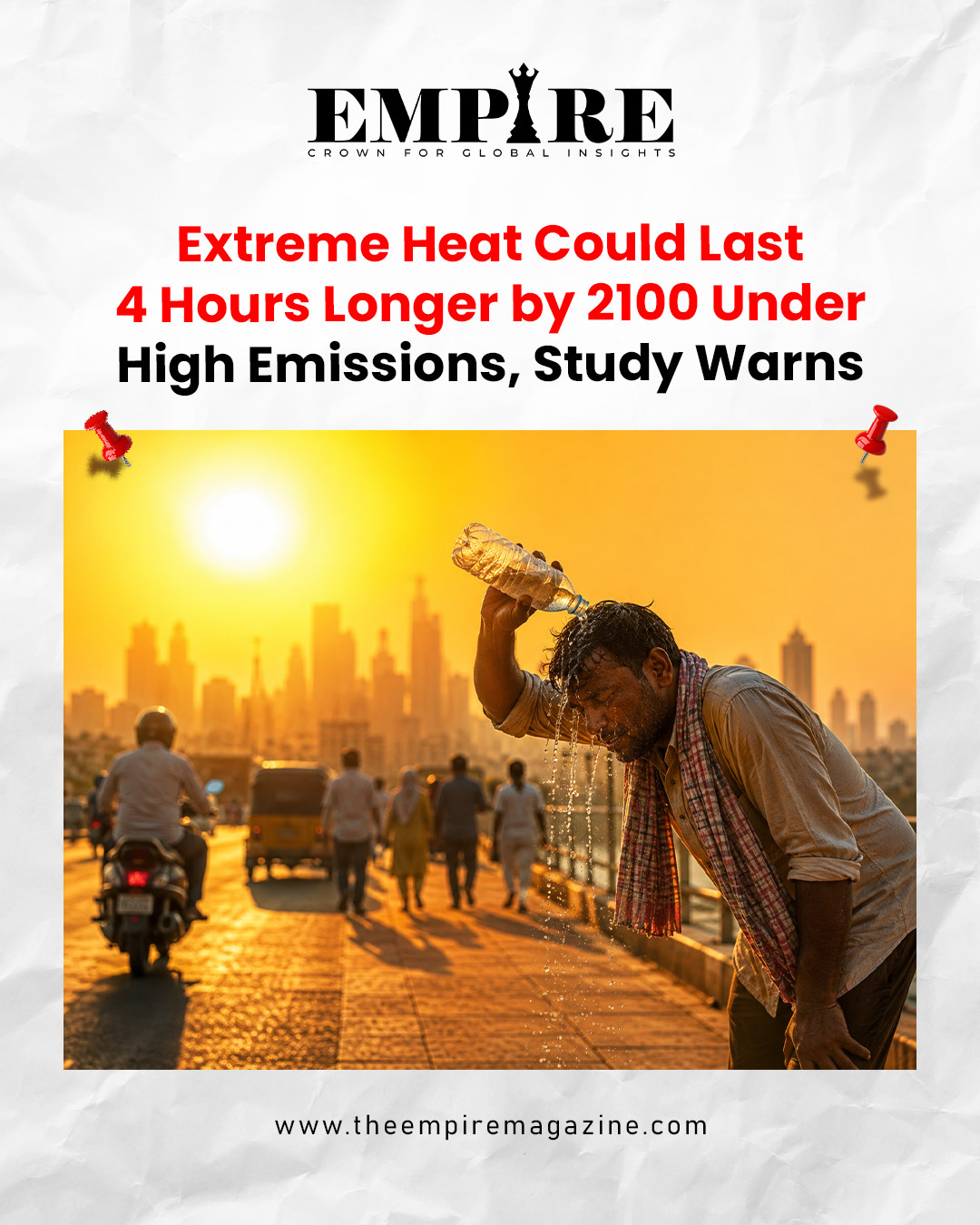
Extreme heat could last 4 hours longer by 2100 under high emissions, increasing health, energy and climate risks worldwide, a new study warns. Extreme heat could last up to four hours longer by 2100 under a high-emissions scenario, increasing risks to human health, energy systems, agriculture and cities. The study highlights how continued global warming could make heatwaves not only hotter, but also longer and more difficult to manage.
Extreme Heat Could Last 4 Hours Longer by 2100 Under High Emissions, Study Warns
Extreme heat is becoming one of the clearest signs of a rapidly changing climate. Heatwaves are not only becoming hotter and more frequent, but in many regions they are also lasting longer, leaving people, cities, agriculture and energy systems with less time to recover. New climate projections are adding another concern: under high-emission pathways, periods of dangerous heat could persist for several additional hours, intensifying the pressure on communities already struggling with rising temperatures.
The warning matters because extreme heat is different from an ordinary hot day. When temperatures remain elevated for longer periods, the human body has less opportunity to cool down, buildings retain more heat, electricity demand rises and outdoor workers face greater health risks. Research consistently shows that climate change is increasing the intensity, frequency and duration of heat extremes, particularly under high-emission scenarios.
The projected changes by 2100 therefore offer more than a distant climate forecast. They provide a picture of what everyday life could look like if greenhouse gas emissions continue at high levels.
Extreme Heat Is Becoming Longer
Extreme heat is no longer defined simply by how high temperatures rise. The duration of dangerous conditions is becoming increasingly important. A heatwave that lasts several days can place a far greater burden on the human body and public infrastructure than a single unusually hot afternoon.
Climate modelling shows that heatwave duration generally increases as global temperatures rise. Research examining regional heatwave characteristics found that some areas could experience dramatically longer heatwaves as warming intensifies, with the strongest changes occurring under higher warming levels.
This means the future of extreme heat will be shaped by three connected factors: how hot conditions become, how often they occur and how long they remain. A few additional hours may sound small when viewed individually, but repeated across increasingly frequent heat events, those extra hours can become a serious public health and economic problem.
Extreme Heat and Climate Change
Climate change is fundamentally altering the conditions that produce extreme heat. As greenhouse gases accumulate in the atmosphere, global temperatures rise and the baseline from which heatwaves develop becomes warmer.
Scientific research has found that extreme heat events are already occurring more frequently than they did under pre-industrial climate conditions. One global study found that by 2100, the occurrence of extreme heat days could be many times higher than under pre-industrial conditions, with the greatest increase projected under the high-emission RCP8.5 pathway.
The result is a dangerous feedback in everyday experience. A temperature once considered exceptional can become increasingly familiar, while events that would previously have been considered extraordinary become more likely.
For communities, that shift makes preparation more difficult because infrastructure designed around historical climate conditions may no longer be adequate.
Why Extreme Heat Could Last Longer
The lengthening of extreme heat is closely connected to overall warming. When average temperatures rise, it becomes easier for temperatures to cross thresholds used to define heatwaves and harder for them to fall below those thresholds.
High-emission scenarios represent a future in which greenhouse gas concentrations continue rising significantly. Climate models consistently show stronger increases in heatwave frequency, intensity and duration under these pathways compared with lower-emission scenarios.
The additional hours of heat highlighted by projections should therefore be understood as part of a broader trend rather than an isolated number. Longer hot periods can also mean warmer nights, slower recovery for the human body and greater demand for cooling.
In practical terms, the difference between a hot day that ends in the evening and one that remains dangerously warm into the night can be significant.
Extreme Heat Risks to Human Health
Extreme heat is a major health threat because the human body depends on its ability to release excess heat. When temperatures remain high, particularly when humidity is also elevated, sweating becomes less effective and physiological stress increases.
Older adults, young children, people working outdoors and individuals without reliable access to cooling can face greater exposure. Outdoor workers may have little choice but to continue working during dangerous conditions, making heat protection an economic as well as a medical issue.
The World Meteorological Organization and FAO have highlighted the growing global risks associated with extreme heat, including impacts on health, labour, food systems and essential infrastructure. Their recent assessment also emphasizes that climate change is increasing the intensity and duration of several forms of heat extremes.
Longer exposure can also reduce sleep and recovery, particularly when nighttime temperatures remain unusually high. This turns extreme heat from a temporary discomfort into a prolonged strain on daily life.
Extreme Heat and India
India is particularly vulnerable to extreme heat because large populations live and work in regions that already experience intense summer temperatures. Heat risks are further complicated by humidity, urbanisation, limited cooling access and the large number of people employed in outdoor and informal work.
Research examining future Indian climate conditions indicates that heatwave frequency and duration are expected to increase under high-emission scenarios. Studies also project substantial increases in heat-stress conditions across different parts of the country as temperatures rise.
For India, the concern is not simply whether a particular city reaches a new temperature record. The larger question is how long people remain exposed to dangerous conditions.
Construction workers, farmers, street vendors, delivery workers and other outdoor workers can experience the consequences first-hand. Longer heat exposure can reduce productivity, increase dehydration and raise the risk of serious illness.
Extreme Heat Threatens Cities
Cities are especially vulnerable because concrete, asphalt and buildings absorb and retain heat. The urban heat island effect can keep neighbourhoods warmer than surrounding rural areas, particularly after sunset.
This makes longer extreme heat events more difficult to manage. Air-conditioning demand rises, public spaces become less comfortable and electricity networks face greater pressure. People living in poorly ventilated homes may have fewer opportunities to escape the heat.
Climate research has repeatedly shown that urban areas will face increasing heat risks as global temperatures rise. The challenge is therefore not only reducing emissions but also redesigning cities to cope with a warmer climate.
More trees, shaded public spaces, reflective surfaces, better building design and accessible cooling centres can all help reduce exposure.
Extreme Heat and Energy Demand
Extreme heat creates another major problem: the more temperatures rise, the more electricity people need for cooling.
During prolonged heat events, households and businesses may run air conditioners and cooling systems for longer periods. This can push electricity demand sharply higher, particularly during peak afternoon and evening hours.
A longer extreme heat event therefore creates a double challenge. People need more cooling precisely when electricity systems are under the greatest pressure.
Research into future heatwaves has already linked increasing heatwave intensity and persistence with changes in electricity demand.
For governments and utilities, this means future energy planning cannot rely only on historical demand patterns. Cooling demand must increasingly be treated as a core part of climate resilience.
Extreme Heat Could Hurt Agriculture
Agriculture is another sector facing growing risks from extreme heat. Crops depend on relatively narrow temperature ranges during critical stages of development, while livestock can experience heat stress when temperatures remain high for extended periods.
Longer heat events can increase water requirements, reduce crop productivity and intensify pressure on already limited water supplies.
The problem becomes more complicated when extreme heat occurs alongside drought. Dry soils can reduce the cooling effect of evaporation, while prolonged heat increases demand for irrigation.
For farmers, the future challenge will therefore involve adapting planting schedules, improving irrigation efficiency, developing heat-tolerant crop varieties and strengthening access to reliable weather information.
Can Extreme Heat Still Be Controlled?
The most important message from climate projections is that the future is not completely predetermined.
Different emissions pathways produce significantly different levels of future heat risk. Research shows that limiting global warming can substantially reduce the increase in heatwave frequency, intensity and duration compared with high-emission scenarios.
Reducing fossil fuel use, expanding clean energy, improving energy efficiency and protecting natural carbon sinks remain central to limiting long-term warming.
At the same time, adaptation cannot wait for emissions reductions to take effect. Governments need heat action plans, early warning systems, resilient healthcare infrastructure and workplace protections that can protect people from heat that is already occurring.
The most effective response will therefore combine mitigation with preparation.
What the Future of Extreme Heat Means
The possibility of extreme heat lasting longer by 2100 is ultimately a warning about the direction in which climate risks are moving. Additional hours of dangerous heat may appear insignificant when viewed as a single statistic, but the consequences become much larger when those hours are added to hotter days, warmer nights and more frequent heatwaves.
The science is clear that continued high greenhouse gas emissions would lead to greater heat risks by the end of the century. Some regions could face heatwaves lasting weeks, while others may experience dangerous heat conditions across much larger portions of the year.
Extreme heat will therefore become a test of how effectively societies can prepare for a warmer world.
The choice is not simply between hot and cool futures. It is between a future where extreme heat becomes increasingly difficult to manage and one where emissions reductions, resilient cities, better public health planning and smarter infrastructure can limit the worst consequences.
By 2100, the most important measure may not be how high the thermometer rises, but how long people are forced to live with the heat.
For more business and retail insights, read more on The Empire Magazine
Previous article: https://theempiremagazine.com/bali-ferry-fire/
Magazine Feautures | Podcasts: Empire Global Talks
Follow The Empire Magazine on Facebook | Instagram | LinkedIn | YouTube
The Empire Magazine | Crown for Global Insights