
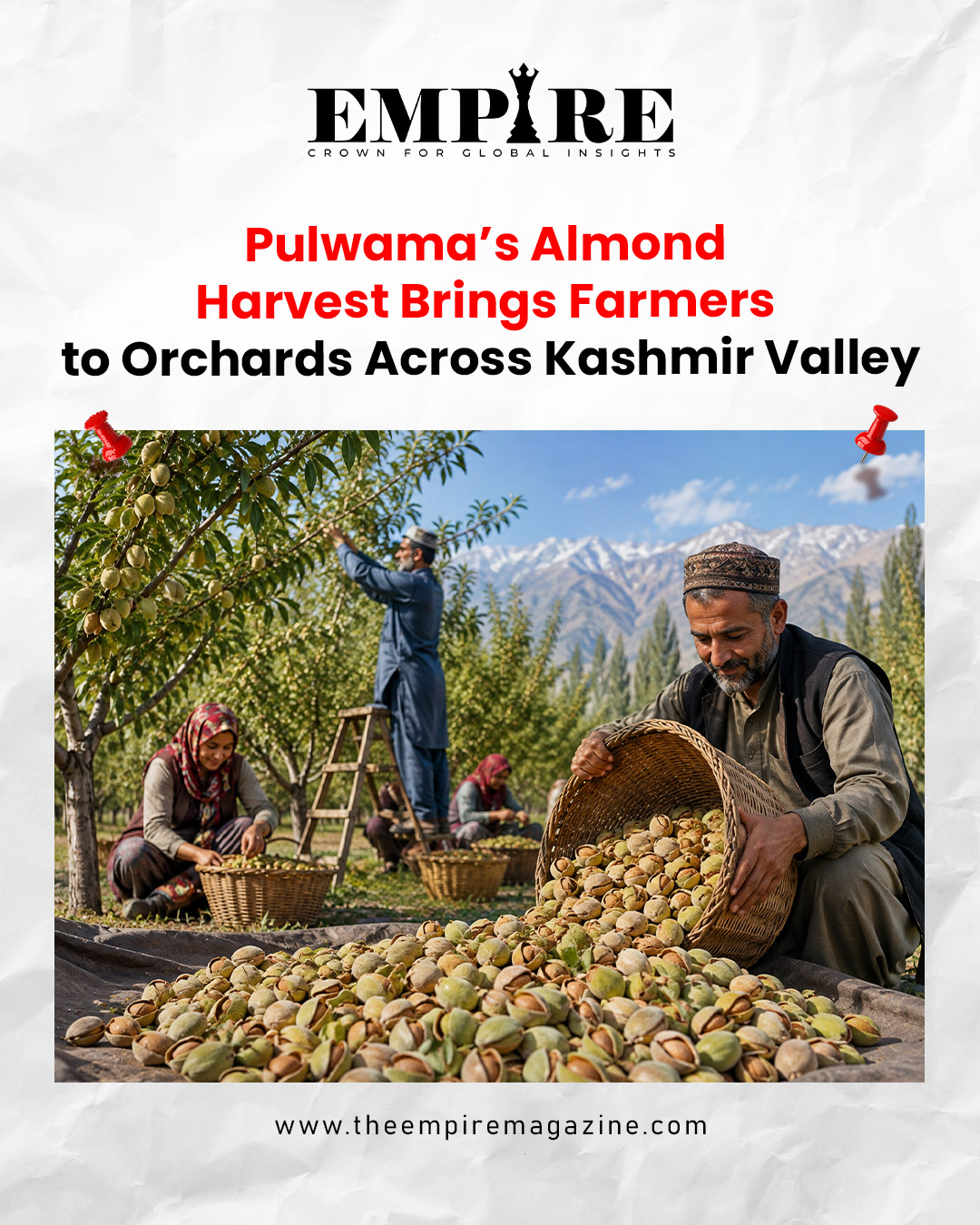
Pulwama almond harvest brings a bumper crop, renewed farmer optimism and fresh hope for Kashmir’s traditional almond industry.
Pulwama Almond Harvest Begins With Fresh Hope
Across the orchards of Pulwama, the arrival of the almond harvest is bringing a familiar rhythm back to Kashmir’s countryside. Farmers are returning to their orchards, gathering almonds, sorting the fresh produce and preparing it for drying and sale. This year, however, the harvest carries an added sense of optimism. Favourable weather has helped produce a significantly better almond crop compared with recent seasons, giving growers a reason to look beyond years of uncertainty.
Pulwama remains one of the most important centres of almond cultivation in Kashmir, making the district central to the story of the region’s traditional dry-fruit economy. During harvest, the work is intensely hands-on. Farmers collect the fallen almonds, separate the outer covering, clean the nuts and spread them out to dry. Images from the 2025 harvest in Parigam, Pulwama, showed farmers using long sticks to shake almond trees while sheets placed beneath the trees caught the crop.
For farming families, the harvest is more than an agricultural activity. It represents income, inherited knowledge and a connection with orchards that have been maintained across generations.
Pulwama, Kashmir Almond Harvest Gets a Boost From Weather
The 2026 Kashmir almond harvest has arrived against a backdrop of cautious optimism. Riyaz Ahmad Shah, Chief Horticulture Officer, Pulwama, said favourable weather conditions had contributed to significantly higher production compared with the previous two or three years. He also noted that timely advisories from the horticulture department helped orchard owners improve their produce.
Weather is particularly important for almond cultivation because the crop can be affected by changes during flowering and fruit development. Earlier this year, unusually early almond blossoms in Kashmir had already raised concerns among growers about the effects of changing weather patterns. The early flowering highlighted how closely farmers are watching temperature changes and seasonal shifts.
The better crop therefore brings relief, but it does not erase those concerns. A strong harvest can improve a farmer’s prospects for one season, yet long-term agricultural security depends on predictable weather, healthy orchards, scientific advice and reliable markets.
For Pulwama’s almond growers, this season is an opportunity to rebuild confidence in a crop that has faced considerable pressure.
Pulwama Almond Farming Carries a Long Tradition
Almond farming in Pulwama is deeply connected to Kashmir’s horticultural heritage. The region’s orchards have long produced almonds that form part of the Valley’s distinctive dry-fruit identity. Farming knowledge has traditionally moved from one generation to another, with growers learning when to prune trees, how to manage orchards and when to harvest from the experience of their families.
Agricultural research has also demonstrated that scientific orchard management can make a difference. The Indian Council of Agricultural Research has documented almond orchard rejuvenation techniques that have been demonstrated in Srinagar, Budgam and Pulwama. According to ICAR, rejuvenated trees can begin bearing within the second year after top-working, with improved trees eventually reaching higher yields than older seedling plantations.
Research from Pulwama has similarly examined the adoption of recommended almond production technologies among local farmers, underlining the importance of combining traditional knowledge with modern agricultural practices.
This combination may prove crucial for the future. Kashmir’s almond story is not simply about preserving old orchards; it is also about making almond farming productive enough for the next generation to continue it.
Pulwama Almond Farmers Face a Shrinking Orchard Landscape
Behind the optimism of the current Pulwama almond harvest lies a serious challenge: the shrinking area devoted to almonds. Recent reports have highlighted a long-term decline in Kashmir’s almond cultivation, with growers increasingly shifting towards apples or other land uses because of concerns over returns and changing agricultural conditions.
Pulwama, historically one of Kashmir’s leading almond-producing districts, has also witnessed the expansion of apple orchards. For farmers, the decision is often economic. Agriculture requires investment, labour and patience, and growers naturally look for crops that can provide more dependable returns.
This creates a difficult cycle for almond cultivation. When orchard acreage declines, the crop’s overall presence becomes weaker. Reduced production can affect supply chains, processing activity and the wider ecosystem built around the crop.
The challenge is therefore not simply to celebrate a good harvest but to make almond farming economically sustainable. If growers can earn competitive returns from almonds, retaining existing orchards becomes more attractive and younger members of farming families may be more willing to remain connected to the sector.
Pulwama Kashmir Almond Orchards Need Better Market Support
A bumper crop is only good news if farmers can sell it at a fair price. This remains one of the most important concerns surrounding the Kashmir almond harvest. In previous seasons, growers have expressed fears that inadequate market infrastructure could prevent them from receiving the returns they expect even when production is strong.
Better market access can change the economics of farming. Farmers need efficient collection systems, grading facilities, storage, packaging and access to buyers beyond local markets. Quality certification and stronger branding could also help distinguish Kashmir-grown almonds in a market where consumers have many choices.
The recently published roadmap for horticulture development in Jammu and Kashmir recognises the importance of market infrastructure, including satellite markets and other facilities intended to improve the horticulture supply chain. Pulwama is among the locations identified in the roadmap’s market network.
For almond growers, such infrastructure is not an abstract policy issue. It can determine how quickly produce moves from an orchard to a buyer and how much value ultimately returns to the farmer.
New High-Density Almond Farming Offers Hope in Pulwama
One of the most significant developments for Kashmir’s almond industry came in July 2026, when the Department of Horticulture launched a pilot project for high-density almond cultivation in Pulwama. The project covers 100 kanals at the Fruit Plant Nursery in the Nowgam area of Newa and is designed to demonstrate modern cultivation techniques.
The objective is straightforward: increase productivity, improve orchard management and make almond cultivation more economically viable for farmers. If successful, the model could encourage growers to adopt modern planting systems and return more land to almond production.
This matters because Kashmir’s almond industry needs more than temporary assistance. It needs a practical model that shows farmers that almonds can compete economically with other horticultural crops.
The pilot project also represents a broader shift in thinking. Preserving Kashmir’s almond heritage does not necessarily mean keeping every orchard exactly as it was decades ago. Instead, the future may depend on combining the identity of traditional almond farming with modern varieties, improved orchard design, scientific management and better productivity.
Pulwama Almond Harvest Shows the Value of Farmer Knowledge
Walk through an almond orchard during harvest and the work can appear simple. Farmers shake or harvest the trees, collect the almonds, remove the outer layers and begin the drying process. But behind every step lies knowledge built through years of observation.
Farmers understand their trees, their land and the seasonal patterns that influence the crop. They know which sections of an orchard perform well, when the fruit is ready and how to handle the harvest after it leaves the tree. That practical knowledge cannot simply be replaced by technology.
At the same time, modern agricultural advice can strengthen this experience. The Pulwama horticulture department has already highlighted the role of timely advisories in improving this year’s almond production.
The strongest future for Kashmir almond farming may therefore come from collaboration rather than replacement: farmers contributing field experience while scientists, horticulture officials and market specialists provide new tools, techniques and commercial opportunities.
That partnership can help turn a seasonal harvest into a sustainable agricultural business.
The Future of Pulwama Kashmir Almond Farming
The current Pulwama almond harvest offers an encouraging picture, but the bigger question is what happens after the harvest season ends. A single bumper crop cannot reverse years of declining acreage. What it can do is demonstrate that the crop still has potential when weather, orchard management and farmer support work together.
The government’s high-density pilot is one step towards that future. The horticulture development roadmap also places greater emphasis on productivity, market infrastructure and modern horticultural systems. NABARD’s 2026–27 Pulwama district plan similarly identifies high-density plantations of crops including almonds as part of efforts to improve land-use efficiency and farmer incomes.
There is also a cultural reason to protect the crop. Almond orchards are part of Kashmir’s agricultural landscape and seasonal identity. Their value cannot be measured only through market prices. They represent family histories, rural employment and an agricultural tradition that has survived changing economic conditions.
If modern farming can make that tradition profitable again, almond cultivation could find a stronger place in Kashmir’s next generation of horticulture.
Why the Pulwama Almond Harvest Matters
The Pulwama almond harvest is ultimately a story about resilience. It is about farmers returning to orchards despite uncertainty, harvesting a crop that has survived difficult seasons and hoping that this year’s better production will translate into better livelihoods.
The bumper crop reported in 2026 has given Kashmir’s almond growers a welcome reason for optimism. Yet the industry still faces challenges from changing weather, shrinking orchard acreage, market competition and the need for better infrastructure.
The response cannot stop at celebrating a good season. Kashmir’s almond industry needs sustained investment, modern cultivation methods, stronger market connections and continued technical support.
For Pulwama’s farmers, every almond gathered from a tree represents more than produce. It represents work, patience and a connection to the land. Protecting that connection while making almond farming economically viable could determine whether Kashmir’s almond orchards remain a living part of the Valley’s future or slowly become a memory of its agricultural past.
The 2026 harvest has brought the optimism back. The next challenge is to make that optimism last.
For more business and retail insights, read more on The Empire Magazine
Previous article: https://theempiremagazine.com/mecca/
Magazine Feautures | Podcasts: Empire Global Talks
Follow The Empire Magazine on Facebook | Instagram | LinkedIn | YouTube
The Empire Magazine | Crown for Global Insights