
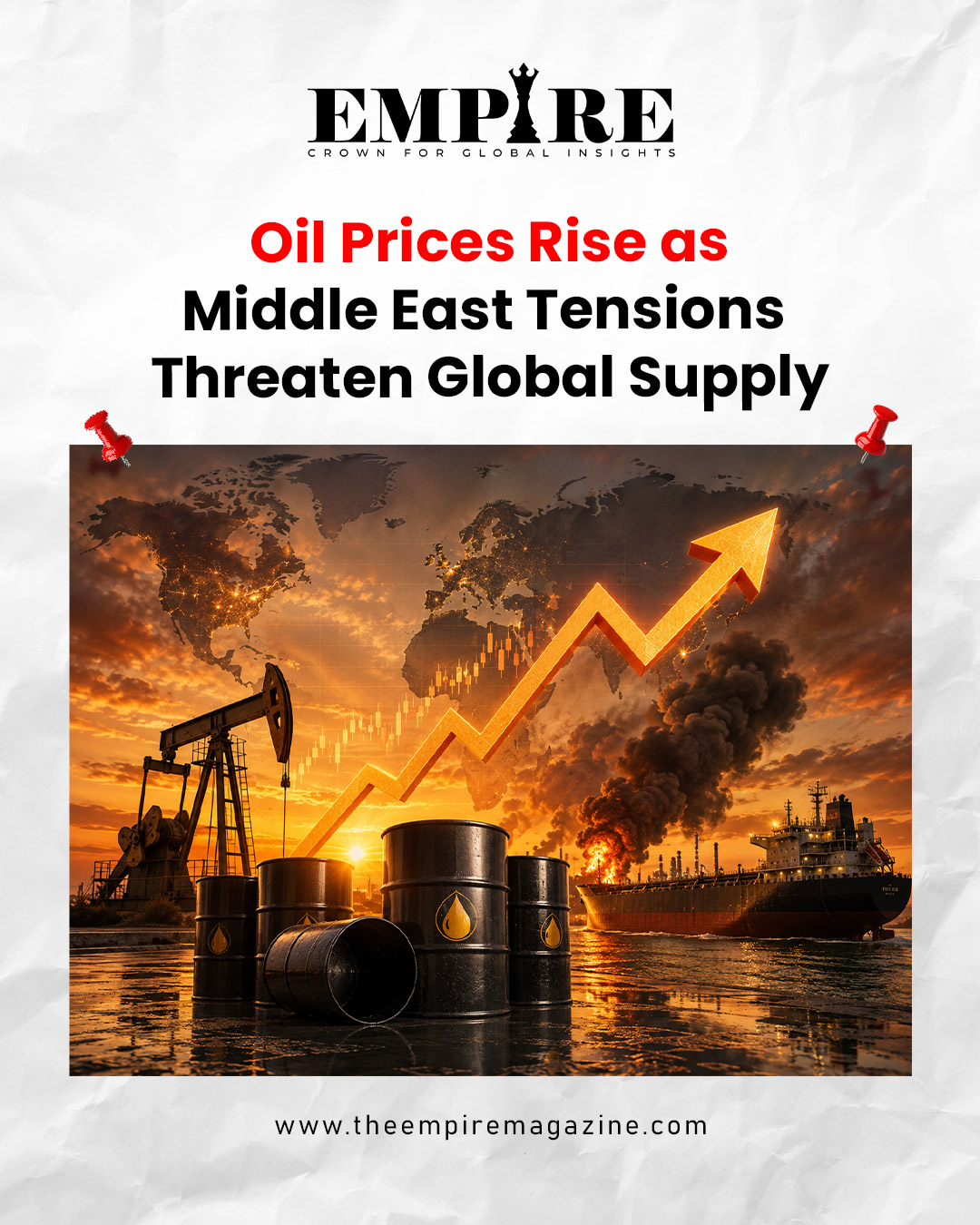
Oil prices rise as Middle East tensions disrupt supply routes, pressure global markets and raise concerns over inflation, fuel costs and energy security. Oil prices rise as renewed Middle East tensions threaten global energy supplies and disrupt shipping through the Strait of Hormuz. Brent crude moved above $91 a barrel on August 19, 2026, as traders priced in the risk of prolonged supply disruptions, higher shipping costs and renewed inflationary pressure across major economies.
Why Oil Prices Rise Amid Middle East Tensions
Oil prices rise when traders begin to fear that future supplies could become tighter, more expensive or more difficult to transport. That fear is once again dominating global energy markets as continuing Middle East tensions create uncertainty around crude production, shipping routes and diplomatic efforts. On August 19, Brent crude futures climbed to $91.47 a barrel, while U.S. West Texas Intermediate crude reached $85.39. Both benchmarks touched their highest levels in about three weeks.
The latest increase is not simply about the amount of oil being produced today. It is about what traders believe could happen next. When a major energy-producing region faces prolonged instability, markets usually add a geopolitical risk premium to crude. That premium can push prices higher even before a physical shortage reaches consumers.
The uncertainty surrounding the Strait of Hormuz has made the situation more serious. Conflicting messages over whether the critical waterway is fully open have encouraged shipping companies to remain cautious, creating additional pressure on energy markets.
For the global economy, this matters because crude oil affects far more than petrol and diesel. Higher oil prices can raise transportation expenses, airline costs, manufacturing bills and logistics charges. If elevated prices continue, the effects can eventually reach inflation, interest rates and consumer spending.
Oil Prices Rise as Hormuz Risk Grows
The Strait of Hormuz is at the centre of the latest energy market concerns. The narrow waterway connects the Persian Gulf with the Gulf of Oman and remains one of the world’s most strategically important energy routes. A substantial share of global oil trade passes through the Strait, making any disruption capable of creating immediate concern among governments, traders and energy companies.
The International Energy Agency has repeatedly highlighted the importance of restoring normal flows through the Strait, describing the reopening of the route as critical to easing pressure on energy supplies and prices.
The current uncertainty has become particularly damaging because ships and energy companies need predictable access to the route. Even when a waterway is technically open, security concerns can discourage shipowners from sending vessels through it. That can reduce the availability of tankers, increase insurance costs and make deliveries more expensive.
Alternative export routes can provide some relief, but they cannot fully replace the capacity of the Strait. Pipelines and ports have physical limits, while rerouting cargoes takes time.
That is why oil prices rise so quickly when Hormuz concerns intensify. Markets do not wait for a complete supply shutdown. Traders react to the possibility of disruption, often moving prices higher before the physical impact becomes visible.
Global Oil Supply Faces New Pressure
The pressure on global oil supply has been building for months. The Middle East remains one of the world’s most important energy-producing regions, and disruption in its production or shipping network can quickly affect international markets.
The IEA reported earlier this year that disruptions to seaborne trade through the Strait of Hormuz contributed to major inventory declines. Global observed oil inventories fell substantially during March and April, highlighting how quickly a prolonged supply shock can drain available stocks.
The agency has also described the Middle East conflict as a historic disruption for the global oil market, with flows through the Strait falling dramatically from levels seen before the conflict.
Producers and governments have been looking for ways to reduce the pressure. Some Middle Eastern producers can redirect exports through alternative infrastructure, while other countries are increasing supplies from outside the region. Iraq, for example, has been working on mechanisms to export crude through alternative outlets as concerns over the Strait continue. But alternative routes cannot completely remove the risk. Oil markets depend on a complex network of production fields, pipelines, ports, refineries and tankers. When one major part of that network is disrupted, replacing the lost capacity is neither immediate nor simple.
This is why the longer Middle East tensions continue, the greater the possibility of sustained oil market volatility.
Oil Prices Rise Across Asian Markets
Oil prices rise have particular significance for Asia because many of the world’s largest energy-consuming economies depend heavily on crude arriving through Middle Eastern shipping routes. Japan, South Korea, China and India are among the major Asian economies watching developments around the Strait of Hormuz closely.
The impact is already being felt across financial markets. Asian shares came under pressure as investors weighed higher crude prices, geopolitical uncertainty and the possibility of prolonged inflation. Higher energy costs can also influence currencies because oil-importing countries require more foreign currency to pay for energy imports.
For investors, the impact is not uniform. Oil producers and energy companies may benefit from stronger crude prices, while airlines, transportation companies and fuel-intensive manufacturers can face margin pressure.
The situation also creates uncertainty for central banks. A rise in energy prices can push headline inflation higher even if other parts of the economy are slowing. Policymakers may therefore find themselves facing a difficult choice between supporting economic growth and preventing inflation from becoming entrenched.
That makes crude oil more than a commodity story. Oil prices rise can become a broader financial-market story when investors begin reassessing inflation, interest rates, currencies and corporate earnings.
India Feels the Oil Price Pressure
For India, the movement in crude oil prices deserves particular attention. The country imports a significant portion of the crude required to meet its energy needs, leaving the economy exposed to changes in international oil prices and shipping costs.
Indian refiners are already facing increased pressure as Middle East disruptions tighten physical crude availability. Reports indicate that refiners have been paying higher premiums for some crude supplies, while discounts on Russian oil have also narrowed.
If oil prices remain elevated, the impact could spread across India’s economy. Higher crude costs can affect transportation, aviation, logistics, manufacturing and chemical industries. Businesses that depend heavily on diesel, petrol or petroleum-based inputs could see their operating costs rise.
Consumers may eventually feel the impact through transportation and other everyday expenses. The extent of the impact, however, will depend on international crude prices, currency movements, government policy and how long the geopolitical disruption lasts.
For India, the current situation also reinforces the importance of energy diversification. Expanding renewable energy, electric mobility, domestic production and alternative fuels can gradually reduce the economy’s vulnerability to external oil shocks.
In the short term, however, any prolonged period of expensive crude remains a challenge for India’s inflation management and import bill.
Oil Prices Rise and Inflation Risks Grow
One of the biggest consequences when oil prices rise is the potential return of inflationary pressure. Crude oil is deeply embedded in modern economic activity. It influences transportation, aviation, manufacturing, agriculture, packaging and international trade.
When fuel costs increase, companies often face a difficult decision. They can absorb the additional expense and accept lower margins, or they can pass some of the increase to customers. When higher costs move through several stages of the supply chain, consumers can eventually face broader price increases.
The aviation industry provides a clear example. Airlines are particularly sensitive to jet fuel prices, and prolonged energy disruptions can affect ticket prices, profitability and route economics.
Shipping companies face similar challenges. When vessels are forced to avoid risky routes or take longer journeys, fuel consumption and insurance costs can increase. Those expenses can ultimately become part of the cost of imported goods.
The bigger concern is duration. A temporary rise in crude may be manageable for many businesses. A prolonged increase is more likely to influence inflation expectations and monetary policy.
This means oil prices rise is not merely a headline for energy investors. It can become an important economic warning signal for governments, businesses and households around the world.
What Happens If Supply Disruptions Continue?
The future direction of oil prices will depend heavily on the duration of the Middle East supply disruption. If shipping through the Strait of Hormuz returns to normal, some of the geopolitical premium could disappear relatively quickly.
However, if uncertainty persists, the pressure on inventories and refined fuel markets could become more serious. The IEA has already documented substantial inventory withdrawals during earlier phases of the disruption, demonstrating how quickly global stocks can respond to supply shocks.
Alternative supply will remain important. Producers outside the Middle East can help fill part of the gap, but infrastructure limitations mean that replacement supplies cannot necessarily arrive at the same scale or speed.
Demand is another crucial factor. Extremely high prices can eventually weaken consumption as consumers reduce travel, companies improve efficiency and slower economic growth reduces industrial demand.
This creates a complicated market equation. Supply disruptions push prices higher, while high prices can eventually weaken demand.
The outcome will therefore depend on several factors at once: Middle East diplomacy, Hormuz shipping, global inventories, alternative production, economic growth and consumer demand.
For traders, that means volatility could remain the dominant feature of the global oil market.
Global Energy Markets Face More Volatility
The latest movement in crude prices shows how closely energy markets remain connected to geopolitics. Brent crude moving above $91 a barrel reflects more than concerns about immediate production. It reflects uncertainty over shipping, diplomacy and the reliability of one of the world’s most important energy corridors.
The crisis is also highlighting vulnerabilities within global supply chains. Energy can be produced in one country, transported through another region, refined elsewhere and eventually consumed thousands of kilometres away. A disruption at one strategic point can therefore create consequences across multiple economies.
Governments are increasingly focused on strategic petroleum reserves, alternative supply routes and energy diversification. Companies, meanwhile, are reviewing procurement strategies, fuel hedging and supply-chain resilience.
The latest crisis could also accelerate investment in alternative energy technologies. Renewable power, electric vehicles, energy efficiency and alternative fuels cannot replace oil overnight, but they can reduce long-term dependence on imported crude.
The IEA has warned that geopolitical uncertainty is already reshaping energy investment decisions, with oil investment expected to decline in 2026 despite higher prices.
That creates an important contradiction: the world may need more secure energy supplies while simultaneously becoming more cautious about long-term fossil-fuel investment.
What Rising Oil Prices Mean for the World
Oil prices rise when markets begin pricing in greater uncertainty, and the current Middle East crisis has made that uncertainty impossible to ignore. With the Strait of Hormuz still facing serious disruption and diplomatic progress uncertain, energy traders are likely to remain highly sensitive to developments from the region.
The immediate question is whether crude prices will continue moving towards higher levels or stabilise as alternative supplies and changing demand provide relief. The longer-term question is much larger: how can countries reduce their exposure to geopolitical shocks in global energy markets?
For now, the message from the oil market is clear. Energy security remains closely linked to geopolitical stability.
As long as uncertainty surrounds Middle Eastern supply routes, oil prices rise and fall on every major diplomatic and military development. That volatility can influence inflation, currencies, interest rates, stock markets, transportation costs and household budgets.
The current situation is therefore much bigger than a move in the price of crude. It is a reminder that the global economy remains deeply dependent on reliable energy flows.
What happens next in the Middle East could determine whether the latest oil-price increase becomes a temporary geopolitical premium or the beginning of another prolonged period of energy-market instability.
Previous article: https://theempiremagazine.com/openai-stargate/
Magazine Feautures | Podcasts: Empire Global Talks
Follow The Empire Magazine on Facebook | Instagram | LinkedIn | YouTube
The Empire Magazine | Crown for Global Insights