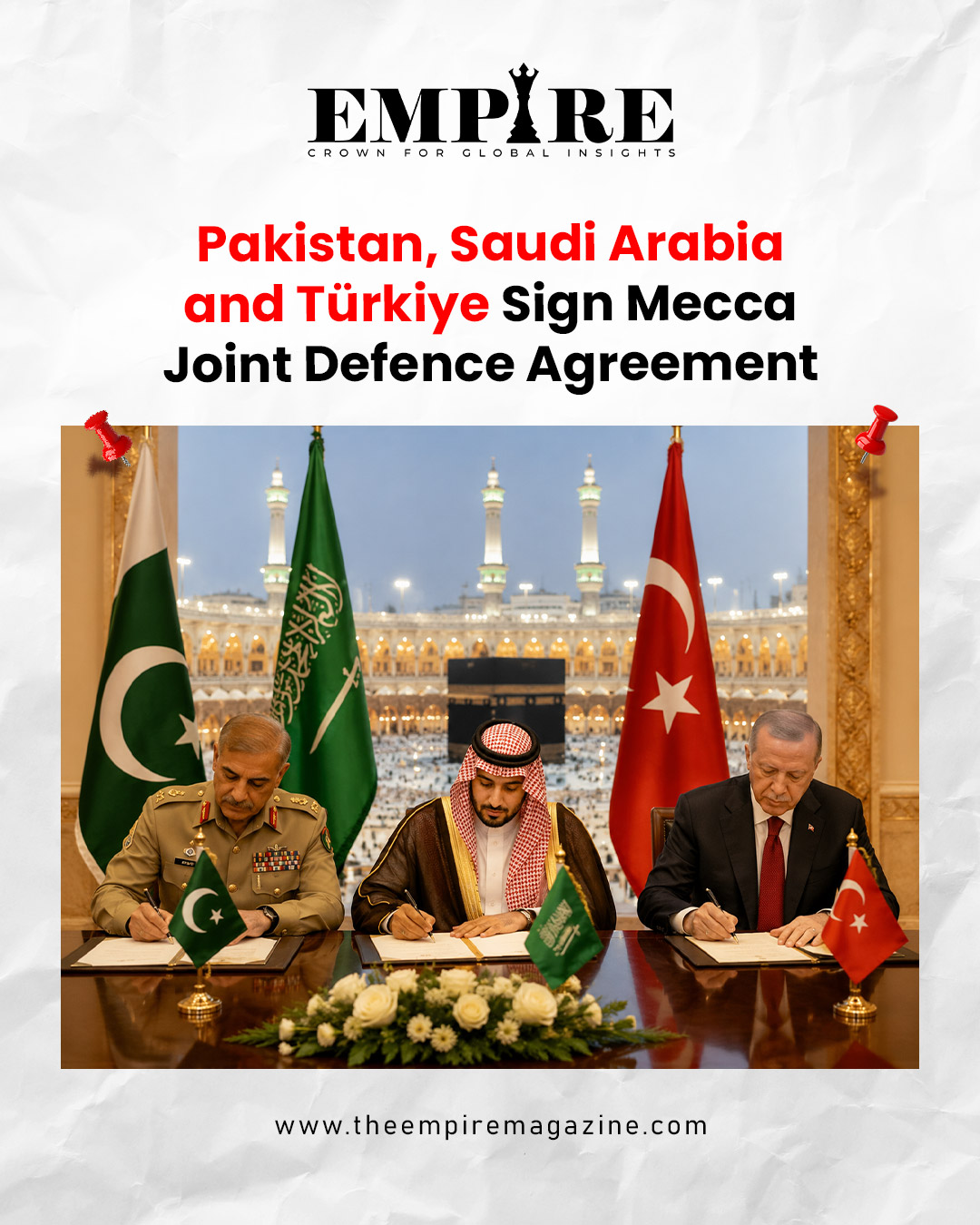
Pakistan, Saudi Arabia and Türkiye sign the Mecca Joint Defence Agreement, creating a new security framework amid rising Middle East tensions. The Mecca Joint Defence Agreement was signed by Pakistan, Saudi Arabia and Türkiye on August 7, 2026. The pact states that an armed attack against one member will be regarded as an attack against all three, strengthening collective deterrence and defence cooperation amid growing regional tensions.
Mecca Joint Defence Agreement Brings Three Powers Together
A new chapter in regional security opened in Makkah on August 7, 2026, when Pakistan, Saudi Arabia and Türkiye signed the Mecca Joint Defence Agreement. The agreement declares that an armed attack against any one of the three countries will be regarded as an attack against all three, creating a stronger framework for collective deterrence and defence cooperation.
The agreement brings together three countries with very different strategic strengths. Saudi Arabia contributes enormous financial resources, energy influence and a strategically important geographic position. Türkiye brings NATO experience, a growing defence industry and advanced capabilities in drones, missiles, naval systems and electronic warfare. Pakistan contributes a large professional military, significant operational experience and the nuclear capability of a state that has long maintained close defence ties with Riyadh. The significance of the Mecca Joint Defence Agreement therefore goes beyond the signing ceremony itself. It reflects a changing regional environment in which Middle Eastern and South Asian powers are increasingly interested in building their own security partnerships while continuing to maintain relationships with major global powers.
Why the Mecca Joint Defence Agreement Matters Now
The timing of the Mecca Joint Defence Agreement is particularly important. The Middle East has experienced heightened military tensions, missile threats, attacks involving Iran-aligned groups and growing concerns around critical maritime routes. Saudi Arabia has faced security challenges involving its territory and infrastructure, while the wider Gulf remains exposed to instability around the Strait of Hormuz and Bab al-Mandeb.
For Riyadh, the agreement provides another layer of strategic insurance. Saudi Arabia has historically relied heavily on the United States for advanced military equipment and security cooperation, but recent regional crises have encouraged the kingdom to diversify its partnerships. The new pact does not end Saudi-US cooperation; rather, analysts describe it as part of Riyadh’s broader effort to build multiple security relationships instead of depending on a single external guarantor. For Pakistan and Türkiye, the agreement offers a different opportunity: deeper access to a strategically important partner and a stronger role in shaping regional security. Together, the three countries are attempting to turn existing bilateral relationships into a more coordinated framework.
Pakistan Saudi Arabia Defence Ties Gain New Weight
The Pakistan Saudi Arabia defence agreement did not emerge suddenly. Islamabad and Riyadh signed a Strategic Mutual Defence Agreement in September 2025, building on almost eight decades of close political, economic and military relations. Saudi Arabia’s official statement described the partnership as being rooted in longstanding ties, Islamic solidarity and close defence cooperation.
The 2026 trilateral agreement expands that foundation by bringing Türkiye into the security framework. Pakistan’s role is particularly significant because of its military experience and nuclear capability. However, the agreement should not automatically be interpreted as creating a Saudi nuclear umbrella. Analysts have stressed that Pakistan’s earlier bilateral arrangement with Riyadh did not include such a commitment. Pakistan also has substantial strategic interests in the Gulf. Millions of Pakistani expatriates live across the region, while the Middle East remains critical to Pakistan’s energy supplies, economic relationships and diplomacy. The Mecca Joint Defence Agreement consequently strengthens Islamabad’s position beyond South Asia and gives it a larger voice in regional security discussions.
Türkiye Adds Technology and Military Reach
Türkiye gives the Mecca Joint Defence Agreement another dimension through its rapidly expanding defence industry and NATO-linked military experience. Ankara has developed strong capabilities in drones, missiles, sensors, electronic warfare, naval systems and other defence technologies. Its military experience also provides a valuable operational component to the new partnership.
Türkiye’s participation is equally important from an industrial perspective. Turkish defence companies have increasingly expanded their presence in international markets, while Saudi Arabia is investing heavily in domestic defence production under its wider economic transformation agenda. A closer relationship could therefore create opportunities for joint manufacturing, technology partnerships, procurement and defence-industrial investment. For Ankara, the agreement also strengthens its position as an independent regional actor. Türkiye remains a NATO member, but its foreign policy has increasingly sought relationships across multiple geopolitical centres. The Saudi Arabia Türkiye defence pact gives Ankara deeper strategic access to the Gulf while connecting its defence industry with one of the world’s most financially powerful markets.
What the Mecca Defence Pact Means for Regional Security
The combined military weight of the three countries is substantial. According to 2026 Global Firepower figures cited by Al Jazeera, the three states together have around 1.4 million active military personnel, more than 3,400 military aircraft, over 6,000 tanks and 344 naval assets. Their combined defence spending is estimated at roughly $124 billion annually.
Yet numbers alone do not determine the effectiveness of an alliance. The real strength of the Mecca defence pact will depend on interoperability, intelligence sharing, command structures, logistics, joint exercises and political willingness to act during a crisis. The three countries have complementary strengths rather than identical military profiles. Saudi Arabia offers financial resources and strategic geography; Türkiye brings defence technology and industrial capacity; Pakistan offers manpower, military experience and strategic deterrence. If these capabilities can be coordinated effectively, the pact could become a meaningful regional security mechanism.
Is the Mecca Pact a New NATO?
Comparisons between the Mecca Joint Defence Agreement and NATO’s Article 5 are inevitable because both frameworks contain a collective-defence principle. Turkish Foreign Minister Hakan Fidan has described the provision as technically similar to NATO’s Article 5, under which an attack on one member is treated as an attack against the alliance.
However, calling the Mecca pact a “Muslim NATO” would be premature. NATO has decades of institutional development, integrated military structures, established command systems and extensive interoperability among its members. The Mecca agreement is still at an early stage, with a ministerial committee and Saudi-based secretariat expected to provide an institutional framework for cooperation. The distinction matters. The Mecca defence pact is significant because it establishes a political commitment to collective defence, but its practical military meaning will only become clearer as the three governments develop operational mechanisms.
India and the Wider Asian Security Picture: Mecca Joint Defence Agreement
The Mecca Joint Defence Agreement also carries implications beyond the Middle East. India will closely watch how the new partnership develops, particularly because Türkiye and Pakistan have strengthened their strategic relationship in recent years. At the same time, Saudi Arabia maintains important economic and strategic relations with India, making the situation more complex than a simple bloc confrontation.
For New Delhi, the most important question will be whether the agreement remains focused on collective regional defence or develops into a broader geopolitical alignment. Saudi Arabia’s substantial economic relationship with India provides an important counterweight, while India’s expanding partnerships with Gulf states give it multiple channels for maintaining strategic engagement. The pact therefore adds another variable to an already complicated Asian security environment. Its long-term impact on India-Pakistan relations will depend less on the signing itself and more on how the collective-defence clause is interpreted and implemented during future crises.
The Economic and Defence Industry Impact
The Mecca Joint Defence Agreement could become an economic agreement in everything but name if defence cooperation expands significantly. Saudi Arabia is seeking greater domestic defence production, while Türkiye and Pakistan possess manufacturing capabilities that could benefit from additional investment and access to the Saudi market.
This creates opportunities in aerospace, unmanned systems, ammunition, naval technology, maintenance, cybersecurity and military logistics. Analysts have noted that Saudi financial strength could help Türkiye and Pakistan expand defence production while Riyadh gains additional sources of equipment and technology. The commercial dimension may ultimately prove as important as the military one. Defence partnerships often create long-term industrial relationships, skilled employment and technology transfers. If the three countries develop joint production programmes, the Mecca Joint Defence Agreement could gradually evolve from a security commitment into a wider strategic and economic partnership.
Challenges Ahead for the Mecca Joint Defence Agreement
Despite its potential, the Mecca Joint Defence Agreement faces serious challenges. The first is political: the three countries do not always share identical foreign-policy priorities. Their threat perceptions, relationships with global powers and regional interests can differ significantly.
The second challenge is operational. An effective collective-defence system requires common procedures, intelligence coordination, communication systems, military exercises and clear decision-making mechanisms. Without these, the agreement could remain more powerful as a diplomatic signal than as an integrated military structure.
There is also the question of expansion. Türkiye has publicly identified Egypt as a potential future partner, with Egyptian membership potentially adding significant military strength and strategic geography because of its position around the Suez Canal. Yet Cairo would have to consider its existing alliances and international commitments before accepting binding defence obligations.
A New Chapter in Regional Security with Mecca Joint Defence Agreement
The Mecca Joint Defence Agreement is ultimately a story about changing strategic calculations. Saudi Arabia, Pakistan and Türkiye are not abandoning their relationships with the United States or other major powers. Instead, they are demonstrating a growing preference for building additional regional capabilities and partnerships.
The agreement brings together Saudi financial power, Turkish defence technology and Pakistani military experience in a framework built around collective deterrence. Whether that combination becomes a durable security architecture will depend on what happens after the ceremony: joint planning, military cooperation, industrial partnerships and, most importantly, how the three governments respond when the next crisis arrives.
For now, the message from Makkah is clear. Regional powers increasingly want a greater role in defining their own security. The Mecca Joint Defence Agreement may not yet be a NATO-style alliance, but it represents an important step toward a more connected and increasingly multipolar security landscape spanning the Middle East and South Asia.
For more business and retail insights, read more on The Empire Magazine
Previous article: https://theempiremagazine.com/hiroshima-bombing/
Magazine Feautures | Podcasts: Empire Global Talks
Follow The Empire Magazine on Facebook | Instagram | LinkedIn | YouTube
The Empire Magazine | Crown for Global Insights