Donald Trump says a Strait of Hormuz agreement could be announced soon. Explore the geopolitical impact, oil markets, Gulf security, and global trade implications. Donald Trump has indicated that a Strait of Hormuz Agreement could be announced soon, raising hopes of easing tensions in one of the world’s most strategic waterways. The development carries major implications for global energy markets, regional diplomacy, international shipping, and geopolitical stability across the Middle East.
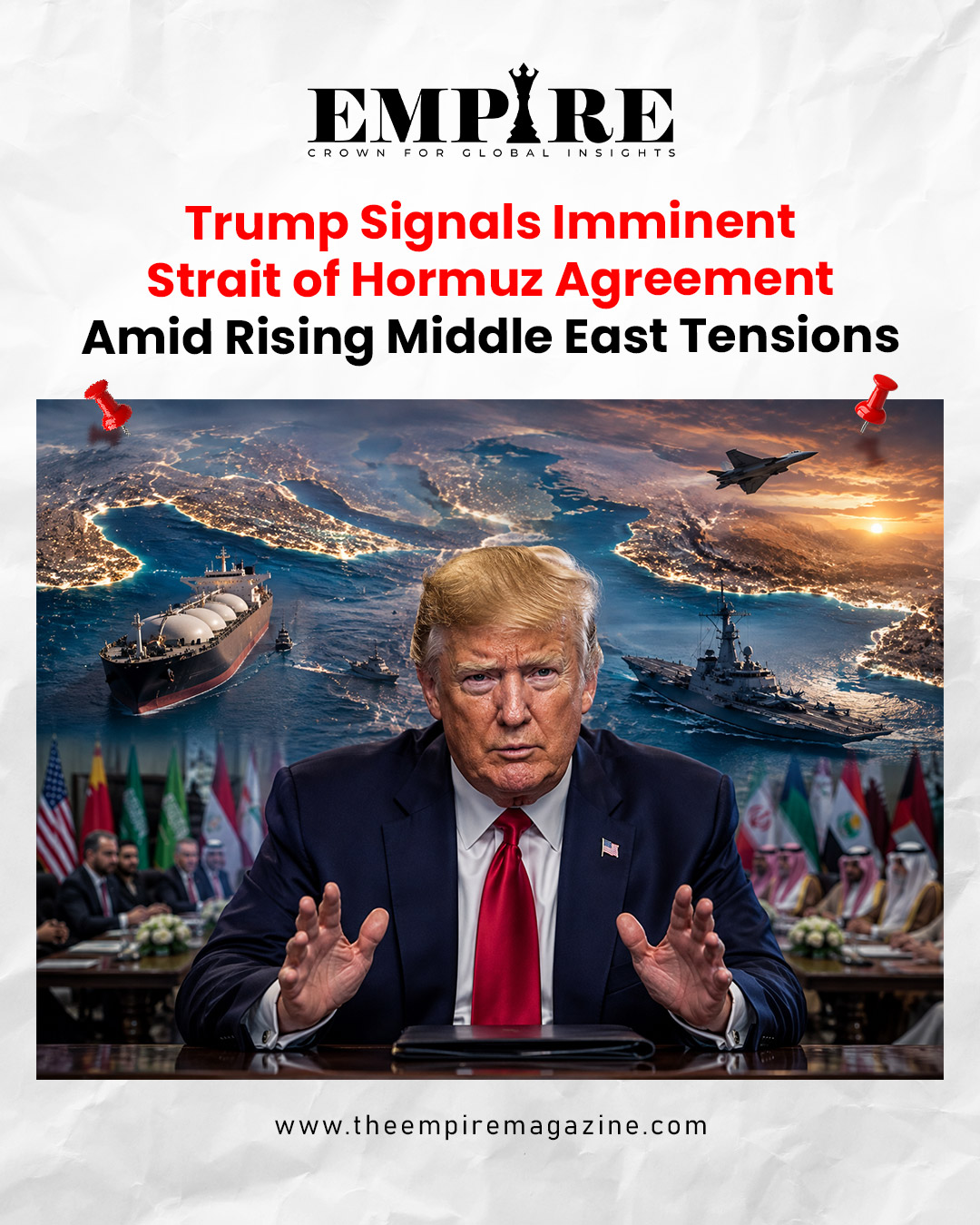
Trump Signals Imminent Strait of Hormuz Agreement Amid Rising Middle East Tensions
For decades, the Strait of Hormuz has remained one of the world’s most strategically important maritime chokepoints, carrying nearly one-fifth of global oil supplies every day. Whenever tensions rise in this narrow passage between Iran and Oman, energy markets react instantly, governments issue warnings, and businesses prepare for economic uncertainty. Now, fresh remarks by former U.S. President Donald Trump suggesting that a Strait of Hormuz Agreement could be announced soon have once again placed the region at the centre of international attention.
The announcement comes at a time when geopolitical tensions continue to shape the Middle East’s security landscape. Maritime attacks, military deployments, sanctions, and diplomatic negotiations have all contributed to an environment where even a small breakthrough could have significant consequences for global trade and energy security. Trump’s statement has therefore generated optimism among investors while also raising questions about what such an agreement might actually involve and whether it could deliver lasting regional stability.
The Strait of Hormuz Agreement Explained
The proposed Strait of Hormuz Agreement revolves around one of the most strategically significant waterways on Earth. Stretching approximately 33 kilometres at its narrowest point, the Strait connects the Persian Gulf to the Gulf of Oman and the Arabian Sea, serving as the primary export route for oil produced by Saudi Arabia, Iraq, Kuwait, the United Arab Emirates, Qatar, and Iran. Every disruption in this maritime corridor immediately affects crude oil prices, shipping insurance costs, and international supply chains. Trump’s recent remarks suggest that diplomatic efforts are underway to reduce tensions surrounding this critical passage. Although the complete details remain undisclosed, analysts believe the discussions may involve guarantees for freedom of navigation, commitments to avoid military escalation, and confidence-building measures among regional stakeholders. Such an agreement would represent more than a political announcement—it would signal renewed efforts to stabilise one of the world’s most volatile regions while reassuring global markets that uninterrupted energy flows remain a shared international priority.
Why the Strait of Hormuz Agreement Matters
The significance of a Strait of Hormuz Agreement extends well beyond the Middle East because the waterway is essential to the functioning of the global economy. Nearly every major industrial nation depends directly or indirectly on the uninterrupted movement of oil and liquefied natural gas through the Strait. When geopolitical tensions threaten maritime traffic, energy prices often surge, inflationary pressures intensify, and financial markets become increasingly volatile. For countries heavily reliant on imported energy, including India, Japan, South Korea, and many European economies, stability in the Strait translates into greater economic certainty. Businesses involved in shipping, logistics, aviation, manufacturing, and transportation closely monitor developments because fluctuations in fuel prices influence operational costs worldwide. Consequently, any credible diplomatic breakthrough capable of reducing security risks in the Strait carries enormous economic significance and is viewed as a positive step towards strengthening international energy resilience.
Trump’s Strait of Hormuz Agreement Signals Renewed Diplomacy
Donald Trump’s comments regarding a possible Strait of Hormuz Agreement have generated widespread debate among foreign policy experts. Throughout his presidency, Trump’s Middle East strategy combined economic sanctions, military deterrence, and diplomatic engagement, particularly concerning Iran and Gulf allies. His latest statement suggests ongoing behind-the-scenes negotiations involving regional governments and international partners seeking to reduce maritime tensions. While no official framework has yet been released, observers believe discussions may include naval de-escalation mechanisms, enhanced communication channels, and mutual commitments aimed at preventing accidental confrontations. Diplomatic progress in such a sensitive region often requires extensive negotiations involving multiple stakeholders with competing interests. Nevertheless, Trump’s remarks have revived hopes that practical cooperation could gradually replace confrontation, offering a pathway toward improved regional security without requiring immediate resolution of broader political disputes that have persisted for decades.
Global Oil Markets Watch the Strait of Hormuz Agreement
Financial markets have reacted cautiously to reports surrounding the Strait of Hormuz Agreement, recognising the enormous influence the region exerts over global energy prices. Oil traders closely analyse every diplomatic statement because even the perception of reduced geopolitical risk can moderate crude prices and improve investor confidence. Energy companies, shipping firms, insurers, and commodity markets understand that stable maritime routes reduce operational uncertainty while encouraging long-term investments. Conversely, renewed tensions or military incidents can trigger immediate spikes in oil prices, increasing costs for consumers and businesses worldwide. Central banks and policymakers also pay close attention because prolonged energy price volatility can affect inflation, interest rates, and economic growth. Should a meaningful agreement emerge, the benefits would likely extend beyond the Gulf, strengthening confidence across international financial markets while supporting more predictable global economic conditions.
Challenges Facing the Strait of Hormuz Agreement
Despite growing optimism, significant obstacles remain before a comprehensive Strait of Hormuz Agreement can become reality. The Middle East continues to experience complex geopolitical rivalries involving Iran, Gulf Cooperation Council members, the United States, Israel, and various regional actors whose strategic priorities frequently diverge. Long-standing disputes over sanctions, nuclear negotiations, maritime security, proxy conflicts, and territorial influence complicate diplomatic progress. Building trust among parties with decades of political disagreements requires sustained dialogue, credible verification mechanisms, and consistent diplomatic engagement. Moreover, isolated security incidents involving commercial vessels or military forces could quickly undermine confidence and derail negotiations. Experts therefore caution against expecting immediate breakthroughs, emphasising that successful agreements often evolve through incremental confidence-building measures rather than sweeping political settlements. Patience, transparency, and continued international cooperation will be essential to transforming political statements into durable regional stability.
Regional Powers and the Strait of Hormuz Agreement
Regional governments recognise that a successful Strait of Hormuz Agreement would provide significant economic and strategic benefits. Gulf nations depend heavily on secure energy exports to sustain national revenues and attract foreign investment, while Iran also relies on maritime trade despite international sanctions. For neighbouring countries, uninterrupted shipping enhances investor confidence, strengthens commercial partnerships, and supports broader economic diversification initiatives. International powers including the United States, European nations, China, and India likewise share a common interest in maintaining safe navigation because global energy security underpins economic growth. Recent years have demonstrated that maritime security cannot rely solely on military deterrence; diplomatic engagement, regional dialogue, and multilateral cooperation have become increasingly important. A carefully negotiated agreement could therefore establish new frameworks for communication, conflict prevention, and maritime coordination that benefit both regional stakeholders and the wider international community.
What the Strait of Hormuz Agreement Means for the World
If successfully concluded, the Strait of Hormuz Agreement could become one of the most consequential diplomatic developments in the Middle East in recent years. Beyond reducing the immediate risk of maritime confrontations, the agreement could strengthen global energy security, stabilise commodity markets, encourage international investment, and improve confidence in diplomatic conflict resolution. Businesses dependent on predictable fuel prices would benefit from greater certainty, while governments could focus more effectively on long-term economic planning rather than responding to repeated geopolitical disruptions. Although substantial challenges remain, the willingness of political leaders to pursue dialogue represents an encouraging sign amid an often volatile regional environment. Trump’s suggestion that an announcement may be imminent has therefore attracted global attention because the outcome has implications reaching far beyond the Gulf, influencing economies, industries, and households around the world.
Strait of Hormuz Agreement arrives at a pivotal moment
The prospect of a Strait of Hormuz Agreement arrives at a pivotal moment when geopolitical stability and energy security have become increasingly interconnected. Donald Trump’s remarks have revived international interest in diplomatic efforts that could reduce tensions in one of the world’s most strategically vital waterways. While negotiations remain complex and uncertainties persist, even incremental progress would represent a meaningful step towards safeguarding global trade, protecting energy supplies, and encouraging regional cooperation. The coming weeks will reveal whether diplomatic optimism translates into tangible outcomes. If successful, the Strait of Hormuz Agreement could reshape Middle Eastern security dynamics while reinforcing confidence across international markets, demonstrating that sustained dialogue remains one of the most effective tools for preserving global stability.
For more business and retail insights, read more on The Empire Magazine
Previous article: https://theempiremagazine.com/mexican-influencer/
Magazine Feautures | Podcasts: Empire Global Talks
Follow The Empire Magazine on Facebook | Instagram | LinkedIn | YouTube
The Empire Magazine | Crown for Global Insights