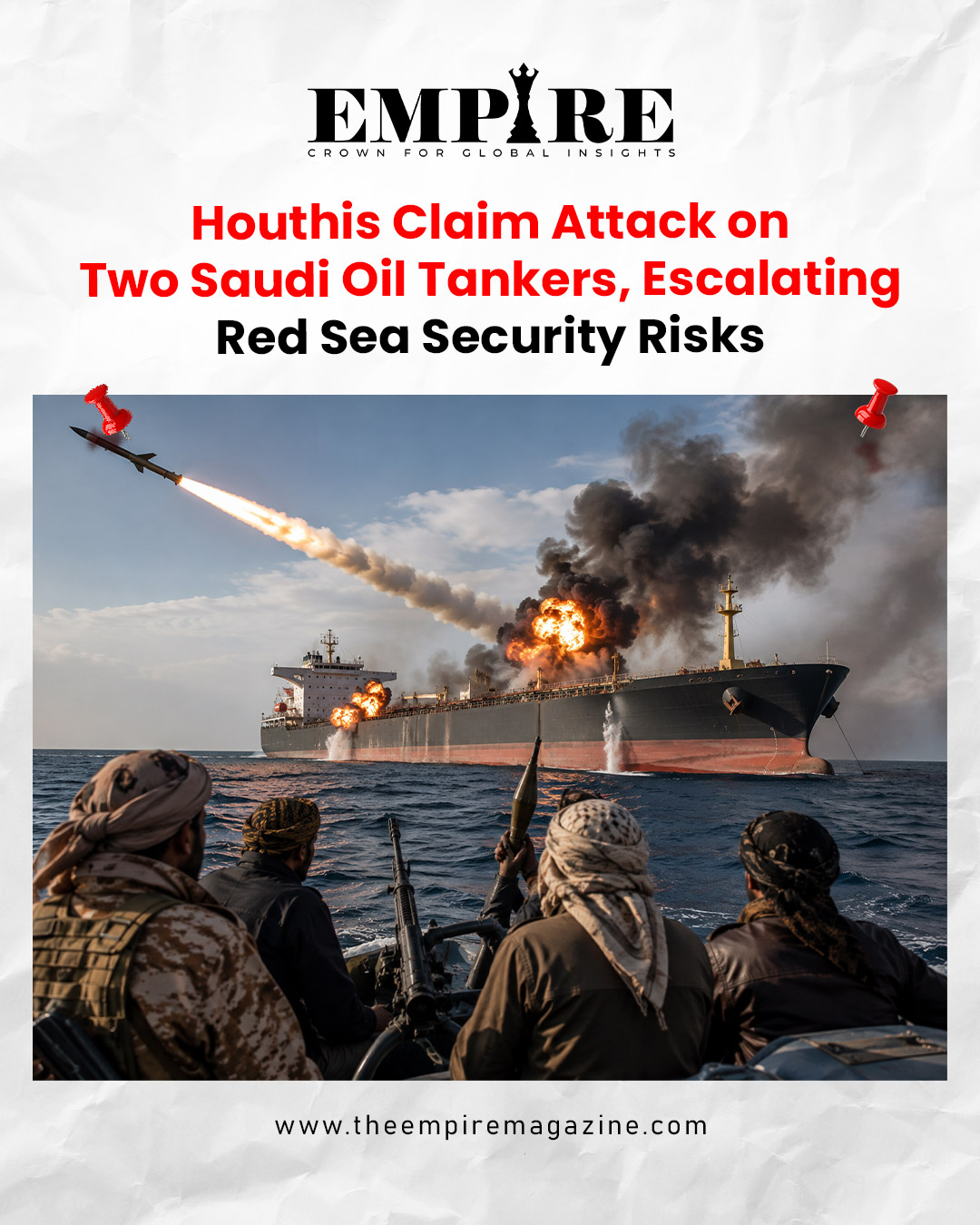
Houthis claim attacks on two Saudi oil tankers, raising fresh Red Sea security risks. Explore the geopolitical impact, global trade concerns, and oil market implications. The Houthis have claimed responsibility for attacks on two Saudi oil tankers in the Red Sea, intensifying concerns over maritime security in one of the world’s busiest trade corridors. The latest escalation threatens global shipping, energy markets, and regional stability while prompting renewed international attention toward the ongoing Yemen conflict.
Houthis Attack on Saudi Oil Tankers Raises Fresh Alarm
The latest Houthis Attack on Saudi Oil Tankers has once again placed the Red Sea at the centre of global geopolitical attention, highlighting how a regional conflict continues to influence international commerce and energy security. Yemen’s Houthi movement announced that it had targeted two Saudi oil tankers operating near the Red Sea, describing the operation as part of its broader military campaign linked to the ongoing regional conflict. While authorities continue to verify the full extent of the damage, the announcement has immediately raised concerns among governments, shipping companies, insurers, and energy markets worldwide. The Red Sea serves as one of the most strategically significant maritime corridors, connecting Europe and Asia through the Suez Canal. Every disruption in this narrow waterway carries consequences that extend far beyond the Middle East. For Saudi Arabia, whose economy remains deeply connected to energy exports despite ongoing diversification efforts, attacks on commercial shipping represent not only a security challenge but also a direct threat to investor confidence and international trade. For the international community, the incident underscores how the Yemen conflict continues to reshape regional stability, demonstrating that maritime security remains vulnerable despite the presence of multinational naval forces. The latest developments also remind businesses and governments that geopolitical tensions can rapidly evolve into global economic concerns.
Houthis Attack on Saudi Oil Tankers Intensifies Red Sea Crisis
The Houthis Attack on Saudi Oil Tankers comes amid months of increasing military activity across the Red Sea, where commercial vessels have repeatedly become targets of missile, drone, and naval attacks. The Houthis have maintained that vessels associated with countries supporting Israel or involved in regional military operations remain legitimate targets, although many commercial operators argue that the attacks have affected ships with little or no connection to the ongoing conflict. This uncertainty has transformed maritime navigation into a high-risk undertaking, forcing shipping companies to invest heavily in additional security measures while reconsidering traditional trade routes. Several shipping operators have already diverted vessels around the Cape of Good Hope instead of using the Red Sea, significantly increasing travel times, operational expenses, and fuel consumption. These changes have affected supply chains worldwide, resulting in higher freight costs and delayed deliveries across industries ranging from manufacturing to consumer goods. The latest attack therefore represents more than another military incident; it reflects an expanding security crisis with growing economic implications. Every strike on commercial shipping further undermines confidence in one of the world’s busiest maritime routes, placing additional pressure on governments seeking to protect international navigation without expanding regional military confrontation.
Red Sea Security Risks Threaten Global Trade
The increasing Red Sea Security Risks extend well beyond the Middle East because the region serves as a vital artery for global commerce. Approximately one-tenth of international trade passes through the Red Sea and the Suez Canal each year, making uninterrupted navigation essential for global supply chains. Oil, liquefied natural gas, food products, automobiles, electronics, and industrial equipment all depend upon safe maritime passage through these waters. When attacks occur, shipping insurers often raise premiums dramatically, increasing transportation costs for businesses and ultimately consumers. Energy markets also react quickly because uncertainty surrounding oil transportation can influence crude prices even when production remains unaffected. Financial markets closely monitor such developments, recognising that sustained disruptions could increase inflationary pressures and slow economic growth in multiple regions. The latest Houthis Attack on Saudi Oil Tankers therefore carries implications far beyond Saudi Arabia and Yemen. European importers, Asian manufacturers, African exporters, and global logistics providers all share a common interest in maintaining secure maritime routes. The interconnected nature of modern trade means that instability in one strategic waterway can ripple through economies worldwide, reinforcing the importance of coordinated international maritime security efforts.
Saudi Arabia Faces Growing Maritime Challenges
For Saudi Arabia, the Houthis Attack on Saudi Oil Tankers highlights the evolving nature of regional security threats. Although the Kingdom has invested significantly in strengthening military capabilities and protecting critical infrastructure, commercial shipping remains vulnerable because of the vast geographical area that must be monitored. Saudi authorities have repeatedly emphasised the importance of securing maritime routes to safeguard energy exports, foreign investment, and regional economic cooperation. The Kingdom’s Vision 2030 strategy seeks to diversify the national economy beyond oil, attract international businesses, and position Saudi Arabia as a global logistics hub. Continued attacks on shipping could complicate these ambitions by increasing operational costs and reinforcing perceptions of regional instability. Nevertheless, Saudi Arabia has continued working with international partners to improve maritime surveillance, intelligence sharing, and naval coordination throughout the Red Sea. These collaborative efforts demonstrate that protecting global trade requires collective responsibility rather than isolated national action. As attacks become increasingly sophisticated through the use of drones, missiles, and unmanned maritime systems, governments must continuously adapt security strategies to address emerging threats while avoiding further escalation that could destabilise the broader Middle East.
Global Powers Respond to Houthis Attack on Saudi Oil Tankers
The international response to the Houthis Attack on Saudi Oil Tankers reflects growing recognition that Red Sea stability has become a global strategic priority. The United States, European nations, Gulf countries, and several international maritime organisations have repeatedly condemned attacks on commercial vessels while expanding naval patrols aimed at safeguarding freedom of navigation. Coalition operations have intercepted missiles, drones, and other threats directed at civilian shipping, yet recurring incidents demonstrate that military protection alone cannot eliminate underlying geopolitical tensions. Diplomats continue advocating renewed peace negotiations for Yemen, recognising that sustainable maritime security ultimately depends upon political solutions rather than solely military responses. At the same time, shipping companies have invested in advanced tracking systems, crisis management protocols, and route planning technologies to minimise operational risks. Financial institutions and insurers are likewise adapting their risk assessments as geopolitical uncertainty becomes an increasingly important factor in global commerce. The latest incident therefore illustrates the complex relationship between regional conflict and international economic stability, reminding policymakers that local disputes can rapidly acquire worldwide consequences when critical trade corridors become involved.
What the Future Holds After the Houthis Attack on Saudi Oil Tankers
The Houthis Attack on Saudi Oil Tankers represents another reminder that the security of international shipping cannot be taken for granted in an increasingly interconnected world. While immediate military responses may help reduce operational threats, lasting stability will depend upon broader diplomatic engagement, regional cooperation, and meaningful progress toward resolving the Yemen conflict. Businesses, investors, and governments will continue monitoring developments closely because every incident influences confidence across global energy and logistics markets. For shipping companies, resilience increasingly means diversifying routes, strengthening contingency planning, and investing in maritime security technologies capable of responding to evolving threats. For policymakers, balancing deterrence with diplomacy will remain essential to preventing wider regional escalation while protecting international commerce. As the Red Sea continues serving as one of the world’s most important maritime corridors, ensuring safe navigation will remain a shared international responsibility. The latest developments demonstrate that geopolitical conflicts no longer remain confined to national borders; instead, they shape global trade, energy security, and economic stability. Whether through diplomatic breakthroughs or strengthened multinational cooperation, the coming months will prove crucial in determining whether tensions ease or whether the Houthis Attack on Saudi Oil Tankers becomes another chapter in an increasingly volatile maritime security landscape.
Significance of the Houthis Attack on Saudi Oil Tankers: Yemen Conflict
To understand the significance of the Houthis Attack on Saudi Oil Tankers, it is essential to look at the broader conflict that has transformed Yemen into one of the Middle East’s most complex geopolitical flashpoints. Since the civil war intensified in 2014, the Houthis have steadily expanded their military capabilities, employing ballistic missiles, armed drones, anti-ship missiles, and naval drones to challenge regional adversaries. What initially appeared to be a domestic conflict has gradually evolved into an international security concern, drawing in Gulf nations, global powers, and international organisations. The Red Sea has increasingly become a strategic battlefield because of its importance to international trade and military positioning. Every attack on commercial shipping demonstrates how non-state actors are capable of influencing global commerce through relatively low-cost but highly disruptive military tactics. Analysts note that the Houthis have adapted their strategies by targeting vessels they associate with regional opponents, making maritime traffic an extension of the wider geopolitical confrontation. As a result, shipping companies are now operating in an environment where commercial decisions are closely linked with military developments, creating uncertainty that affects logistics, investment, and international confidence. The continued instability also places humanitarian concerns at the forefront, as prolonged conflict has devastated Yemen’s economy, displaced millions, and deepened one of the world’s worst humanitarian crises, making peaceful resolution increasingly urgent for both regional stability and global security.
Houthis Attack on Saudi Oil Tankers Impacts Global Energy Markets
The economic consequences of the Houthis Attack on Saudi Oil Tankers extend well beyond the immediate security incident because energy markets are highly sensitive to geopolitical disruptions. Saudi Arabia remains one of the world’s largest oil exporters, supplying millions of barrels of crude oil daily to markets across Asia, Europe, and North America. Even when attacks do not significantly damage infrastructure, the perception of increased risk can influence crude oil prices, freight rates, insurance premiums, and investor sentiment. Energy traders closely monitor developments in the Red Sea because any prolonged disruption could affect supply chains, refinery operations, and fuel prices worldwide. Insurance providers have already designated several parts of the Red Sea as high-risk zones, leading to substantial increases in war-risk premiums for commercial vessels. These additional costs are eventually passed along the supply chain, affecting businesses and consumers alike. Economists warn that sustained disruptions could contribute to inflationary pressures by increasing transportation expenses for goods ranging from fuel and food to electronics and industrial materials. Meanwhile, governments are reviewing strategic petroleum reserves and contingency plans to minimise the impact of potential supply interruptions. The latest incident therefore serves as another reminder that maritime security has become inseparable from global economic resilience, with the stability of shipping lanes directly influencing international markets and long-term energy security.
Why International Cooperation Matters After the Houthis Attack on Saudi Oil Tankers
The recurring Houthis Attack on Saudi Oil Tankers underscores the growing need for coordinated international action to protect one of the world’s most critical maritime corridors. While naval patrols and military escorts have helped intercept numerous threats, experts increasingly argue that sustainable security requires a combination of diplomatic engagement, intelligence sharing, technological innovation, and regional cooperation. International organisations continue encouraging dialogue aimed at reducing hostilities while ensuring freedom of navigation under international maritime law. Governments are also investing in advanced surveillance systems, satellite monitoring, artificial intelligence-driven threat detection, and enhanced naval coordination to identify emerging risks before they escalate. At the same time, shipping companies are strengthening crisis response protocols, training crews for hostile environments, and adopting more sophisticated route-planning technologies to minimise exposure to danger. These combined efforts reflect an understanding that safeguarding global trade cannot depend solely on military deterrence but must also address the political and humanitarian factors that fuel regional instability. As geopolitical tensions continue evolving, the international community faces the challenge of protecting commercial shipping while avoiding actions that could further intensify conflict. The future of the Red Sea will therefore depend not only on military preparedness but also on successful diplomacy capable of reducing tensions and restoring long-term stability across one of the world’s most strategically important waterways.
Houthis Attack on Saudi Oil Tankers is far more than another headline emerging from an already volatile region
The Houthis Attack on Saudi Oil Tankers is far more than another headline emerging from an already volatile region it is a stark reminder of how regional conflicts can quickly reshape global economic and security dynamics. As attacks on commercial shipping become increasingly frequent and sophisticated, the Red Sea has transformed into one of the world’s most closely watched maritime corridors. For Saudi Arabia, protecting energy infrastructure and shipping routes remains central to both national security and long-term economic ambitions. For the international community, the challenge lies in preserving freedom of navigation while preventing further escalation that could destabilise the broader Middle East.
Beyond the immediate military implications, the incident highlights the fragile balance upon which global trade depends. A single disruption along a strategic shipping lane can trigger higher freight costs, increased insurance premiums, fluctuations in oil prices, and delays across international supply chains. Businesses, investors, and policymakers are therefore paying close attention not only to military developments but also to diplomatic initiatives that could restore confidence in one of the world’s busiest maritime routes.
The path forward will require more than naval deployments and defensive operations. Lasting stability will depend upon meaningful diplomatic engagement, regional cooperation, intelligence sharing, and renewed efforts to resolve the underlying conflict in Yemen. As governments strengthen maritime security frameworks and shipping companies adapt to evolving threats, international collaboration will remain essential in safeguarding global commerce.
Ultimately, the Houthis Attack on Saudi Oil Tankers demonstrates that maritime security is no longer merely a regional concern it has become a defining issue for global economic resilience. The decisions taken by regional powers, international organisations, and global stakeholders in the coming months will shape not only the future of the Red Sea but also the stability of international trade, energy markets, and geopolitical relations for years to come.
For more business and retail insights, read more on The Empire Magazine
Previous article: https://theempiremagazine.com/mexican-influencer/
Magazine Feautures | Podcasts: Empire Global Talks
Follow The Empire Magazine on Facebook | Instagram | LinkedIn | YouTube
The Empire Magazine | Crown for Global Insights