
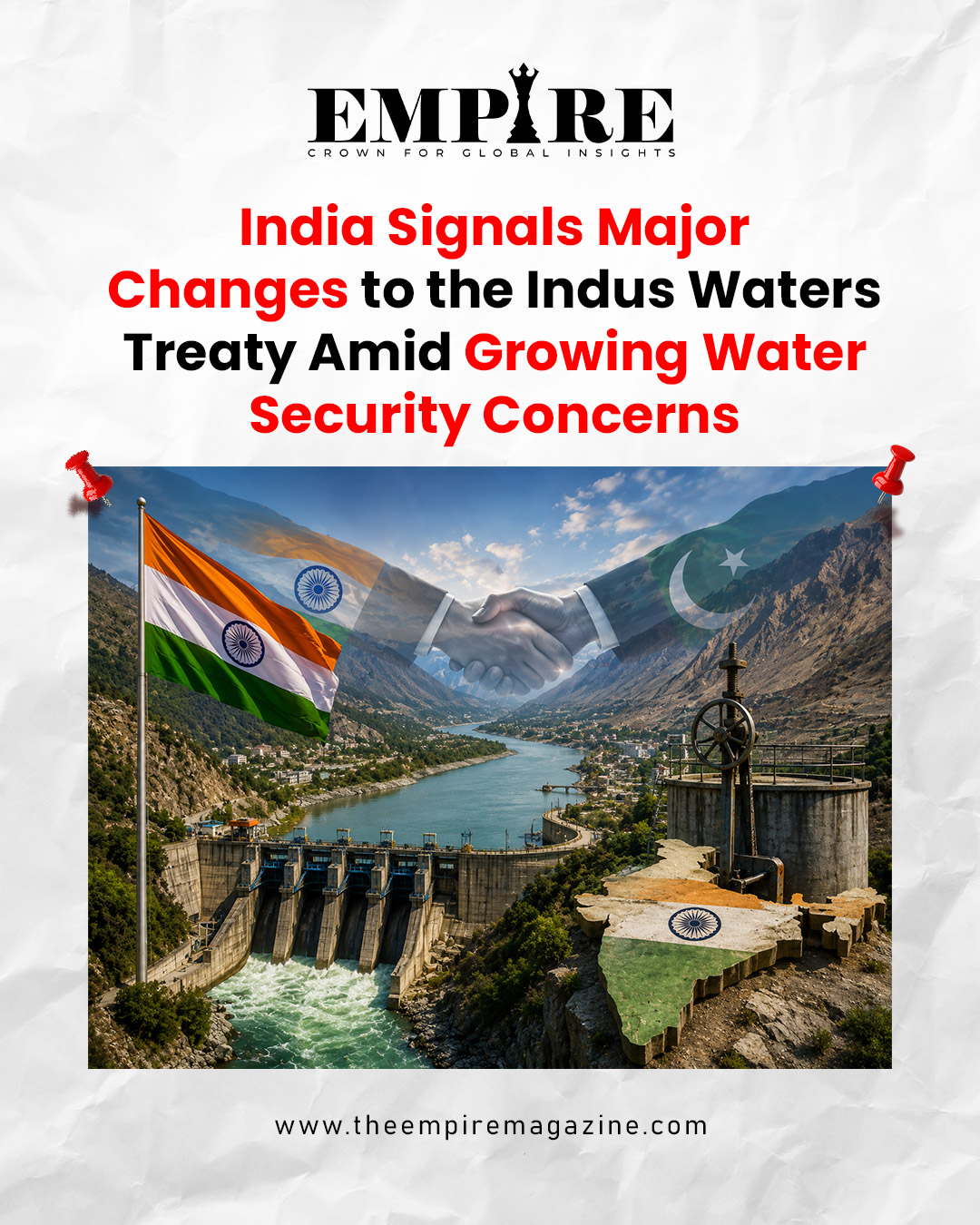
India signals major changes to the Indus Waters Treaty as water security concerns rise. Explore the treaty’s future, geopolitical impact, and regional implications. India Signals Major Changes to the Indus Waters Treaty as New Delhi reassesses one of South Asia’s most significant water-sharing agreements amid evolving security challenges. The move reflects India’s increasing focus on water security, infrastructure development, climate resilience, and strategic policymaking, with potential implications for regional diplomacy and long-term resource management.
India Signals Major Changes to the Indus Waters Treaty
For more than six decades, the Indus Waters Treaty has stood as one of the world’s most enduring international water-sharing agreements, surviving wars, diplomatic crises, and prolonged political tensions between India and Pakistan. Signed in 1960 with the support of the World Bank, the treaty established a framework for sharing the waters of the Indus River system, allowing both nations to utilize designated rivers while ensuring cooperation through technical mechanisms and dispute resolution processes. Today, however, India Signals Major Changes to the Indus Waters Treaty, reflecting a broader shift in national priorities driven by rising water demand, infrastructure expansion, climate uncertainty, and heightened security considerations. Indian policymakers increasingly argue that agreements negotiated more than sixty years ago should evolve alongside changing geopolitical realities and domestic development needs. Rapid urbanisation, industrial growth, expanding agricultural requirements, and the growing need for renewable hydroelectric power have intensified discussions regarding how India’s allocated water resources should be managed more efficiently. The renewed debate is therefore not merely about diplomacy with Pakistan but also about India’s long-term strategy for water security, economic resilience, and sustainable development. As water becomes one of the most valuable strategic resources of the twenty-first century, India’s evolving position on the treaty has attracted international attention and sparked important conversations about balancing regional stability with national interests.
Why India Signals Major Changes to the Indus Waters Treaty
The decision behind India Signals Major Changes to the Indus Waters Treaty stems from a combination of strategic, environmental, and developmental factors rather than a single political event. Officials have repeatedly stated that India’s growing population and expanding economy require better utilisation of every available natural resource, particularly freshwater. Although the treaty grants India rights over the eastern rivers while allowing limited use of the western rivers for hydropower and irrigation, policymakers believe that administrative delays, legal disputes, and procedural challenges have often slowed infrastructure development. At the same time, recurring cross-border tensions have prompted security experts to question whether agreements established under vastly different geopolitical conditions remain fully aligned with today’s realities. India’s leadership has increasingly linked water management to national security, arguing that protecting critical resources has become as important as safeguarding territorial boundaries. The government has simultaneously accelerated investments in dams, irrigation systems, flood management projects, and hydroelectric facilities aimed at supporting both economic growth and environmental sustainability. These developments indicate that India’s reassessment of the treaty represents a broader policy evolution focused on ensuring that domestic water resources are utilised responsibly while remaining consistent with international obligations wherever possible.
India Signals Major Changes to the Indus Waters Treaty and Water Security
As India Signals Major Changes to the Indus Waters Treaty, water security has emerged as the central theme driving public debate. India faces increasing pressure from rapid population growth, changing rainfall patterns, groundwater depletion, and recurring droughts across several states. Climate scientists have repeatedly warned that Himalayan glaciers—the primary source of the Indus River system—are experiencing significant changes due to rising global temperatures, creating long-term uncertainty regarding river flows. These environmental realities require governments to adopt more flexible and resilient water management strategies than those envisioned when the treaty was drafted in 1960. Indian planners argue that improving storage capacity, modernising irrigation infrastructure, reducing water wastage, and expanding hydropower generation are essential for ensuring food security and economic stability. Water security is no longer viewed solely through an agricultural lens but also as an issue affecting energy production, urban development, disaster preparedness, and industrial competitiveness. Consequently, discussions surrounding the treaty increasingly intersect with broader national initiatives focused on climate adaptation, sustainable infrastructure, and integrated river basin management. The emphasis on efficient resource utilisation reflects India’s recognition that future prosperity depends heavily on securing reliable freshwater supplies amid mounting environmental challenges.
India Signals Major Changes to the Indus Waters Treaty: Pakistan’s Concerns
While India Signals Major Changes to the Indus Waters Treaty, Pakistan has expressed significant concern regarding the possible implications for downstream water availability and regional stability. Pakistan’s agricultural economy depends heavily on the Indus River system, with millions of farmers relying on consistent water flows for irrigation, food production, and rural livelihoods. Any perception of reduced water access naturally generates political sensitivity and public anxiety. Pakistani officials have consistently maintained that the treaty remains a cornerstone of regional cooperation and have called for continued adherence to its established mechanisms for technical consultation and dispute resolution. International observers note that although disagreements regarding hydroelectric projects and infrastructure development have occurred repeatedly over the decades, the treaty has largely continued to function even during periods of heightened diplomatic tension. This historical resilience has often been cited as evidence that water cooperation can survive broader political disagreements. Nevertheless, analysts also acknowledge that changing environmental conditions, increasing water scarcity, and evolving security dynamics may require both countries to strengthen dialogue, improve transparency, and modernise institutional cooperation to prevent future misunderstandings while ensuring equitable and sustainable water management.
India Signals Major Changes to the Indus Waters Treaty and Climate Challenges
Climate change has become one of the strongest reasons why India Signals Major Changes to the Indus Waters Treaty now resonates beyond traditional geopolitical debates. Scientists increasingly warn that unpredictable monsoon patterns, glacier retreat, extreme flooding, prolonged droughts, and rising temperatures are reshaping the hydrology of the entire Indus basin. Such changes create uncertainty not only for governments but also for millions of families whose livelihoods depend directly on agriculture, fisheries, and local water supplies. Water-sharing agreements negotiated under historical climate conditions may face growing pressure as environmental realities continue to evolve. Experts argue that future cooperation should include advanced forecasting technologies, satellite monitoring, real-time hydrological data sharing, improved flood warning systems, and collaborative scientific research to strengthen resilience across the basin. Sustainable river management will likely require greater investment in conservation, watershed restoration, efficient irrigation techniques, and climate-resilient infrastructure capable of adapting to increasingly volatile weather patterns. These measures would benefit both countries regardless of political differences because water security is ultimately a shared regional challenge shaped by forces that extend beyond national borders.
India Signals Major Changes to the Indus Waters Treaty: Future Outlook
Looking ahead, India Signals Major Changes to the Indus Waters Treaty is likely to remain a defining issue in South Asian diplomacy for years to come. While India continues to emphasise its sovereign right to maximise legitimate utilisation of its allocated water resources, the international community will closely observe how future policy decisions align with regional stability and international commitments. The treaty’s future may ultimately depend less on political rhetoric and more on practical cooperation involving scientific expertise, engineering innovation, climate adaptation, and transparent communication between both countries. Water has increasingly become a strategic asset comparable to energy, technology, and food security, making effective governance essential for long-term peace and development. India’s infrastructure ambitions, combined with the urgent need to prepare for climate-related risks, suggest that policy evolution is inevitable. However, sustainable progress will require balancing national development objectives with responsible stewardship of shared natural resources. If managed carefully, modernisation efforts could create opportunities for improved efficiency, stronger resilience, and more effective regional water governance rather than prolonged confrontation.
India Signals Major Changes to the Indus Waters Treaty
The debate surrounding India Signals Major Changes to the Indus Waters Treaty reflects far more than a bilateral diplomatic issue. It highlights the growing importance of water security in an era shaped by climate change, population growth, infrastructure expansion, and geopolitical competition. As India reassesses one of the world’s oldest international water agreements, the outcome will influence not only relations with Pakistan but also broader discussions about sustainable resource management across South Asia. Balancing development, environmental responsibility, and regional cooperation will be essential for ensuring that future generations inherit a stable and resilient water system. Whether through policy reforms, technological innovation, or strengthened diplomatic engagement, the evolving conversation around the Indus Waters Treaty demonstrates that freshwater will remain one of the defining strategic resources of the twenty-first century.
For more business and retail insights, read more on The Empire Magazine
Previous article: https://theempiremagazine.com/russia-military-support/
Magazine Feautures | Podcasts: Empire Global Talks
Follow The Empire Magazine on Facebook | Instagram | LinkedIn | YouTube
The Empire Magazine | Crown for Global Insights