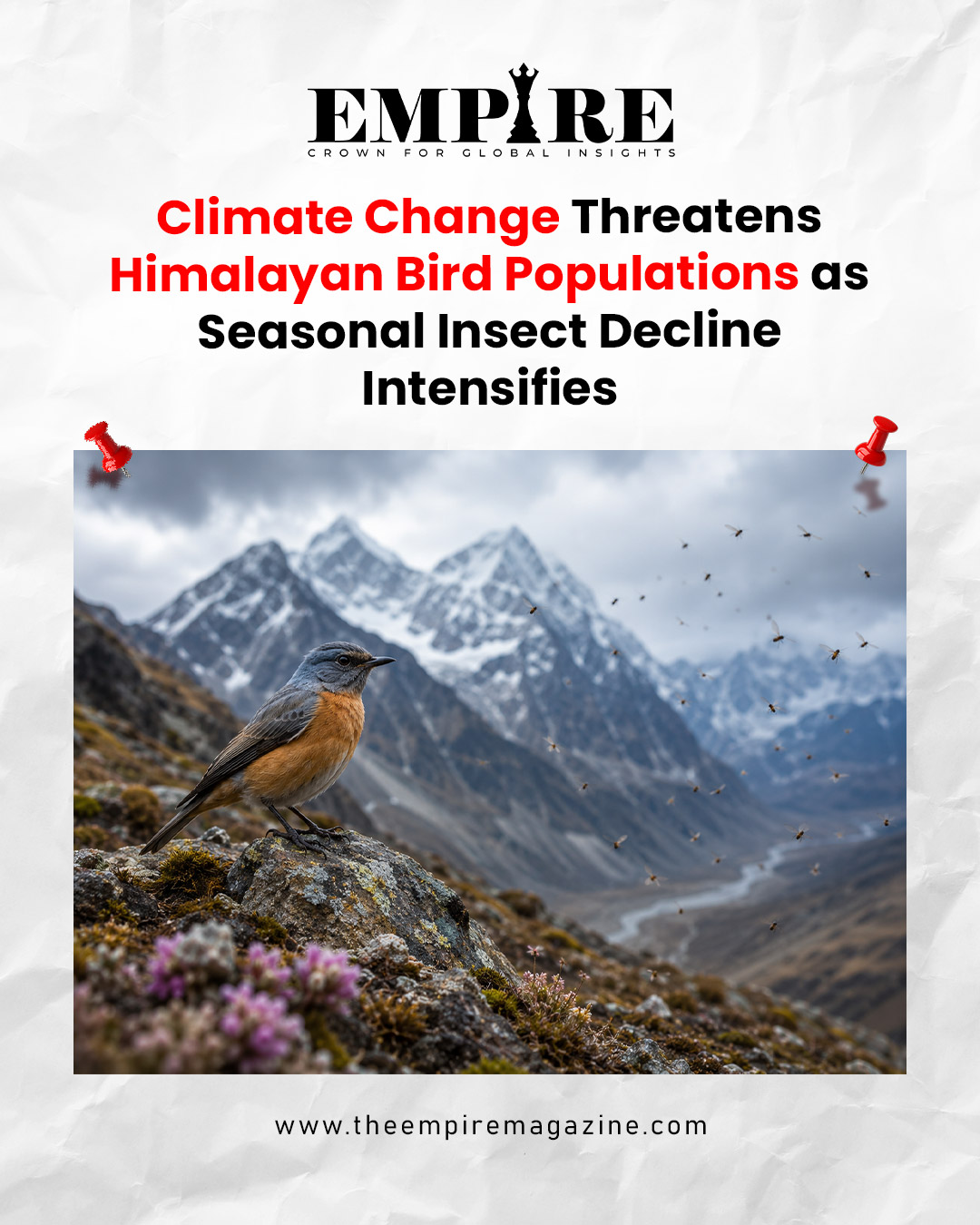
Climate change is disrupting Himalayan bird populations as seasonal insect decline threatens breeding, biodiversity, and fragile mountain ecosystems. Climate Change Threatens Himalayan Bird Populations as rising temperatures and changing weather patterns reduce seasonal insect populations. Scientists warn that this ecological imbalance is affecting breeding success, migration, and biodiversity across the Himalayan ecosystem, highlighting the urgent need for climate action and conservation.
Climate Change Threatens Himalayan Bird Populations as Seasonal Insect Decline Intensifies
The Himalayas have long been recognised as one of the world’s richest biodiversity hotspots, home to thousands of species that have evolved in delicate balance with nature over millions of years. From snow-covered peaks to lush alpine forests, these mountains provide refuge to hundreds of bird species whose survival depends on predictable seasonal changes. However, scientists are now raising alarms that Climate Change Threatens Himalayan Bird Populations more seriously than ever before, as warming temperatures and erratic weather patterns disrupt one of nature’s most essential food chains the seasonal emergence of insects.
The decline in insects may appear insignificant at first glance, but it has profound consequences for birds that rely on them during breeding seasons. Across several Himalayan regions, researchers have observed that insects are emerging earlier, disappearing faster, or declining altogether because of shifting climatic conditions. This mismatch between insect availability and bird breeding cycles is reducing the survival chances of chicks, weakening bird populations, and threatening an ecosystem that millions of people indirectly depend upon.
Himalayas are often described as Asia’s water tower
The Himalayas are often described as Asia’s water tower because they influence weather systems and freshwater supplies for billions of people. Their ecological health extends far beyond mountain communities. As Climate Change Threatens Himalayan Bird Populations, it also signals deeper environmental disruptions affecting forests, pollination, agriculture, and overall biodiversity. Understanding this growing crisis is essential not only for conservationists but for everyone concerned about climate resilience and the future of our planet.
Climate Change Threatens Himalayan Bird Populations Across Fragile Ecosystems
The Himalayan ecosystem has always functioned through remarkable synchronisation between seasonal weather, flowering plants, insect emergence, and bird breeding. Birds such as flycatchers, warblers, tits, and various migratory species depend on a brief but abundant supply of insects to feed their young during spring and early summer. Rising global temperatures, however, are altering snowfall patterns, accelerating glacier melt, and changing rainfall cycles. These climatic shifts have caused insects to emerge earlier than usual or decline significantly due to habitat stress, leaving birds struggling to find adequate food when chicks hatch. Scientists studying Himalayan biodiversity explain that even a difference of a few weeks in seasonal timing can create ecological mismatches with lasting consequences. Forest habitats are also shifting to higher elevations as temperatures rise, forcing both insects and birds to migrate uphill in search of suitable conditions. Unfortunately, higher elevations provide limited habitat, increasing competition among species and reducing available nesting sites. This ecological imbalance demonstrates why Climate Change Threatens Himalayan Bird Populations on multiple fronts, affecting not only food availability but also migration routes, breeding success, habitat stability, and long-term survival.
Climate Change Threatens Himalayan Bird Populations Through Insect Decline
Seasonal insect decline has emerged as one of the most worrying consequences of climate change in mountain ecosystems. Insects are highly sensitive to temperature and moisture changes, making them among the first organisms to respond to environmental disturbances. Warmer winters reduce natural population cycles, while unpredictable rainfall affects breeding habitats for butterflies, moths, beetles, caterpillars, and other insects that birds depend upon. Research across Himalayan forests indicates that insect abundance has become increasingly inconsistent, with some species appearing weeks earlier than usual and others declining sharply because of prolonged dry spells or sudden storms. For birds raising young chicks, timing is everything. Nestlings require protein-rich insects for healthy development, and even short periods of food shortage can lead to reduced survival rates. Parents must travel longer distances to find prey, expending valuable energy while exposing nests to predators. Experts warn that Climate Change Threatens Himalayan Bird Populations because these repeated seasonal disruptions reduce reproductive success year after year, eventually leading to measurable population declines among species already vulnerable to habitat loss and environmental degradation.
Climate Change Threatens Himalayan Bird Populations During Breeding Season
Breeding season represents the most critical period in the life cycle of Himalayan birds, making them particularly vulnerable to climatic changes. Many species have evolved to lay eggs at precisely the moment when insect populations reach their seasonal peak. Climate change is disrupting this synchronisation, creating what ecologists describe as a “phenological mismatch.” Birds often begin nesting based on daylight duration, while insects respond primarily to temperature changes. As temperatures rise earlier each year, insects may complete their life cycles before chicks hatch, leaving insufficient food during the most demanding growth period. Researchers monitoring Himalayan forests have already documented reduced chick weights, slower development, and lower fledging success among several insect-eating species. These impacts extend beyond individual birds because fewer surviving chicks mean declining populations over successive generations. In addition, unpredictable weather events, including intense rainfall and heatwaves, damage nests and reduce adult feeding opportunities. Consequently, Climate Change Threatens Himalayan Bird Populations by disrupting breeding success, weakening reproductive outcomes, and reducing the resilience of bird communities that have adapted to stable seasonal rhythms over centuries.
Climate Change Threatens Himalayan Bird Populations and Biodiversity
Birds play an essential role in maintaining Himalayan biodiversity, making their decline far more significant than the loss of individual species. Many birds help control insect populations naturally, disperse seeds across forests, pollinate flowering plants, and contribute to ecological balance through interconnected food webs. As bird populations decrease, these ecosystem services become weaker, potentially accelerating forest degradation and reducing biodiversity across mountain landscapes. Climate change compounds these challenges by increasing wildfire risks, altering vegetation patterns, and encouraging invasive species that further disrupt native ecosystems. Conservationists emphasise that Climate Change Threatens Himalayan Bird Populations because environmental pressures rarely occur in isolation. Habitat fragmentation from roads, tourism infrastructure, expanding settlements, and unsustainable land use already limits movement between suitable habitats. Combined with declining insect populations and changing weather patterns, these pressures create cumulative risks that many species may struggle to overcome. Since the Himalayas support numerous endemic and migratory birds found nowhere else on Earth, protecting these ecosystems has become a global conservation priority with implications extending far beyond South Asia.
Climate Change Threatens Himalayan Bird Populations Despite Adaptation
Nature possesses remarkable resilience, and some Himalayan bird species are attempting to adapt to changing environmental conditions. Scientists have observed certain birds adjusting migration schedules, nesting earlier, or shifting their ranges to higher elevations where temperatures remain cooler. However, adaptation has clear limits. Mountains provide finite space, and species cannot continue moving uphill indefinitely. Beyond certain elevations, suitable vegetation disappears, oxygen levels decrease, and nesting habitats become scarce. Similarly, insects themselves face environmental constraints that prevent them from adapting rapidly enough to shifting climates. Human intervention therefore becomes increasingly important. Conservation programmes focused on restoring forests, protecting natural habitats, reducing pollution, and limiting unsustainable development can improve ecosystem resilience. Monitoring insect populations alongside bird breeding patterns also enables researchers to identify vulnerable species before declines become irreversible. Governments, local communities, scientists, and conservation organisations must collaborate because Climate Change Threatens Himalayan Bird Populations in ways that require coordinated action combining climate mitigation with ecosystem restoration and long-term biodiversity management.
Climate Change Threatens Himalayan Bird Populations: The Road Ahead
The growing evidence surrounding Himalayan ecosystems serves as a powerful reminder that climate change is no longer a distant possibility but a present-day ecological reality. The disappearance of seasonal insects may seem like a minor environmental change, yet it reflects a chain reaction capable of reshaping entire ecosystems. When birds lose their primary food source during breeding season, the consequences ripple across forests, wildlife populations, agriculture, and human livelihoods that depend upon healthy mountain environments. Scientists continue to emphasise that reducing greenhouse gas emissions remains the most effective long-term solution, while conservation measures can help vulnerable species adapt during this period of rapid environmental transformation. Protecting forest corridors, preserving biodiversity hotspots, encouraging sustainable tourism, and supporting scientific research will all play essential roles in safeguarding the Himalayas. Ultimately, Climate Change Threatens Himalayan Bird Populations because it disrupts the natural relationships that sustain life in one of Earth’s most extraordinary mountain ecosystems. Responding to this challenge requires global commitment, informed policymaking, and collective responsibility to ensure that future generations inherit Himalayan landscapes still filled with thriving birdlife and the vibrant biodiversity that has defined these mountains for centuries.
For more business and retail insights, read more on The Empire Magazine
Previous article: https://theempiremagazine.com/pfizers-prostate-cancer/
Magazine Feautures | Podcasts: Empire Global Talks
Follow The Empire Magazine on Facebook | Instagram | LinkedIn | YouTube
The Empire Magazine | Crown for Global Insights