
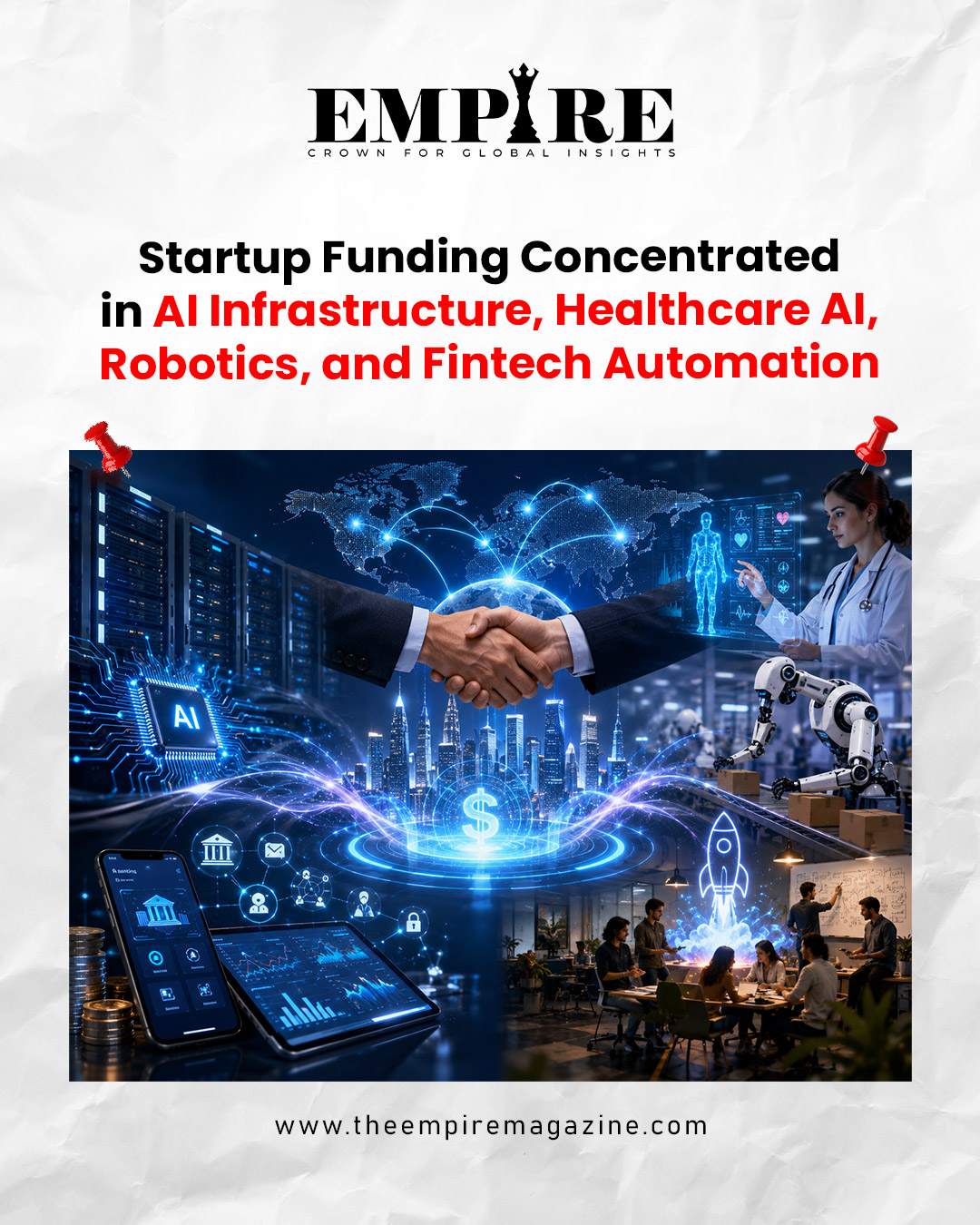
Startup funding is increasingly flowing into AI infrastructure, healthcare AI, robotics, and fintech automation as investors prioritize scalable innovation. Startup funding is witnessing a significant transformation as investors increasingly back AI infrastructure, healthcare AI, robotics, and fintech automation. Rather than spreading investments across multiple sectors, venture capital firms are focusing on technologies that promise long-term scalability, productivity gains, and sustainable economic impact, shaping the next generation of global innovation.
Startup Funding Enters a New Investment Era
The global startup ecosystem is experiencing one of its biggest shifts in investment strategy. After years of aggressive funding across diverse consumer applications, venture capital firms are becoming increasingly selective, directing capital toward technologies capable of transforming entire industries rather than solving isolated problems. As economic uncertainty, higher interest rates, and increased investor scrutiny reshape funding decisions, startup funding is now concentrating around sectors that offer measurable long-term value. Artificial intelligence infrastructure, healthcare AI, robotics, and fintech automation have emerged as the clear winners because they combine scalable technology with enormous commercial demand. Investors are no longer chasing growth at any cost; instead, they are seeking businesses with defensible intellectual property, recurring revenue models, enterprise adoption, and the ability to become foundational technology providers. This strategic shift reflects a broader understanding that future economic growth will be driven by intelligent systems capable of improving productivity, reducing operational costs, and supporting digital transformation across industries. From multinational corporations to government-backed innovation funds, capital is increasingly flowing toward startups building the technology backbone of tomorrow rather than simply creating another consumer application.
Why Startup Funding Is Focusing on AI Infrastructure
Startup funding has increasingly shifted toward AI infrastructure because every artificial intelligence application ultimately depends on powerful computing resources, advanced semiconductors, cloud platforms, high-speed networking, cybersecurity, and efficient data management. The rapid adoption of generative AI has created unprecedented demand for GPU clusters, AI data centers, inference platforms, model optimization software, and cloud-native development tools, making infrastructure companies some of the most attractive investment opportunities in today’s venture capital landscape. Investors recognize that while consumer AI applications may come and go, the infrastructure supporting them will continue to generate long-term demand as enterprises expand their AI capabilities. Governments are also investing heavily in sovereign AI initiatives, semiconductor manufacturing, and domestic computing capacity, creating additional momentum for infrastructure-focused startups. As organizations across finance, manufacturing, retail, healthcare, logistics, and education deploy AI at scale, infrastructure providers become indispensable partners, offering predictable revenue streams and long-term enterprise contracts that significantly reduce investment risk while creating substantial opportunities for sustained business growth.
Startup Funding Drives Healthcare AI Innovation
Healthcare AI has rapidly become one of the strongest recipients of startup funding because the sector combines technological innovation with meaningful social impact. Artificial intelligence is improving medical diagnostics, accelerating drug discovery, supporting precision medicine, optimizing hospital operations, enabling predictive healthcare, and reducing administrative burdens that have traditionally consumed healthcare resources. Investors increasingly view healthcare AI as a high-impact sector capable of delivering both financial returns and measurable improvements in patient outcomes. The growing availability of digital health records, wearable devices, medical imaging datasets, and genomic information has significantly expanded opportunities for AI-driven innovation, while healthcare providers continue seeking technologies that improve efficiency amid rising operational costs and workforce shortages. Regulatory agencies are also developing clearer approval pathways for AI-powered medical technologies, encouraging greater confidence among investors. Rather than replacing healthcare professionals, AI is becoming an intelligent assistant that helps doctors make faster, more accurate clinical decisions, ultimately creating a healthcare ecosystem that is more proactive, personalized, and accessible for millions of patients worldwide.
Robotics Startup Funding Expands Across Industries
Startup funding for robotics has accelerated as businesses increasingly seek automation solutions to overcome labor shortages, improve operational efficiency, and enhance workplace safety. Modern robotics has evolved far beyond industrial assembly lines, with intelligent machines now supporting logistics, warehouse management, agriculture, healthcare, manufacturing, hospitality, defense, and even retail operations. Advances in computer vision, machine learning, sensor technology, edge computing, and autonomous navigation have dramatically expanded the capabilities of robotic systems, making them more adaptable and commercially viable than ever before. Investors are particularly attracted to robotics startups that integrate artificial intelligence into autonomous decision-making, enabling machines to operate efficiently in dynamic environments without continuous human supervision. The rise of collaborative robots, autonomous delivery systems, surgical robotics, warehouse automation, and agricultural robots demonstrates how robotics is becoming an essential productivity tool rather than an experimental technology. As demographic shifts create labor shortages across developed economies, demand for intelligent automation is expected to continue growing, strengthening investor confidence in robotics startups capable of delivering scalable enterprise solutions.
Fintech Automation Continues to Attract Startup Funding
Fintech automation remains one of the strongest areas of startup funding because financial institutions continue pursuing digital transformation at an unprecedented pace. Artificial intelligence, machine learning, robotic process automation, and advanced analytics are helping banks, insurance companies, payment providers, and financial technology firms streamline operations while improving customer experiences. Automated fraud detection, AI-powered lending, intelligent compliance systems, digital wealth management, personalized financial planning, and embedded finance solutions are transforming how financial services are delivered. Investors recognize that financial institutions operate within highly regulated environments where automation can significantly reduce operational costs while increasing compliance accuracy and reducing human error. Small and medium-sized businesses are also driving demand for automated accounting, payroll, invoicing, expense management, and cash-flow forecasting platforms, creating substantial market opportunities for fintech startups. As digital payments continue expanding globally and financial inclusion becomes a policy priority across many economies, automation technologies are enabling financial services to become faster, safer, and more accessible, making fintech one of the most resilient sectors for venture capital investment.
What Startup Funding Means for Founders and Investors
The concentration of startup funding around AI infrastructure, healthcare AI, robotics, and fintech automation reflects a broader evolution in how investors evaluate innovation. Capital is increasingly flowing toward startups capable of solving fundamental business challenges instead of simply creating consumer convenience. Founders entering these sectors are expected to demonstrate strong technical expertise, scalable business models, measurable customer traction, and clear paths toward profitability. Enterprise customers now demand technologies that integrate seamlessly with existing systems while delivering quantifiable operational improvements, making execution just as important as innovation. Investors are also placing greater emphasis on responsible AI development, cybersecurity resilience, regulatory compliance, and sustainable growth strategies. This environment favors startups capable of building long-term competitive advantages through proprietary technology, high switching costs, and recurring enterprise revenue. Rather than pursuing rapid expansion without clear business fundamentals, today’s funding landscape rewards disciplined execution, strong governance, and products that become critical infrastructure for businesses navigating digital transformation.
The Future of Startup Funding Is Built Around Intelligent Technologies
The future of startup funding is increasingly defined by technologies that strengthen global digital infrastructure while solving complex real-world challenges. Artificial intelligence, robotics, healthcare innovation, and financial automation are no longer emerging trends but strategic priorities shaping the next decade of economic growth. Governments continue supporting domestic innovation ecosystems through AI missions, research grants, semiconductor investments, healthcare modernization programs, and digital finance initiatives, while corporations are expanding partnerships with startups to accelerate technological adoption. Venture capital firms are expected to remain focused on companies capable of delivering scalable enterprise solutions with sustainable competitive advantages rather than short-lived market excitement. For entrepreneurs, this represents an opportunity to build businesses that address structural challenges facing industries worldwide, from healthcare accessibility and financial inclusion to industrial productivity and intelligent automation. Startup funding is therefore becoming less about speculative growth and more about supporting technologies that create lasting economic value, improve operational efficiency, and redefine how businesses operate in an increasingly AI-powered global economy.
Startup funding is entering a more mature and strategically focused era
Startup funding is entering a more mature and strategically focused era where capital follows long-term value creation rather than temporary market enthusiasm. AI infrastructure provides the foundation for intelligent computing, healthcare AI is redefining patient care, robotics is transforming industrial productivity, and fintech automation is reshaping global financial services. Together, these sectors represent the future of technological innovation and are attracting sustained investor confidence because they address critical challenges while enabling scalable growth. As venture capital continues evolving alongside enterprise digital transformation, startups operating in these domains are likely to remain at the forefront of global investment activity, driving innovation that extends far beyond the technology industry and into every aspect of modern business and society.
For more business and retail insights, read more on The Empire Magazine
Previous article: https://theempiremagazine.com/energy-energy-contracts/
Magazine Feautures | Podcasts: Empire Global Talks
Follow The Empire Magazine on Facebook | Instagram | LinkedIn | YouTube
The Empire Magazine | Crown for Global Insights