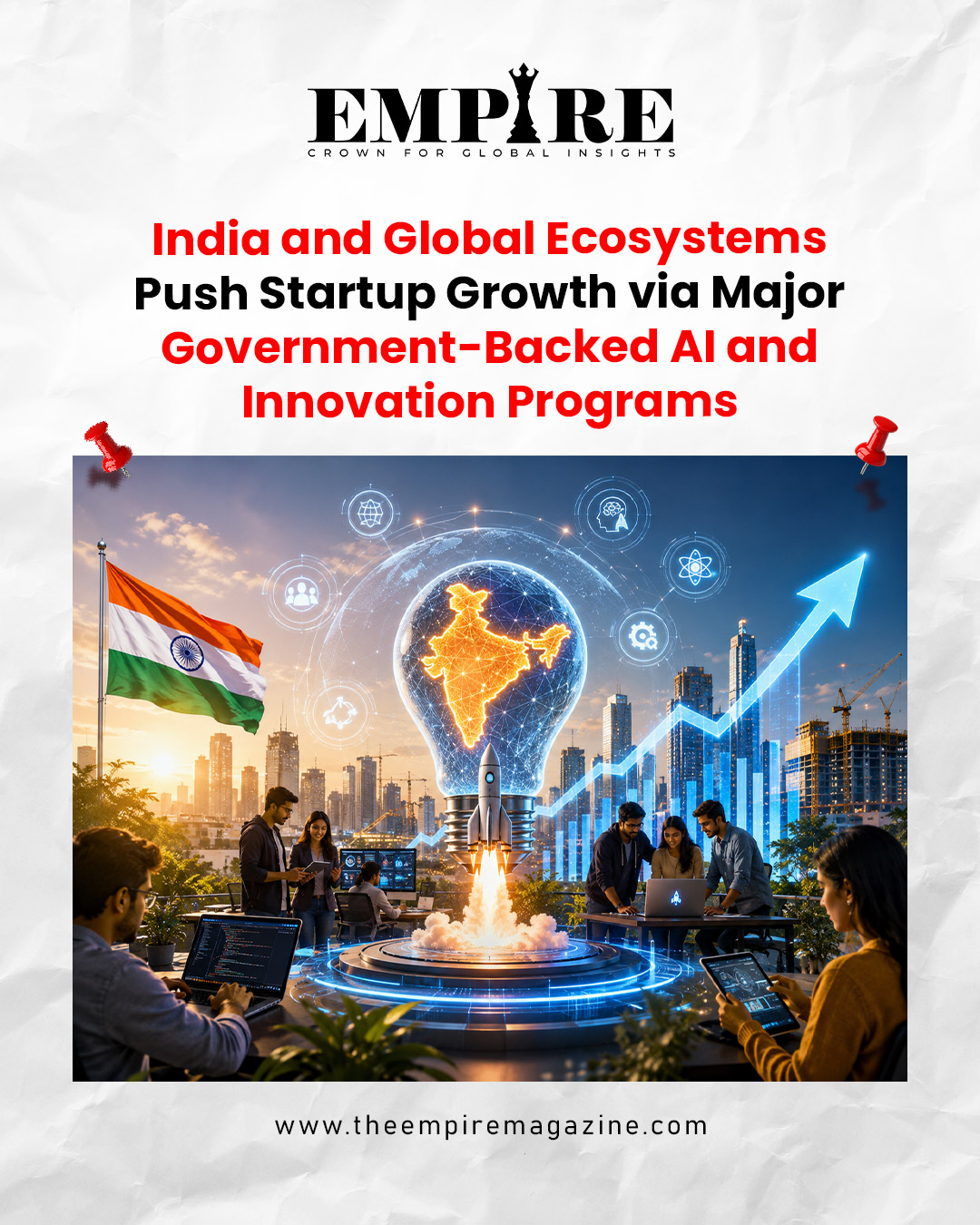
The Global Startup Growth ecosystem is entering a transformative era. Governments across the world are no longer limiting their role to policymaking or infrastructure development, they are becoming active enablers of innovation, entrepreneurship, and artificial intelligence. From India’s ambitious AI Mission to Europe’s AI investments, the United States’ semiconductor and innovation funding, and the Middle East’s technology diversification plans, public-sector support is increasingly becoming the foundation upon which the next generation of startups is being built.
Startup growth is accelerating worldwide as governments invest heavily in artificial intelligence, innovation programs, digital infrastructure, and research ecosystems. India and leading global economies are creating supportive environments that help startups access funding, technology, talent, and market opportunities, positioning entrepreneurship as a key driver of future economic growth.
The Startup shift comes at a crucial moment
Venture capital funding has become more selective over the past two years, forcing startups to demonstrate sustainable business models rather than relying solely on rapid expansion. In this environment, government-backed innovation programs are providing startups with access to funding, research facilities, computing infrastructure, mentorship, regulatory support, and international partnerships that significantly reduce the barriers to innovation.
India, in particular, has emerged as one of the strongest examples of this transition. Already home to the world’s third-largest startup ecosystem, the country is now combining digital public infrastructure with AI-focused policies, research grants, and deep-tech investments to create an ecosystem that encourages long-term innovation rather than short-term valuation growth.
Globally, a similar pattern is unfolding. Countries increasingly recognize that leadership in artificial intelligence, semiconductor technology, healthcare innovation, clean energy, and advanced manufacturing will define economic competitiveness for decades to come. As a result, startup growth is becoming closely linked with national innovation strategies, making entrepreneurship a central pillar of economic policy rather than an independent private-sector activity.
Startup Growth Enters a New AI Era
The relationship between governments and startups has evolved dramatically over the past decade. Earlier, governments primarily focused on creating favorable business regulations, while entrepreneurs depended largely on private investors to finance innovation. Today, however, artificial intelligence has fundamentally changed the equation. AI development requires significant computing power, specialized research talent, access to quality datasets, and high-end digital infrastructure—resources that individual startups often struggle to afford independently. Recognizing this challenge, governments worldwide have begun investing billions into AI research centers, startup accelerators, digital infrastructure, semiconductor manufacturing, cloud computing resources, and university-industry collaborations. These initiatives are not simply encouraging entrepreneurship; they are actively building national innovation ecosystems where startups can experiment, scale, and compete globally. This strategic approach reduces financial barriers for founders while accelerating commercialization of cutting-edge technologies. As countries compete for technological leadership, startup growth has become increasingly intertwined with national economic planning, transforming entrepreneurial success into a matter of strategic importance rather than private enterprise alone.
Startup Growth Gains Momentum in India
India’s startup ecosystem has witnessed remarkable evolution over the past decade, supported by progressive reforms and large-scale digital transformation initiatives. Programs such as Startup India, Digital India, the IndiaAI Mission, and multiple state-level innovation policies have collectively created an environment where entrepreneurs can move from idea to execution more efficiently than ever before. The government’s increasing investment in AI computing infrastructure, semiconductor development, research grants, and innovation clusters reflects a long-term commitment to building indigenous technological capabilities. Beyond funding, startups benefit from simplified regulatory frameworks, incubation centers, academic collaborations, mentorship opportunities, and growing public-private partnerships that encourage commercialization of research. India’s robust digital public infrastructure; including Aadhaar, UPI, DigiLocker, and ONDC, has also provided entrepreneurs with scalable platforms that significantly reduce customer acquisition costs while enabling innovative business models across finance, healthcare, logistics, agriculture, education, and governance. This combination of policy support, digital infrastructure, and entrepreneurial talent continues to strengthen startup growth, positioning India as one of the world’s most attractive destinations for technology-driven innovation.
Government Programs Reshape Startup Growth
Around the world, governments are increasingly competing to attract innovative companies by offering comprehensive support ecosystems rather than isolated funding opportunities. The United States continues to strengthen research commercialization through federal innovation grants, semiconductor investments, and university partnerships. The European Union is channeling billions into AI development, sustainability technologies, digital infrastructure, and cross-border innovation projects that encourage startups to scale throughout Europe. Countries in the Middle East, including the UAE and Saudi Arabia, are investing heavily in artificial intelligence, robotics, clean energy, fintech, and smart-city technologies as part of broader economic diversification strategies. Singapore continues expanding its reputation as an innovation hub by offering startup-friendly regulations, international market access, and deep collaboration between academia and industry. These initiatives share a common objective: reducing entrepreneurial risk while accelerating technological breakthroughs. Rather than replacing venture capital, government-backed innovation programs increasingly complement private investment by helping startups reach commercial readiness, thereby making them more attractive to institutional investors and global partners while strengthening long-term startup growth.
AI Innovation Creates New Business Opportunities
Artificial intelligence is rapidly becoming the defining technology of this decade, creating entirely new categories of startups while transforming existing industries. Entrepreneurs are leveraging AI to improve healthcare diagnostics, financial services, manufacturing efficiency, precision agriculture, logistics optimization, cybersecurity, education, legal technology, climate solutions, and customer service automation. Government-supported AI innovation programs are enabling startups to access high-performance computing resources, foundation models, research collaborations, and specialized datasets that were previously accessible only to large technology companies. This democratization of advanced technology is lowering entry barriers and allowing smaller startups to compete in highly sophisticated markets. At the same time, universities, research institutions, and innovation centers are producing skilled talent capable of developing commercially viable AI applications. The convergence of academic research, government investment, and private entrepreneurship is accelerating technology transfer from laboratories into real-world businesses. As AI continues to mature, startup growth will increasingly depend on founders’ ability to solve meaningful problems while responsibly integrating emerging technologies into scalable, customer-focused solutions that deliver measurable economic and social value.
Startup Growth Faces New Challenges
Despite unprecedented momentum, startup growth continues to face several structural challenges that governments and entrepreneurs must address collaboratively. Access to capital remains uneven, particularly for early-stage deep-tech startups requiring longer development cycles before generating revenue. Talent shortages in advanced AI engineering, semiconductor design, cybersecurity, and scientific research continue to limit innovation capacity in many regions. Regulatory uncertainty surrounding artificial intelligence, data privacy, intellectual property, and cross-border digital trade creates additional complexity for rapidly scaling businesses. Furthermore, startups increasingly face global competition from well-funded international players capable of expanding into emerging markets quickly. Building sustainable businesses also requires founders to prioritize governance, ethical AI practices, cybersecurity resilience, and long-term financial discipline rather than focusing exclusively on valuation growth. Government-backed innovation programs can reduce many of these obstacles, but lasting success ultimately depends on entrepreneurs combining technological excellence with responsible leadership, operational efficiency, customer trust, and adaptability in rapidly evolving markets where competitive advantages change faster than ever before.
The Future of Startup Growth
The future of entrepreneurship will be shaped not only by groundbreaking ideas but by the strength of the ecosystems that nurture them. Governments are increasingly recognizing that innovation requires coordinated investment across education, research, infrastructure, regulation, finance, and international collaboration. India is particularly well positioned to capitalize on this shift by combining its youthful talent pool, expanding digital economy, strong engineering capabilities, and rapidly growing AI ecosystem with supportive government policies. Around the world, similar strategies are creating fertile environments where startups can innovate confidently while addressing pressing challenges in healthcare, sustainability, finance, agriculture, mobility, manufacturing, and digital governance. As artificial intelligence becomes deeply integrated into every sector of the economy, countries that successfully combine entrepreneurial ambition with forward-looking public policy are likely to emerge as global innovation leaders. Startup growth, therefore, is no longer simply an indicator of business activity; it has become a reflection of national competitiveness, technological resilience, and economic preparedness for an increasingly AI-driven future. The countries that invest consistently in innovation ecosystems today will likely shape the global economy of tomorrow.
Public-sector investment in artificial intelligence
The evolution of startup ecosystems demonstrates that innovation flourishes when governments, academia, investors, and entrepreneurs work together toward a shared vision. Public-sector investment in artificial intelligence, digital infrastructure, research, and innovation has become a powerful catalyst for entrepreneurship, enabling startups to move beyond traditional limitations of funding and scale.
India’s growing emphasis on AI, deep technology, and digital public infrastructure places it among the world’s most promising innovation hubs. At the same time, global economies are reinforcing their commitment to startup-led growth through strategic investments that encourage technological leadership and economic resilience.
For founders, these developments present unprecedented opportunities but they also demand stronger governance, responsible innovation, and long-term thinking. As the world enters the next phase of the AI economy, startup growth will increasingly depend on the ability of ecosystems to transform ambitious ideas into sustainable businesses capable of delivering lasting value for society, industry, and future generations.
For more business and retail insights, read more on The Empire Magazine
Previous article: https://theempiremagazine.com/chevron-microsoft/
Magazine Feautures | Podcasts: Empire Global Talks
Follow The Empire Magazine on Facebook | Instagram | LinkedIn | YouTube
The Empire Magazine | Crown for Global Insights