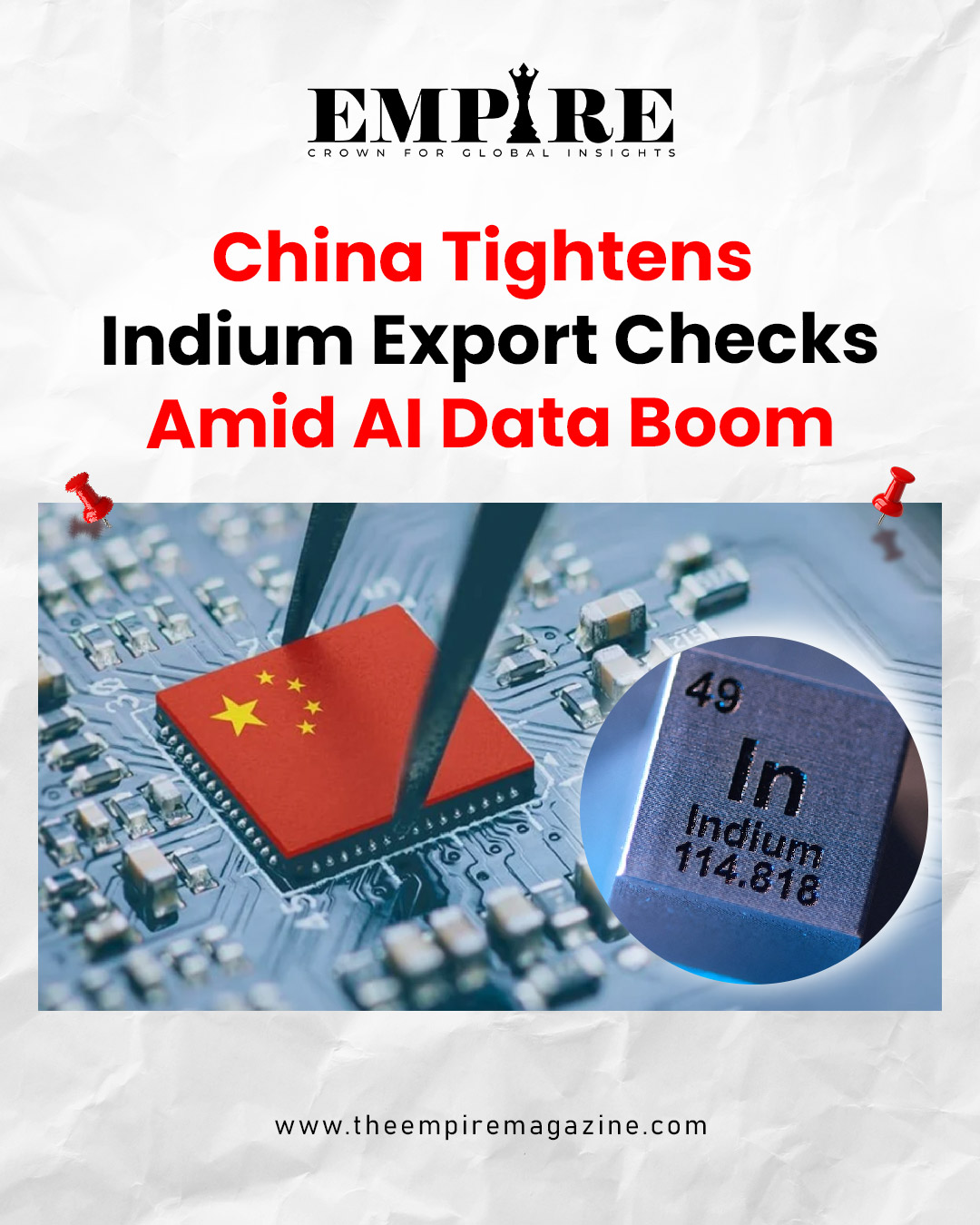
China increases scrutiny of indium exports as AI data center demand surges. Here’s how the move could impact Nvidia, photonics, and global chip supply chains.
China Tightens Indium Export Checks Amid AI Data Boom as Global Chip Supply Chains Face New Pressure
The global race to build artificial intelligence infrastructure has created unprecedented demand for advanced semiconductors, powerful GPUs, and high-speed networking equipment. Yet one of the most critical components behind this transformation is not a cutting-edge AI chip but a relatively obscure metal: indium.
China, which accounts for nearly 70% of global indium production, has stepped up customs scrutiny of indium exports, sparking concerns across the semiconductor industry. While indium metal has not been officially added to China’s export control list, buyers in Europe and North America report increased inspections, longer approval times, and requests for detailed end-user information.
The move comes at a time when hyperscalers and AI companies are investing billions of dollars in next-generation data centers. As demand for high-speed optical chips surges, industry experts warn that tighter oversight of critical minerals could become another geopolitical flashpoint in the global AI race.
China Tightens Indium Export Checks as AI Infrastructure Expands
The latest customs measures reflect Beijing’s growing focus on strategic materials that are increasingly important to advanced technologies.
According to Reuters, exporters have experienced additional documentation requirements and more rigorous customs inspections before indium shipments receive approval. Although no confirmed shipment bans have been reported, the heightened scrutiny has created uncertainty among global buyers, many of whom fear that indium could eventually face formal export controls similar to other strategic minerals.
China’s approach follows a broader strategy of tightening oversight over critical raw materials with military and technological applications. Over the past two years, Beijing has introduced export controls on several minerals and advanced materials, reinforcing its influence over global technology supply chains.
Why Indium Is Critical to the AI Data Boom
Although indium is widely used in smartphone displays, touchscreens, and solar panels, its strategic importance has grown significantly with the rise of artificial intelligence.
Indium serves as the primary raw material for indium phosphide (InP), a semiconductor compound used to manufacture high-speed optical communication chips. These photonic chips enable rapid data transmission between thousands of GPUs inside AI data centers, making them indispensable for training and deploying large language models.
Unlike conventional copper interconnects, indium phosphide-based optical components deliver higher bandwidth, lower latency, and improved energy efficiency. As AI clusters continue expanding, these capabilities have become essential for maintaining performance and reducing power consumption.
The growing reliance on optical networking means that demand for indium is no longer driven solely by consumer electronics but increasingly by enterprise AI infrastructure.
How China’s Export Policies Could Reshape the AI Semiconductor Supply Chain amidst Indium
China’s dominance in indium production gives it considerable leverage over a niche yet strategically significant segment of the semiconductor industry.
Since February 2025, Beijing has already placed indium phosphide under its export control regime, requiring export licenses for overseas shipments. Those restrictions have complicated procurement for several international photonics manufacturers and increased concerns about future supply availability.
The latest customs checks on indium metal itself suggest that authorities are extending oversight further upstream in the supply chain.
Industry participants worry that even modest administrative delays can disrupt production schedules because semiconductor manufacturing depends on highly coordinated global logistics. Longer customs procedures may increase inventory costs, delay chip production, and complicate procurement planning for manufacturers worldwide.
AI Data Centers Depend on High-Speed Photonic Chips
Modern AI data centers contain tens of thousands of graphics processors working simultaneously to train foundation models and generative AI applications.
These processors constantly exchange enormous amounts of information through optical interconnects rather than traditional electrical wiring.
Companies developing AI infrastructure increasingly rely on indium phosphide lasers and optical transceivers to achieve the data transfer speeds required by advanced AI workloads. Without these components, GPU clusters cannot operate efficiently at scale.
As organizations including OpenAI, Microsoft, Google, Amazon, and Meta continue expanding AI infrastructure, demand for photonic networking equipment is expected to grow rapidly over the coming years.
indium story has attracted global attention
One reason the indium story has attracted global attention is its connection to Nvidia’s rapidly expanding AI ecosystem.
Reuters reported that the CEO of Coherent, a major photonics company backed by Nvidia investments, travelled to Beijing alongside a U.S. business delegation to raise concerns over export licensing delays affecting indium phosphide.
Coherent manufactures optical networking components that enable communication between Nvidia’s AI accelerators inside hyperscale data centers.
Although Nvidia itself does not manufacture indium phosphide, any disruption in the optical networking supply chain could indirectly affect deployment timelines for AI infrastructure projects.
This highlights how AI hardware extends far beyond GPUs alone, relying on an increasingly complex ecosystem of specialized materials and semiconductor technologies.
Global Companies Seek Alternatives to Chinese Indium
The uncertainty surrounding Chinese exports is accelerating efforts to diversify supply chains.
Several companies are exploring alternative sources of indium while investing in domestic production capabilities. Japanese manufacturers have also increased investment in indium phosphide production, although current capacity remains insufficient to replace China’s dominant market position.
Meanwhile, governments are recognizing indium as a strategic resource.
Reuters reports that the U.S. Defense Logistics Agency has initiated efforts to stockpile approximately 403 tonnes of indium, reflecting growing concerns over future supply security and national resilience.
Such initiatives illustrate how governments increasingly view critical minerals as strategic assets rather than ordinary industrial commodities.
The AI Boom Is Making Critical Minerals a Geopolitical Asset
Artificial intelligence has transformed previously overlooked raw materials into strategic economic resources.
Just as rare earth elements became central to electric vehicles and renewable energy, indium is emerging as an indispensable input for AI infrastructure.
Countries controlling production of these materials now possess greater influence over global technology supply chains.
China’s actions demonstrate how upstream control of niche minerals can affect downstream industries worth hundreds of billions of dollars.
Rather than restricting finished semiconductors directly, controlling essential raw materials provides another mechanism for influencing international technology competition.
Will China Impose Full Export Controls on Indium?
At present, there is no official indication that China intends to prohibit indium exports.
Reuters reports that customs inspections remain inconsistent across shipments, and industry participants have not confirmed any outright export bans. Nevertheless, the increased scrutiny has heightened concerns because it resembles earlier patterns observed before formal export controls were introduced on other strategic materials.
Many companies are therefore preparing contingency plans by increasing inventories, diversifying suppliers, and expanding long-term procurement agreements.
These precautionary measures reflect the industry’s recognition that geopolitical developments can rapidly reshape semiconductor supply chains.
What This Means for the Future of AI Infrastructure
The AI revolution is often associated with powerful processors and sophisticated software models, but its success also depends on a resilient supply of specialized materials.
As AI workloads become increasingly demanding, optical networking technologies built on indium phosphide will play a larger role in connecting next-generation computing systems.
China’s tighter scrutiny over indium exports highlights the growing intersection of technology, trade policy, and national security.
For governments, semiconductor manufacturers, and cloud providers, ensuring stable access to critical minerals is becoming as important as securing advanced chip manufacturing capacity itself.
China’s decision to tighten indium export
China’s decision to tighten indium export checks underscores how the AI boom is reshaping global supply chains far beyond processors and software.
Although indium metal remains outside China’s formal export control regime, increased customs scrutiny signals that critical minerals are becoming powerful strategic tools in an era defined by artificial intelligence.
As demand for AI data centers continues to accelerate, companies will need to balance technological innovation with supply chain resilience. Whether through diversification, domestic production, or strategic stockpiling, securing access to essential materials like indium will become a defining challenge for the next phase of the global AI economy.
For more business and retail insights, read more on The Empire Magazine
Previous article: SK Hynix
Magazine Feautures | Podcasts: Empire Global Talks
Follow The Empire Magazine on Facebook | Instagram | LinkedIn
The Empire Magazine | Crown for Global Insights