SK Hynix overtakes Samsung as South Korea’s most valuable company, driven by AI memory chips, HBM technology, Nvidia demand, and the global AI boom.
SK Hynix Overtakes Samsung in Korea’s AI Memory Boom as HBM Chips Redefine the Semiconductor Industry
For decades, Samsung Electronics symbolized South Korea’s technological dominance. From smartphones and televisions to memory chips, the company remained the country’s most valuable listed corporation and one of the world’s most influential technology giants. That dominance, however, is being challenged by an unlikely rival from within South Korea itself.
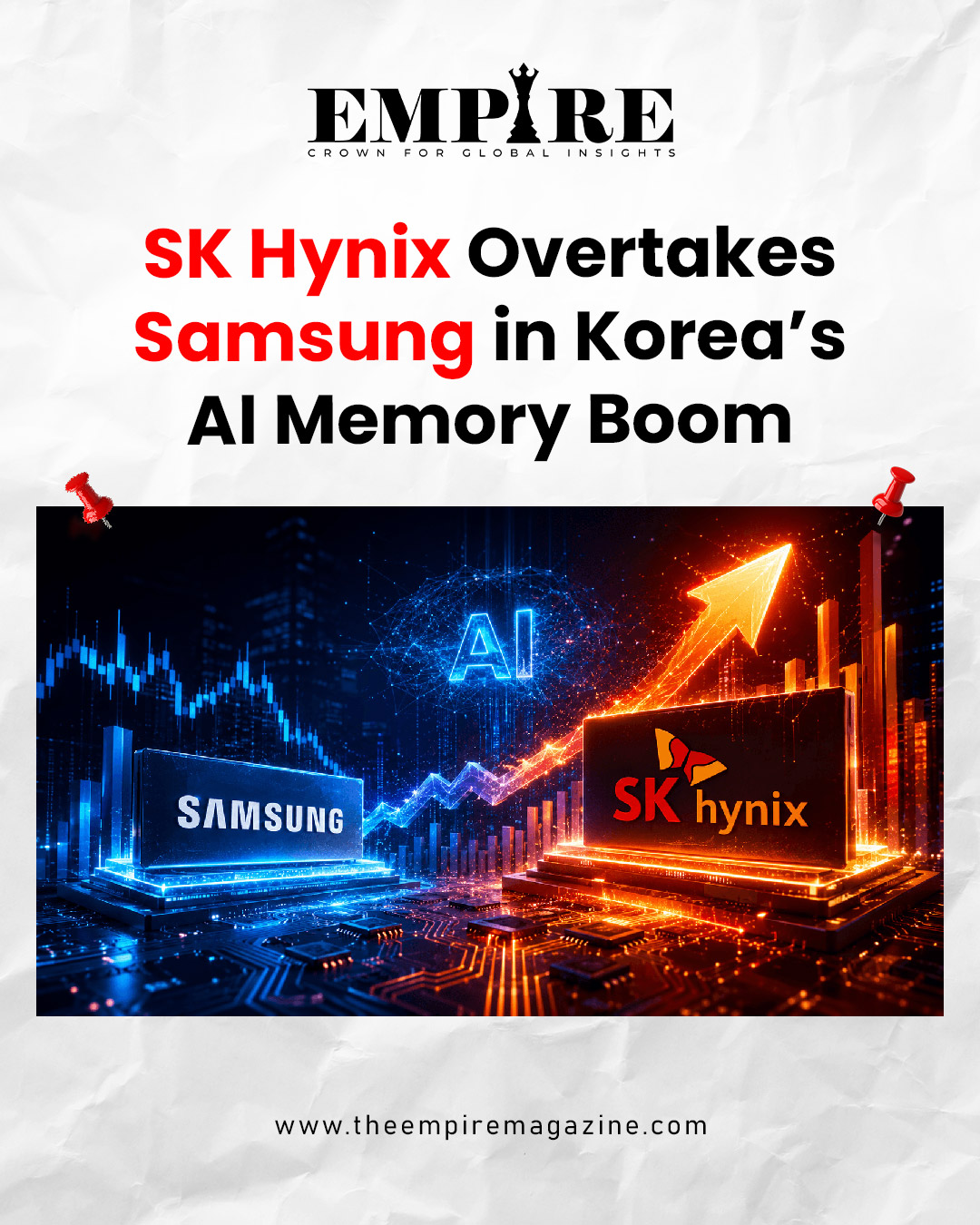
Driven by surging demand for artificial intelligence infrastructure, SK Hynix has overtaken Samsung Electronics to become South Korea’s most valuable listed company, marking one of the biggest shifts in the country’s semiconductor industry in decades. The milestone reflects how the AI revolution is transforming the global chip market, where specialized memory chips have become just as important as AI processors themselves.
The company’s rise has been fueled by its leadership in High Bandwidth Memory (HBM), a technology that powers AI accelerators from companies including Nvidia and AMD. As hyperscalers continue investing billions in AI data centers, SK Hynix has emerged as one of the biggest beneficiaries of the AI infrastructure boom.
SK Hynix Overtakes Samsung After Riding the AI Memory Boom
The shift became official in June 2026 when SK Hynix’s market capitalization surpassed Samsung Electronics, making it South Korea’s largest listed company.
According to Reuters, SK Hynix reached a market capitalization of approximately 2,080 trillion won, narrowly exceeding Samsung’s valuation. Although the rankings may fluctuate with daily trading, the achievement symbolizes a broader transition in investor priorities from consumer electronics toward AI infrastructure.
Investors increasingly believe that companies supplying essential AI hardware components will capture a larger share of future technology spending.
Unlike previous semiconductor cycles driven by smartphones and PCs, today’s growth is powered primarily by AI servers requiring enormous amounts of advanced memory.
Why the AI Memory Boom Is Changing the Semiconductor Industry
Artificial intelligence models process enormous datasets simultaneously, demanding significantly faster memory than traditional computing workloads.
This is where High Bandwidth Memory (HBM) becomes indispensable.
HBM stacks multiple DRAM chips vertically using advanced packaging technologies, enabling dramatically higher bandwidth, lower power consumption, and faster communication with AI processors.
Modern AI accelerators from Nvidia, AMD, and other chipmakers rely heavily on HBM to train and run increasingly sophisticated large language models.
Without these memory chips, today’s AI systems would struggle to process complex workloads efficiently. This has made HBM one of the semiconductor industry’s most valuable product categories.
How SK Hynix Built Its Lead in High Bandwidth Memory
SK Hynix’s leadership did not emerge overnight.
More than a decade ago, the company invested aggressively in HBM technology while many competitors viewed the market as too niche to justify large investments.
It introduced one of the world’s earliest HBM products in partnership with AMD in 2014 and continued expanding manufacturing capabilities despite uncertain commercial demand.
Although the company faced technical setbacks during early generations of HBM, it maintained long-term investment, anticipating that AI workloads would eventually require faster memory architectures.
That strategic patience has paid off.
Today, SK Hynix is widely recognized as the leading supplier of HBM chips used in Nvidia’s AI accelerators, giving it a significant competitive advantage as AI infrastructure spending accelerates globally.
Nvidia’s AI Success Has Fueled SK Hynix’s Growth
Few companies have benefited more from Nvidia’s rapid expansion than SK Hynix.
Every generation of Nvidia’s AI GPUs requires increasingly sophisticated HBM chips to maximize performance.
As cloud providers such as Microsoft, Amazon, Google, and Meta continue expanding AI data centers, demand for Nvidia’s accelerators has remained exceptionally strong.
Because SK Hynix supplies much of the advanced memory powering these systems, its revenue and profitability have risen alongside Nvidia’s AI ecosystem.
This close relationship has strengthened investor confidence that SK Hynix will remain a central supplier in the global AI supply chain.
Samsung Is Fighting Back in the AI Chip Race
Despite losing the valuation crown, Samsung remains one of the world’s largest semiconductor manufacturers.
The company continues investing heavily in next-generation HBM products, advanced packaging technologies, and foundry manufacturing.
Samsung has begun shipping advanced HBM4 memory to customers while working to strengthen its position in AI accelerators and logic chips. It also maintains leadership across smartphones, displays, televisions, and consumer electronics, giving it a far more diversified business than SK Hynix.
Analysts believe Samsung still possesses the manufacturing scale and research capabilities necessary to regain momentum in AI memory over the coming years.
SK’s Semiconductor Industry Benefits from the AI Boom
The rivalry between Samsung and SK Hynix reflects South Korea’s broader strength in semiconductor manufacturing.
Together, the two companies dominate the global memory market, supplying much of the world’s DRAM and NAND flash memory.
Memory semiconductors remain South Korea’s largest export category and an essential contributor to the country’s economy.
Growing investment in AI data centers has further reinforced South Korea’s strategic importance within the global semiconductor supply chain, especially as governments seek resilient chip manufacturing ecosystems.
Investors See AI Infrastructure as the Next Growth Engine
The AI investment cycle is expanding beyond software developers.
While companies like OpenAI, Anthropic, and Google attract attention for developing AI models, investors increasingly recognize that AI infrastructure providers may capture equally significant long-term value.
Memory manufacturers, networking companies, chip packaging firms, and semiconductor equipment suppliers are becoming critical beneficiaries of enterprise AI spending.
SK Hynix’s rise illustrates how essential infrastructure providers can outperform even established technology leaders during structural technology shifts.
Challenges Could Slow the AI Memory Boom
Despite impressive growth, the sector faces several risks.
Recent volatility in semiconductor stocks reflects investor concerns about whether AI infrastructure spending can maintain its current pace. Analysts are closely monitoring memory pricing, capital expenditure by hyperscalers, geopolitical uncertainty, and potential oversupply if manufacturers expand production too aggressively.
Additionally, increasing trade restrictions, export controls, and supply chain disruptions could influence future semiconductor demand.
Although long-term AI adoption remains strong, investors expect periodic corrections as the industry matures.
What SK Hynix’s Rise Means for the Global AI Industry
SK Hynix’s ascent represents more than a shift in market capitalization.
It demonstrates that success in artificial intelligence increasingly depends on specialized hardware capable of supporting next-generation computing workloads.
As AI models become larger and more computationally demanding, memory performance has become nearly as important as processing power.
This changing dynamic is reshaping competition across the semiconductor industry, encouraging companies to invest heavily in advanced memory technologies, chip packaging, and AI infrastructure.
The Bottom Line
SK Hynix overtaking Samsung as South Korea’s most valuable listed company marks a defining moment in the AI era.
The achievement reflects years of investment in High Bandwidth Memory technology, strong partnerships across the AI ecosystem, and the explosive growth of global AI infrastructure spending.
While Samsung remains a formidable competitor with vast technological capabilities and diversified businesses, SK Hynix has demonstrated how strategic specialization can create leadership in emerging technology markets. As AI adoption continues to expand across industries, the competition between South Korea’s two semiconductor giants is likely to shape the future of memory innovation—and the next phase of the global AI economy.
For more business and retail insights, read more on The Empire Magazine
Previous article: https://theempiremagazine.com/cyera-raises-600m/
Magazine Feautures | Podcasts: Empire Global Talks
Follow The Empire Magazine on Facebook | Instagram | LinkedIn
The Empire Magazine | Crown for Global Insights