Rolex Raises Gold Watch Prices Again amidst economic crisis
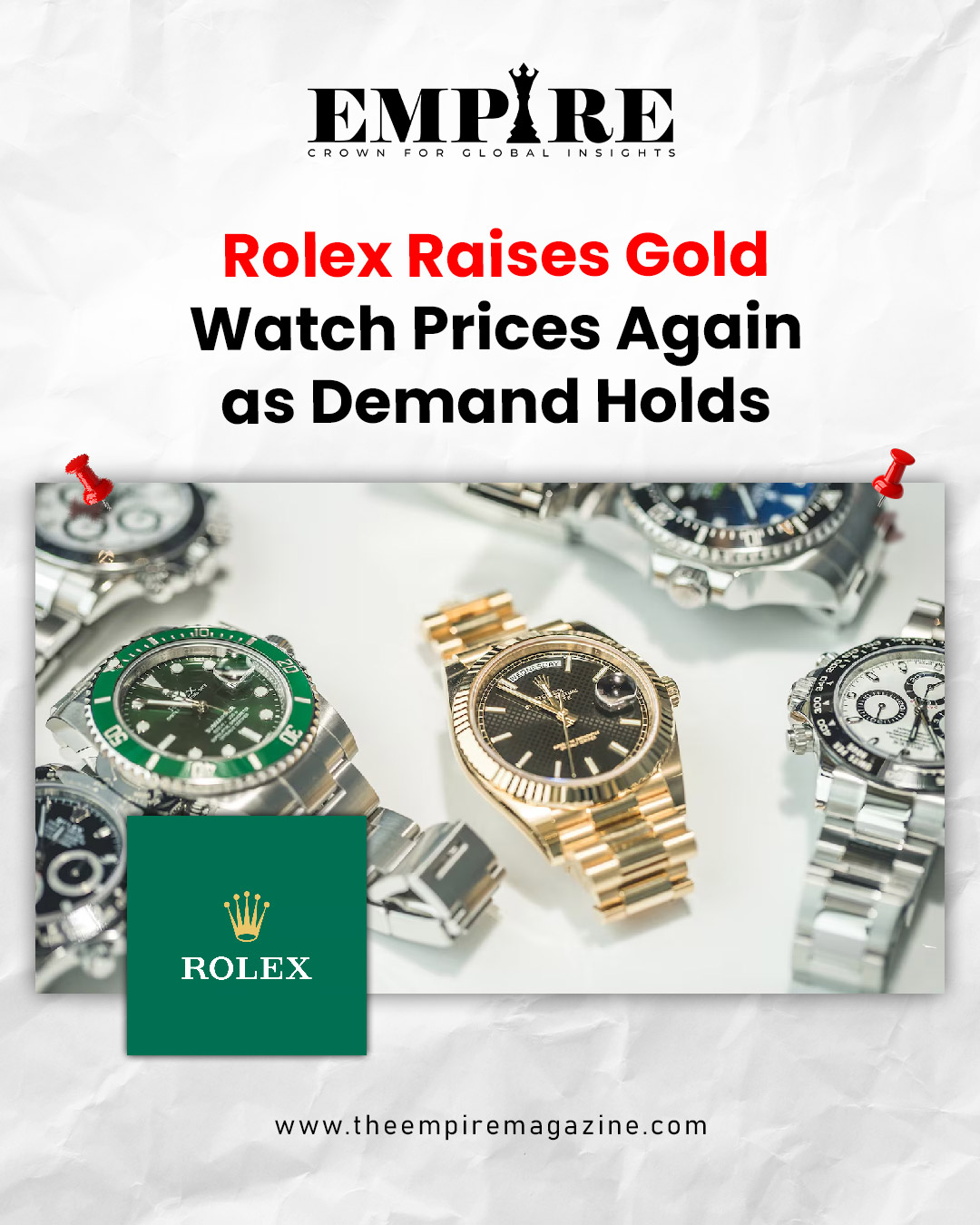
Luxury brands like Rolex often face a delicate balancing act between maintaining exclusivity and keeping customers engaged. While frequent price increases can discourage buyers in many industries, Swiss luxury watchmaker Rolex continues to prove that it plays by a completely different set of rules. The company has once again increased prices for several of its gold watch models, marking another significant pricing revision as demand for premium timepieces remains exceptionally resilient across global markets.
The latest move comes at a time when gold prices continue to trade near historic highs, increasing production costs for manufacturers that rely heavily on precious metals. Yet the decision reflects much more than fluctuating commodity prices. It underscores Rolex’s remarkable ability to command premium pricing without weakening consumer confidence, a rare achievement in today’s unpredictable economic environment.
Across Europe, Asia, the Middle East and North America, demand for Rolex watches continues to exceed supply. Waiting lists remain long for many of the brand’s most sought-after collections, while prices in the secondary market often remain above official retail levels. This persistent imbalance has helped Rolex preserve one of the strongest brand images in the luxury industry, where scarcity itself has become a valuable asset.
For consumers, purchasing a Rolex is no longer viewed simply as buying a luxury accessory. It represents craftsmanship, heritage, financial success and, increasingly, a long-term store of value. This perception has transformed the company into one of the few global luxury brands capable of introducing repeated price increases without triggering a meaningful slowdown in demand.
Industry analysts believe the latest adjustment also signals confidence from Rolex about the broader luxury market. Despite concerns surrounding inflation, slowing economic growth in several regions and geopolitical uncertainty, affluent consumers continue allocating significant spending toward products that combine exclusivity with lasting value. As a result, Rolex remains one of the clearest examples of how premium brands can thrive even when broader consumer markets become cautious.
Rising Gold Costs and the Power of Rolex’s Brand Value
Gold has experienced a remarkable surge over the past year, supported by strong central bank purchases, geopolitical tensions, inflation concerns and investor demand for safe-haven assets. Since Rolex manufactures a substantial portion of its premium watches using precious metals, rising bullion prices naturally increase production expenses. However, the company’s latest pricing decision cannot be explained solely by higher raw material costs. Rolex has spent decades building a vertically integrated manufacturing system that allows it to produce many of its own components, including proprietary gold alloys, while maintaining extraordinary quality standards throughout every stage of production. Each timepiece undergoes meticulous assembly, precision testing and extensive quality inspections before reaching customers. This relentless commitment to craftsmanship has enabled Rolex to create an unmatched reputation for durability, reliability and timeless design. Consequently, customers purchasing a gold Rolex rarely focus only on the cost of materials. Instead, they associate the watch with prestige, engineering excellence and enduring value. Unlike many luxury goods that depreciate significantly after purchase, several Rolex references have demonstrated impressive value retention over time, with certain rare models appreciating considerably in secondary markets. This unique combination of heritage, scarcity and investment appeal allows Rolex to introduce periodic price adjustments while preserving customer loyalty. Rather than discouraging buyers, higher prices often reinforce perceptions of exclusivity, strengthening the brand’s position within the global luxury ecosystem. For collectors and enthusiasts, the latest increase simply reflects the growing value attached to owning one of the world’s most recognized luxury watches.
Wealthy Consumers Continue to Fuel Luxury Demand like Rolex
Perhaps the most fascinating aspect of Rolex’s latest pricing strategy is the unwavering confidence displayed by affluent consumers around the world. While inflation continues affecting everyday households and many industries experience softer consumer spending, the luxury sector has largely remained resilient thanks to sustained wealth creation across technology, finance, entrepreneurship and private investment. High-net-worth individuals increasingly prioritize experiences and products that symbolize long-term achievement, making luxury watches one of the most desirable categories within personal wealth spending. Rolex occupies a particularly unique position because its products appeal to multiple generations simultaneously. Younger professionals often aspire to purchase their first Rolex as a milestone celebrating career success, while seasoned collectors continue expanding carefully curated collections with precious-metal models and limited-production references. This broad customer base has helped insulate the company from temporary economic fluctuations. Social media has further amplified Rolex’s desirability, with entrepreneurs, athletes, entertainers and business leaders frequently showcasing the brand as a symbol of accomplishment and refined taste. The visibility created by these influential figures continually introduces Rolex to new audiences while reinforcing its aspirational image among existing customers. At the same time, Rolex has resisted the temptation to dramatically increase production simply to satisfy growing demand. Instead, the company continues following a disciplined supply strategy that intentionally preserves scarcity across many of its flagship collections. This careful balance between demand and availability strengthens consumer perception that owning a Rolex represents membership in an exclusive community rather than merely completing a financial transaction. As long as waiting lists remain extensive and resale values continue outperforming expectations, affluent buyers appear willing to absorb further price increases without hesitation.
What the Price Increase of Rolex Means for the Luxury Watch Industry
Rolex’s latest decision extends far beyond its own catalog and has significant implications for the broader luxury watch market. As the industry’s undisputed benchmark, Rolex often sets pricing trends that influence competitors ranging from established Swiss manufacturers to emerging independent watchmakers. When the company raises prices while maintaining robust demand, it sends a strong signal that consumers are still willing to pay a premium for brands with exceptional heritage and proven craftsmanship. Other luxury watchmakers are likely to view this as validation that strategic price increases can be implemented without damaging long-term demand, provided they continue delivering superior quality and exclusivity. Retailers are also expected to benefit from the renewed attention surrounding premium watches, as heightened interest in Rolex often spills over into other luxury brands. Meanwhile, the secondary market continues to play a crucial role in reinforcing Rolex’s desirability. Many sought-after models still command prices above their official retail values, reflecting the ongoing imbalance between supply and demand. Although market premiums have moderated compared to the extraordinary highs seen during the post-pandemic luxury boom, resale values remain considerably stronger than those of most competing brands. This consistent performance has encouraged many collectors to view Rolex watches as tangible assets capable of preserving wealth over the long term. Financial advisers may caution against treating luxury watches purely as investments because market conditions can fluctuate, yet Rolex’s historical resilience has undoubtedly strengthened buyer confidence. Beyond economics, the company’s strategy highlights a broader shift in luxury consumption. Today’s affluent consumers increasingly prioritize authenticity, craftsmanship and legacy over conspicuous spending. They are willing to invest in products that offer emotional satisfaction alongside practical value, and Rolex continues to embody that balance better than almost any other watchmaker. As the luxury industry adapts to evolving consumer expectations, Rolex’s disciplined approach to pricing, production and brand management is likely to remain a case study for competitors seeking sustainable growth in an increasingly competitive global marketplace.
Can Rolex Continue This Winning Strategy?
Looking ahead, Rolex appears exceptionally well positioned to maintain its leadership despite a rapidly evolving luxury landscape. The company benefits from one of the strongest brand identities in the world, built over more than a century through relentless attention to quality, innovation and consistency. While many luxury brands rely heavily on seasonal collections, celebrity collaborations or aggressive marketing campaigns to generate excitement, Rolex has achieved something far more enduring: timeless desirability. Iconic collections such as the Submariner, Daytona, Date adjust, Day-Date and GMT-Master II continue attracting buyers decade after decade, proving that exceptional design rarely goes out of fashion. At the same time, Rolex continues investing significantly in modern manufacturing technologies, sustainability initiatives and production capabilities while carefully preserving the meticulous craftsmanship that defines every watch leaving its factories. The company has demonstrated remarkable discipline by expanding production gradually rather than flooding the market, ensuring that exclusivity remains one of its greatest competitive advantages. Nevertheless, challenges remain on the horizon. Prolonged economic slowdowns, currency fluctuations, changing trade policies and continued volatility in precious metal prices could influence future pricing decisions. Consumer preferences may also evolve as younger generations increasingly embrace digital lifestyles and alternative luxury experiences. However, Rolex has repeatedly demonstrated its ability to adapt without compromising its core identity. The brand’s reputation for reliability, precision and enduring value continues to resonate across generations, making it one of the few luxury companies capable of weathering changing economic cycles with remarkable stability. If current trends continue, future price increases are unlikely to significantly weaken demand, particularly among affluent consumers who prioritize quality and long-term ownership over short-term affordability. Rather than chasing rapid expansion, Rolex seems committed to protecting the exclusivity that has defined its success for decades, ensuring that every pricing decision reinforces the brand’s premium positioning instead of diluting it.
Rolex: Extraordinary Strength
Rolex’s latest increase in gold watch prices is about far more than higher production costs or rising gold prices. It reflects the extraordinary strength of a brand that has spent generations earning the trust of collectors, enthusiasts and luxury consumers across the globe. In an era when many businesses struggle to maintain pricing power amid economic uncertainty, Rolex continues demonstrating that genuine prestige, meticulous craftsmanship and carefully managed scarcity remain powerful competitive advantages. The company has successfully created an ecosystem where higher prices often reinforce exclusivity instead of discouraging demand, a feat that very few luxury brands have managed to achieve consistently.
For consumers, the latest adjustment reinforces the perception that owning a Rolex is not simply about telling time but about possessing an object that represents achievement, heritage and enduring value. For investors and industry observers, it highlights the resilience of the global luxury market, particularly among affluent buyers whose purchasing decisions remain largely insulated from broader economic pressures. The continued strength of the secondary market, combined with long waiting lists at authorized retailers, further underscores the brand’s unique position within the luxury ecosystem.
Perhaps the most significant lesson from Rolex’s latest pricing strategy is that true luxury extends beyond materials or manufacturing costs. It is built on trust, consistency, exceptional quality and the ability to create products that remain desirable across generations. These qualities have allowed Rolex to transform its watches into cultural symbols that carry emotional and financial significance alike. As long as the company continues balancing innovation with tradition while carefully managing supply and preserving its reputation for excellence, its pricing power is likely to remain unmatched.
In a world where consumer preferences shift rapidly and economic conditions remain unpredictable, Rolex has once again demonstrated why it occupies the pinnacle of the luxury watch industry. The latest gold watch price increase is not merely a response to market dynamics, it is a reflection of enduring confidence in one of the world’s most valuable and respected luxury brands. For competitors, collectors and consumers alike, the message is unmistakable: when heritage, craftsmanship and exclusivity come together, demand can remain strong regardless of the price tag.
For more business and retail insights, read more on The Empire Magazine
Previous article: EU extra Co2 permits for Industry
Magazine Feautures | Podcasts: Empire Global Talks
Follow The Empire Magazine on Facebook | Instagram | LinkedIn
The Empire Magazine | Crown for Global Insights