Mercedes-Benz Steps Into a New Defence Era
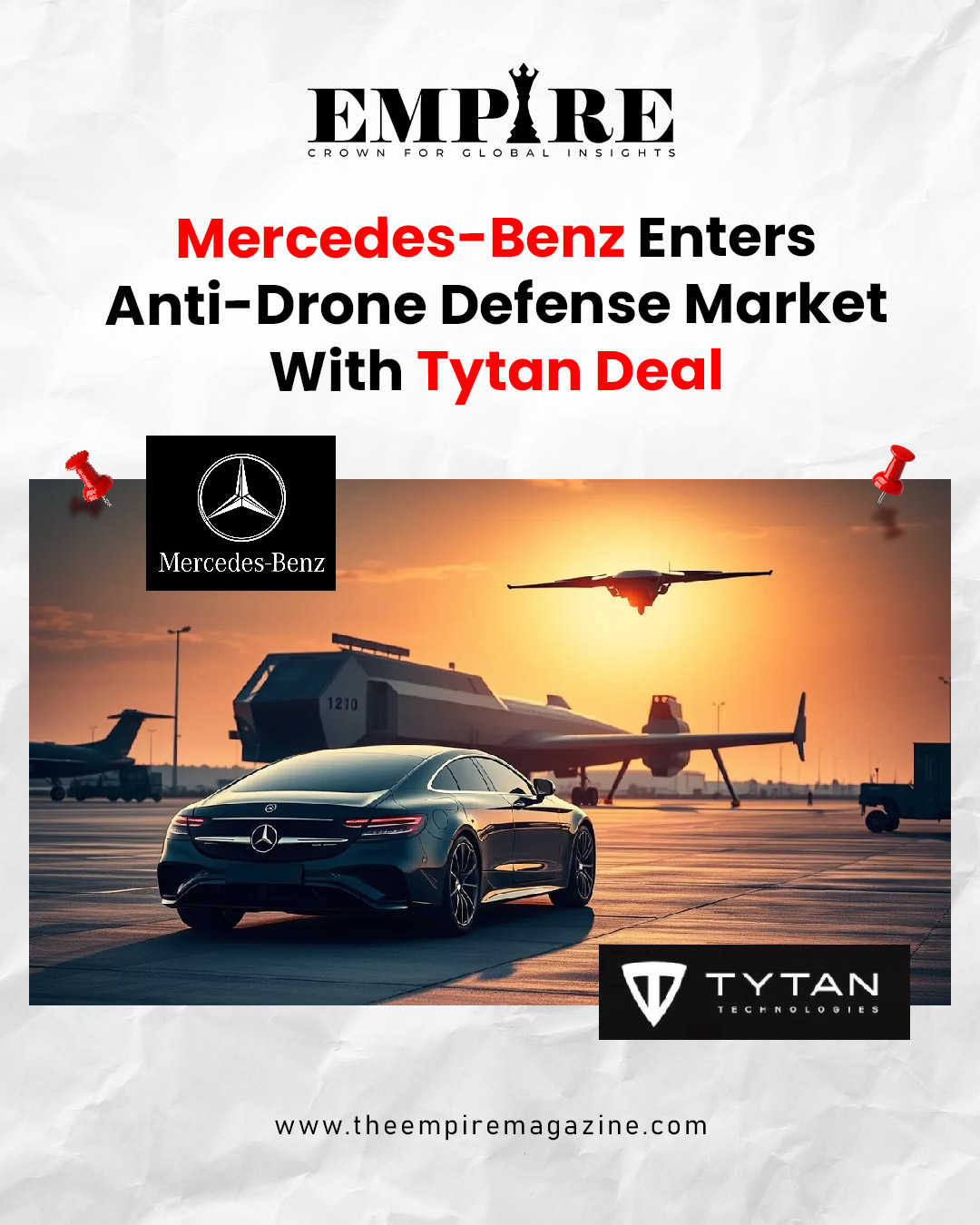
Mercedes-Benz has officially taken a bold step beyond its traditional automotive identity by entering the rapidly growing anti-drone defence market through a strategic partnership with Munich-based startup Tytan Technologies. The collaboration marks one of the most significant signals yet that major European carmakers are no longer limiting themselves to civilian mobility, but are now positioning themselves within the defence technology ecosystem. The deal focuses on developing advanced mobile counter-drone systems designed to protect critical infrastructure across Europe, including airports, military bases, and urban security zones, at a time when drone-related threats are escalating globally.
This move reflects a deeper transformation within the European industrial landscape, where automotive engineering, AI systems, and defence requirements are increasingly converging into a single technological frontier. Mercedes-Benz, long known for luxury engineering and high-performance vehicles, is now leveraging its platforms like the G-Class SUV and Sprinter van as potential defence mobility systems, signaling a dramatic strategic pivot.
The Tytan Deal Explained: What the Partnership Really Means
At the heart of the agreement is a memorandum of understanding between Mercedes-Benz and Tytan Technologies, signed during the ILA 2026 aerospace and defence exhibition in Berlin. The partnership is designed to create a mobile “Drone Defender” system that integrates interceptor drones, advanced detection systems, and vehicle-mounted launch platforms into a unified defence solution.
Rather than building weapons directly, Mercedes-Benz is contributing its engineering expertise and vehicle platforms, while Tytan provides the core interception technology. The system is expected to be mounted on modified versions of the Mercedes G-Class and Sprinter, transforming them into mobile anti-drone units capable of responding quickly to aerial threats. Although the deal currently remains exploratory without confirmed production volumes, it has already positioned Mercedes-Benz as an emerging participant in Europe’s expanding defence supply chain.
Why Anti-Drone Systems Are Becoming Critical in Modern Warfare
The urgency behind this partnership stems from the rapidly evolving threat landscape. Small unmanned aerial vehicles, particularly first-person-view (FPV) drones, have become a major security challenge for both military and civilian infrastructure. These drones are inexpensive, highly manoeuvrable, and increasingly used for surveillance and attack missions in modern conflict zones.
Traditional air defence systems, designed to intercept missiles or large aircraft, are often too expensive or too slow to counter mass drone swarms effectively. As a result, governments across Europe are now investing heavily in cost-efficient, scalable counter-drone technologies. The Mercedes-Tytan collaboration directly addresses this gap by developing lightweight interceptor drones designed to neutralize threats in real time.
The broader geopolitical context, particularly the increased use of drones in the Russia-Ukraine conflict, has accelerated demand for such technologies, making anti-drone defence one of the fastest-growing sectors in modern military innovation.
Inside the Drone Defender Concept and Vehicle Integration
The proposed “Drone Defender” system represents a mobile air-defence platform designed for rapid deployment and flexible response. It integrates sensors, AI-driven tracking systems, and interceptor drones capable of neutralizing hostile UAVs either through kinetic impact or controlled detonation near the target.
Mercedes-Benz vehicles serve as the operational backbone of this system. The G-Class SUV, already used in military configurations under the “Wolf” variant, provides rugged terrain mobility, while the Sprinter van offers a versatile base for equipment storage and drone deployment. Together, these platforms form a mobile defence unit capable of being deployed near airports, military bases, or critical infrastructure zones.
What makes the system particularly significant is its focus on scalability and cost efficiency. Instead of relying on large and expensive missile-based defence systems, the Drone Defender concept prioritizes rapid production and distributed deployment, allowing multiple units to operate simultaneously across different regions.
Tytan Technologies: The Startup Behind the Interceptor Revolution
Tytan Technologies, founded in Munich in 2023, is one of Europe’s most promising counter-drone startups. The company specializes in AI-guided interceptor drones designed to physically collide with hostile UAVs, neutralizing them at a fraction of the cost of traditional missile systems.
The company’s flagship interceptor system, developed through advanced 3D printing and AI navigation, has already been tested in real-world conflict environments, including Ukraine, where drone warfare has become a defining feature of the battlefield. Tytan has also attracted significant investment, including backing from NATO-related innovation funds, and is scaling production toward thousands of interceptors per month.
Its partnership with Mercedes-Benz adds industrial scale and automotive manufacturing expertise to its rapidly evolving defence technology portfolio, potentially accelerating its transition from startup to major defence contractor.
Strategic Shift: Why Automakers Are Entering Defence Markets
The Mercedes-Benz-Tytan partnership is not an isolated case but part of a broader trend across the European automotive industry. Several major car manufacturers are increasingly exploring defence collaborations as traditional automotive markets face pressure from electric vehicle transitions, rising costs, and global competition.
Automakers possess large-scale manufacturing capabilities, advanced supply chain networks, and expertise in mobility systems, all of which are directly transferable to defence production. This convergence has made the automotive sector an attractive partner for defence startups and government agencies seeking rapid scaling of new technologies.
For Mercedes-Benz, this move also reflects a strategic diversification beyond luxury vehicles into high-value industrial sectors, where demand is driven not by consumer cycles but by national security priorities.
Economic and Geopolitical Impact of the Move
Economically, the partnership signals a new revenue stream for European automakers at a time when profitability in traditional car markets is under pressure. Defence contracts offer long-term stability, government-backed funding, and high-margin opportunities that contrast sharply with volatile consumer automotive markets.
Geopolitically, the deal reinforces Europe’s growing emphasis on defence self-reliance. As European governments increase defence budgets and prioritize domestic manufacturing capabilities, collaborations like Mercedes-Benz and Tytan represent a shift toward strengthening internal industrial ecosystems rather than relying heavily on external suppliers.
This also reflects a broader reorientation of European industrial policy, where innovation in mobility, AI, and defence is increasingly interconnected within a unified strategic framework.
What This Means for Europe’s Future Defence Ecosystem
The emergence of partnerships between automotive giants and defence startups is reshaping how Europe approaches modern warfare and security infrastructure. Instead of relying solely on traditional defence contractors, the continent is now leveraging its automotive engineering strength to build faster, cheaper, and more scalable defence systems.
The Mercedes-Tytan collaboration may serve as a blueprint for future hybrid defence platforms where vehicles, AI systems, and autonomous drones operate as integrated networks. This approach could significantly enhance Europe’s ability to respond to emerging threats, particularly in urban and infrastructure-heavy environments. If successful, the model could also encourage other automakers to expand further into defence technologies, accelerating the transformation of Europe’s industrial landscape.
A Turning Point for Automotive and Security Industries
The Mercedes-Benz entry into the anti-drone defence market through its partnership with Tytan Technologies represents more than a corporate diversification strategy, it marks a structural shift in how industries respond to global security challenges. By combining automotive engineering with advanced drone interception technology, the collaboration reflects a future where mobility platforms double as defence systems.
As drone warfare continues to evolve and become more accessible, the demand for agile and cost-effective countermeasures will only increase. In this context, the Mercedes-Tytan deal stands as an early indicator of a much larger transformation—one where the boundaries between civilian technology and defence innovation continue to blur, reshaping both industries in the process.
For more business and retail insights, read more on The Empire Magazine
Previous article: ChatGPT hits 1 billion monthly users
Magazine Feautures | Podcasts: Empire Global Talks
Follow The Empire Magazine on Facebook | Instagram | LinkedIn
The Empire Magazine | Crown for Global Insights