
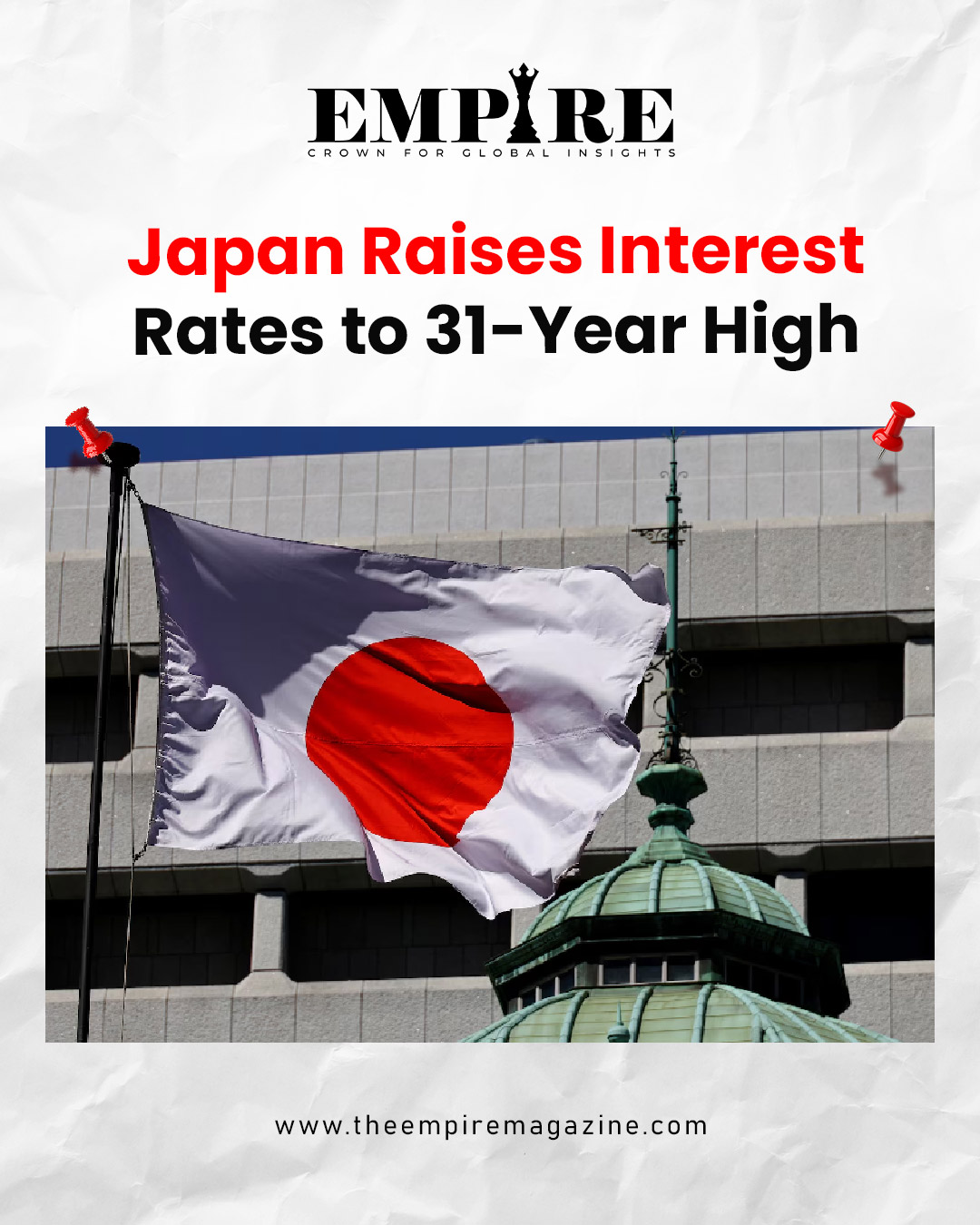
Japan’s Historic Rate Hike and Market Shock
Japan has officially entered a new financial era as the Bank of Japan (BOJ) raised interest rates to their highest level in 31 years, marking a dramatic departure from decades of ultra-loose monetary policy that defined the country’s economic strategy since the 1990s. This decision has sent shockwaves through global markets, reshaping expectations for the yen, bond yields, and equity flows across Asia and beyond. For years, Japan remained the symbol of negative or near-zero interest rates, a policy designed to fight deflation and stimulate growth in a stagnant economy. However, rising inflationary pressures, stronger wage growth, and persistent currency depreciation have forced policymakers to rethink their long-standing stance. The move has been widely interpreted as a signal that Japan is finally transitioning away from its “cheap money” era, with profound implications for global liquidity. Investors in Tokyo, particularly those tracking the Nikkei index and Japanese government bonds, reacted with heightened volatility as markets tried to price in a future where borrowing costs are no longer artificially suppressed. The yen strengthened sharply following the announcement, reflecting renewed confidence in Japan’s monetary direction, while exporters faced immediate pressure due to currency fluctuations. Analysts have described this as one of the most significant policy pivots in modern Japanese economic history, comparable in importance to global rate cycles in the United States and Europe.
Why the Bank of Japan Changed Its Long-Standing Policy
The decision by the Bank of Japan was not abrupt but rather the result of mounting economic signals that made the continuation of ultra-low interest rates increasingly unsustainable. Under Governor Kazuo Ueda of the Bank of Japan, policymakers have been closely monitoring inflation trends that have finally remained above the BOJ’s long-elusive 2% target for a sustained period. Unlike previous inflation spikes driven by external shocks, the current price pressures in Japan are increasingly supported by domestic wage growth, particularly after major labor unions negotiated stronger pay hikes in recent annual shunto wage talks. This shift is critical because Japan’s decades-long deflationary mindset was deeply embedded in weak wage dynamics and cautious consumer behavior. At the same time, the weakening yen over the past years significantly increased import costs for energy and food, pushing household inflation higher and creating political pressure for policy normalization. The BOJ also faced growing concerns about financial distortions caused by prolonged negative interest rates, including pressure on banking profitability and inefficient capital allocation. With global central banks such as the U.S. Federal Reserve and the European Central Bank tightening aggressively in recent cycles, Japan’s divergence became increasingly difficult to justify. As a result, this rate hike represents a carefully calibrated response to both domestic inflation dynamics and global monetary alignment, signaling that Japan is gradually rejoining the mainstream interest rate environment after decades of exceptional policy conditions.
Impact on Japan’s Economy, Inflation, and Households
The ripple effects of the interest rate hike are expected to be deeply felt across Japan’s domestic economy, particularly in borrowing costs, consumer sentiment, and housing markets. Higher interest rates will directly increase mortgage payments and corporate loan costs, affecting both household budgets and business investment plans. While savers may benefit from improved deposit returns for the first time in decades, heavily indebted households could face financial strain as variable-rate loans adjust upward. The move also comes at a delicate time for Japan’s economic recovery, which has been gradually stabilizing after years of pandemic disruption and supply chain shocks. Inflation, which has been hovering above target levels, may moderate slightly in the long run if demand cools due to tighter financial conditions, but short-term price pressures are likely to remain elevated due to energy imports and currency fluctuations. Retail spending patterns could shift as consumers become more cautious, especially in urban centers like Tokyo and Osaka, where living costs are already high. Meanwhile, businesses, particularly small and medium enterprises, may face tighter credit conditions, potentially slowing expansion plans and hiring momentum. However, policymakers believe that a controlled normalization of rates is necessary to prevent asset bubbles and restore long-term financial stability. The balancing act for Japan’s economy is therefore complex: supporting sustainable growth while ensuring that inflation does not spiral beyond control, all while carefully unwinding decades of unconventional monetary easing without triggering financial instability.
Global Market Reaction and Currency Volatility
Global financial markets reacted swiftly to Japan’s landmark interest rate decision, with immediate implications for currency trading, equity flows, and bond market dynamics. The Japanese yen surged against major currencies, reflecting expectations that higher yields will attract foreign capital back into Japanese assets after years of outflows driven by ultra-low returns. This sudden appreciation, however, created mixed reactions in global export markets, particularly for Japanese multinational corporations that rely heavily on overseas revenues. Stock markets in Asia saw volatility as investors reassessed valuations of export-heavy sectors such as automobiles and electronics, which are highly sensitive to currency strength. In bond markets, yields on Japanese government bonds rose sharply as traders adjusted to the new rate environment, marking the end of an era defined by yield suppression under the Bank of Japan. Internationally, the move has also influenced expectations for global liquidity conditions, with analysts suggesting that Japan’s shift could accelerate capital reallocation from U.S. and European markets back into Asia. Emerging markets are also watching closely, as changes in Japanese investment flows often have spillover effects on regional currencies and equities. Meanwhile, hedge funds and institutional investors are recalibrating their strategies, particularly those involved in yen carry trades, which have historically depended on Japan’s near-zero interest rate environment. The unwinding of these positions could contribute to further short-term volatility across global financial systems, reinforcing Japan’s outsized influence on international capital markets despite its relatively modest inflation-adjusted growth rate.
What Comes Next for Japan and Global Investors
Looking ahead, Japan’s monetary policy trajectory will be one of the most closely watched economic developments in the global financial system. The key question is whether this 31-year high interest rate marks the beginning of a sustained tightening cycle or a cautious one-off adjustment designed to stabilize inflation expectations without derailing growth. Policymakers at the Bank of Japan are expected to proceed carefully, likely adopting a data-dependent approach that responds to inflation trends, wage growth, and currency stability rather than committing to aggressive rate hikes. For investors, this new environment introduces both opportunities and risks: Japanese financial assets may become more attractive due to higher yields, but volatility is likely to remain elevated during the transition away from decades of ultra-loose monetary policy. The housing market, corporate borrowing patterns, and export competitiveness will all play critical roles in shaping Japan’s next economic phase. On a global scale, Japan’s shift could mark the final chapter in the world’s prolonged era of cheap money, especially as other major economies have already moved through tightening cycles. If Japan successfully navigates this transition, it could strengthen its long-term economic resilience and restore balance to its financial system. However, any missteps could risk slowing growth or destabilizing fragile recovery momentum. Ultimately, Japan’s historic rate hike is not just a domestic policy change, it is a signal that global monetary dynamics are entering a new and more uncertain phase, where capital costs, currency flows, and inflation management will redefine economic strategy for years to come.
For more business and retail insights, read more on The Empire Magazine
Previous article: India Opens Stock Market for Global Retail Investors
Magazine Feautures | Podcasts: Empire Global Talks
Follow The Empire Magazine on Facebook | Instagram | LinkedIn
The Empire Magazine | Crown for Global Insights