
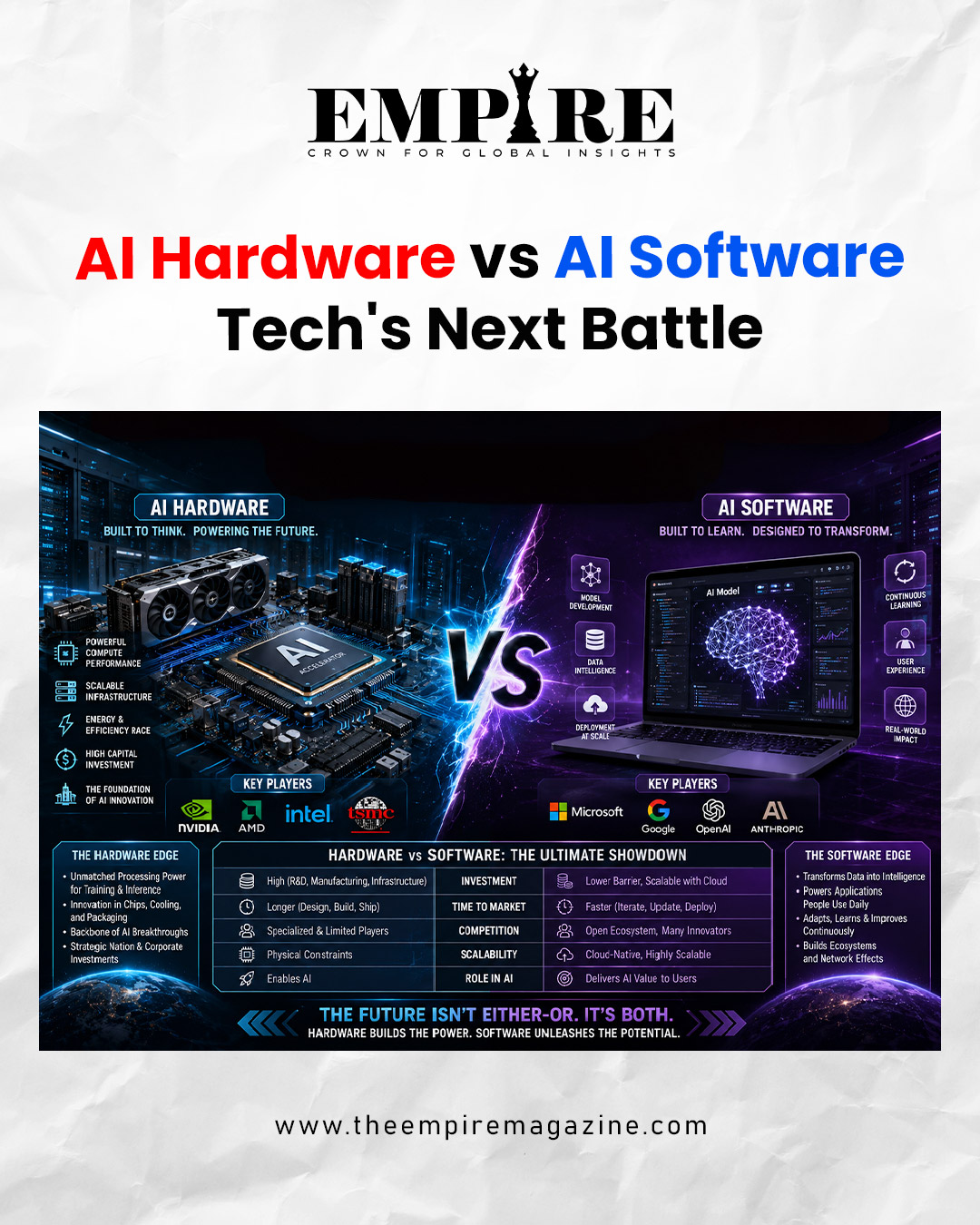
Artificial intelligence is no longer a futuristic promise, it is the defining infrastructure layer of modern technology. From generative AI tools reshaping content creation to enterprise systems automating decision-making, the industry is expanding at a pace that is forcing a quiet but significant divide: the race between AI hardware and AI software.
On one side are the engineers building increasingly sophisticated models and applications. On the other are the semiconductor giants designing the physical backbone that makes those models possible. What was once a complementary relationship is now becoming a strategic competition in its own right. And in many ways, the next phase of the AI economy will be decided not by who builds the smartest model, but by who controls the bottleneck.
The AI Boom and the New Infrastructure Reality
The rapid acceleration of AI adoption over the past few years has exposed a fundamental truth: intelligence at scale is expensive.
Large language models, generative image systems, and multimodal AI require massive computational power. Training a single frontier model can involve thousands of high-performance GPUs running for weeks or months. Even after training, running these systems at scale, known as inference, demands continuous infrastructure support.
This has created a structural dependency. Every breakthrough in AI software now relies heavily on hardware availability, energy efficiency, and data center capacity. In earlier software revolutions, innovation was often limited by code. Today, it is increasingly constrained by silicon. This shift has elevated semiconductor companies from background suppliers to central players in the AI economy.
AI Software: The Race for Intelligence at Scale
While hardware sets the foundation, AI software remains the visible face of the revolution. Companies building foundation models and applications are shaping how AI is experienced by users and businesses.
Large language models (LLMs), multimodal systems, and autonomous agents are rapidly evolving into productivity layers across industries. From customer service automation to code generation and enterprise analytics, AI software is embedding itself into workflows that were previously human-led.
What makes this layer particularly competitive is its scalability. Once a model is trained, it can be deployed across millions of users with relatively low marginal cost compared to traditional industries. This has allowed software-first AI companies to scale rapidly, attracting massive investment and global attention.
However, there is a hidden constraint: the more capable the software becomes, the more dependent it is on compute power. Advanced reasoning models, for example, require exponentially more processing than earlier systems. This means software innovation is increasingly tied to hardware evolution. In other words, AI software is pushing the limits of what AI hardware can currently support.
The AI Hardware Arms Race: Chips, GPUs, and Beyond
If AI software is the brain, AI hardware is the nervous system and it is undergoing one of the most aggressive transformation cycles in tech history.
At the center of this shift are graphics processing units (GPUs), which have become the backbone of AI computation. Originally designed for gaming and graphics rendering, GPUs are now indispensable for training and running AI models due to their ability to handle parallel processing at scale.
Companies like NVIDIA have emerged as dominant players in this space, effectively becoming infrastructure providers for the AI era. Their chips power everything from research labs to enterprise AI systems.
At the same time, competitors such as AMD and custom silicon developers are intensifying the race. Cloud providers are also entering the hardware game, designing proprietary chips optimized for their ecosystems. This includes AI accelerators and application-specific integrated circuits (ASICs) designed to reduce dependency on external suppliers.
Behind the scenes, the semiconductor supply chain has become geopolitically significant. Fabrication hubs, particularly advanced foundries like TSMC, play a critical role in determining global AI capacity. Without access to cutting-edge chip manufacturing, even the most advanced AI software cannot scale effectively. This has turned AI hardware into a strategic asset, not just a technical requirement.
When Software Meets Hardware: The Convergence Point
Despite the apparent divide, AI hardware and software are not evolving independently. Instead, they are increasingly shaping each other.
Modern AI systems are being designed with hardware awareness in mind. Model architectures are now optimized for efficiency, reducing compute costs without sacrificing performance. Techniques such as quantization, sparsity, and distillation are helping models run faster and cheaper on available hardware.
At the same time, hardware is being designed with AI workloads as the primary focus. Instead of general-purpose computing, chips are now built specifically for matrix operations, neural network training, and inference optimization.
A major emerging frontier is edge AI where intelligence is processed directly on devices such as smartphones, sensors, and vehicles rather than centralized data centers. This shift requires ultra-efficient chips capable of running complex models with minimal power consumption.
The result is a feedback loop: better hardware enables better models, and better models demand better hardware. The boundary between the two is gradually dissolving.
The Economics of AI: Where Value Is Actually Being Created
The competition between AI hardware and software is not just technological, it is deeply economic.
Hardware companies benefit from infrastructure-level demand. Every AI company, regardless of its model or application, needs compute resources. This creates a relatively stable, high-demand market where pricing power can be significant.
Software companies, on the other hand, operate in a more volatile environment. While they can scale rapidly and reach massive user bases, they also face intense competition and rapid commoditization. As AI models become more accessible, differentiation is increasingly shifting from model quality to ecosystem integration and user experience.
Interestingly, some of the most powerful positions in the AI economy today are held by companies that sit at the intersection of both layers those controlling cloud infrastructure, compute access, and platform distribution.
This has led to a subtle but important shift in investor sentiment. Rather than asking “Who has the best AI model?”, markets are increasingly asking “Who controls the compute?”
Energy, Data Centers, and the Hidden Constraint
Beyond chips and models lies another critical factor: energy. AI data centers are becoming some of the most power-intensive infrastructure systems ever built. Training large-scale models and serving billions of inference requests requires enormous electricity consumption and cooling systems.
This introduces a new layer of constraint that affects both hardware and software development. Even if chip performance continues to improve, energy availability and efficiency will determine how far AI systems can scale globally.
As a result, companies are investing heavily in energy-efficient architectures, advanced cooling systems, and geographically distributed data centers. The future of AI may depend as much on energy strategy as on algorithmic innovation.
The Road Ahead: A Balanced but Competitive Future
The debate between AI hardware and AI software is not a zero-sum conflict. Instead, it is becoming a co-dependent evolution where each side pushes the other forward.
AI software will continue to define what intelligence looks like how models reason, generate, and interact. But AI hardware will define how far and how fast that intelligence can scale across the world.
In the coming years, the most successful players in the AI ecosystem are unlikely to be those that specialize in only one layer. Instead, advantage will come from integration: software designed with hardware efficiency in mind, and hardware designed for the next generation of AI workloads.
The real competition, therefore, is not AI hardware versus AI software. It is about which companies can best unify the two into a seamless system of intelligence.
And as the industry matures, that integration will likely define the next era of technological leadership.
For more business and retail insights, read more on The Empire Magazine
Previous articles: Subscription based models | Airport Slowdown
Magazine Edits: Magazines
Podcasts: Empire Global Talks
Follow The Empire Magazine on Facebook | Instagram | LinkedIn
The Empire Magazine | Crown for Global Insights