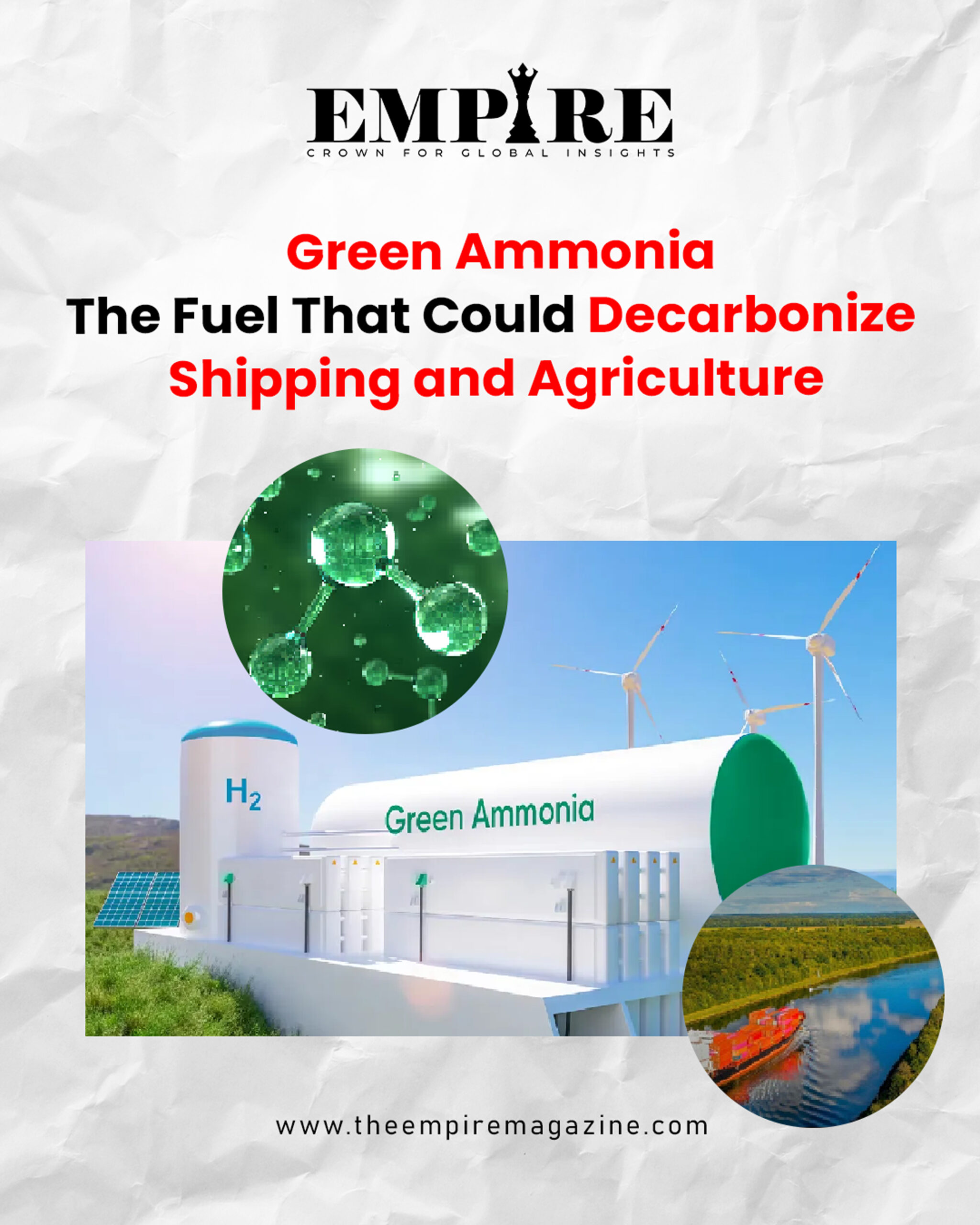
Green ammonia is emerging as one of the most promising solutions in the global transition to net-zero emissions. Produced using renewable energy, green ammonia offers a clean, versatile, and scalable fuel that could significantly decarbonize two of the hardest-to-abate sectors: international shipping and agriculture. As of 2026, this carbon-free compound is gaining serious traction as a game-changing energy carrier for the future.
What is Green Ammonia?
Ammonia (NH₃) is a compound made of nitrogen and hydrogen. While traditional “grey ammonia” is produced from natural gas through the energy-intensive Haber-Bosch process, green ammonia is manufactured using renewable electricity.
The production process involves:
- Electrolysis of water to produce green hydrogen
- Combining hydrogen with nitrogen (extracted from the air)
- Powered entirely by solar, wind, or hydropower
The result is ammonia with near-zero carbon emissions during production, making it a truly sustainable fuel and chemical feedstock.
Why Green Ammonia Matters
Unlike batteries or hydrogen gas, ammonia is easier to store and transport. It has a high energy density, can be liquefied at moderate pressures, and leverages existing global infrastructure built for traditional ammonia. These characteristics make it an ideal candidate for decarbonizing sectors where direct electrification is difficult.
Decarbonizing Shipping with Green Ammonia
The shipping industry accounts for nearly 3% of global greenhouse gas emissions. With over 100,000 commercial vessels operating worldwide, finding a clean fuel has been challenging.
Green ammonia is currently one of the top contenders for zero-emission shipping:
- It can be used directly in internal combustion engines or fuel cells.
- Several major shipping companies, including Maersk, have placed orders for ammonia-powered vessels.
- In 2026, the first large-scale green ammonia-powered ships are expected to enter commercial operations.
- Ports in Singapore, Rotterdam, and Fujairah are developing green ammonia bunkering facilities.
Compared to other alternatives like methanol or LNG, green ammonia offers the advantage of truly zero carbon emissions at the point of combustion (it releases nitrogen and water vapor).
Revolutionizing Agriculture
Agriculture is responsible for a significant portion of global emissions, particularly through synthetic fertilizers. Ironically, ammonia is the key ingredient in nitrogen fertilizers.
Green ammonia can close this loop sustainably:
- Replace grey ammonia in fertilizer production, cutting emissions from one of the most carbon-heavy industrial processes.
- Enable “carbon-neutral farming” by producing fertilizers using renewable energy.
- Support precision agriculture by providing clean inputs for food production.
This dual use — as both fuel and fertilizer — gives green ammonia a unique advantage in the energy transition.
Major Projects and Developments in 2026
The green ammonia sector is expanding rapidly:
- Australia, Saudi Arabia, and Chile are leading large-scale green ammonia export projects powered by massive solar and wind farms.
- India has launched ambitious national programs to produce green ammonia for both domestic use and exports.
- Europe is investing heavily through the EU’s Hydrogen Strategy, with several green ammonia import terminals under construction.
- Companies like Yara, CF Industries, and new startups are scaling up production facilities.
By 2026, global green ammonia production capacity has crossed 2 million tonnes per year and is projected to grow exponentially by 2030.
Key Advantages of Green Ammonia
- Energy Storage: Can store renewable energy seasonally, solving intermittency issues of solar and wind.
- Global Trade Potential: Easier to ship long distances than hydrogen.
- Leverages Existing Infrastructure: Uses tanks, pipelines, and ships already designed for ammonia.
- Versatile Applications: Fuel for shipping, power generation, fertilizer, and even as a hydrogen carrier.
- Safety Improvements: Modern technologies have made handling ammonia safer than in previous decades.
Challenges Facing Green Ammonia
Despite its promise, several hurdles remain:
- High Production Cost: Green ammonia is currently 2–4 times more expensive than grey ammonia due to the cost of renewable electricity and electrolyzers.
- Toxicity and Safety: Ammonia is corrosive and toxic, requiring careful handling and new safety protocols.
- Engine and Infrastructure Development: Most existing ship engines and fertilizer plants need modification or replacement.
- Energy Efficiency: The full production-to-use cycle still has efficiency losses.
- Policy Support: Needs consistent government incentives and carbon pricing to become competitive.
The Road Ahead
Experts believe that with continued cost reduction in renewable energy and electrolyzers, green ammonia could become cost-competitive by 2030–2035. International collaborations, such as the Mission Innovation Green Ammonia program, are accelerating research and deployment.
In the long term, green ammonia could become a cornerstone of the global energy system — powering ships across oceans, fertilizing crops, and storing clean energy at scale.
For more inspiring stories of leadership, technology, and global innovation, read our detailed coverage here.
Follow The Empire Magazine for more updates on business, startups, technology, and global insights: Instagram | Facebook
– The Empire Magazine
Crown For Global Insights