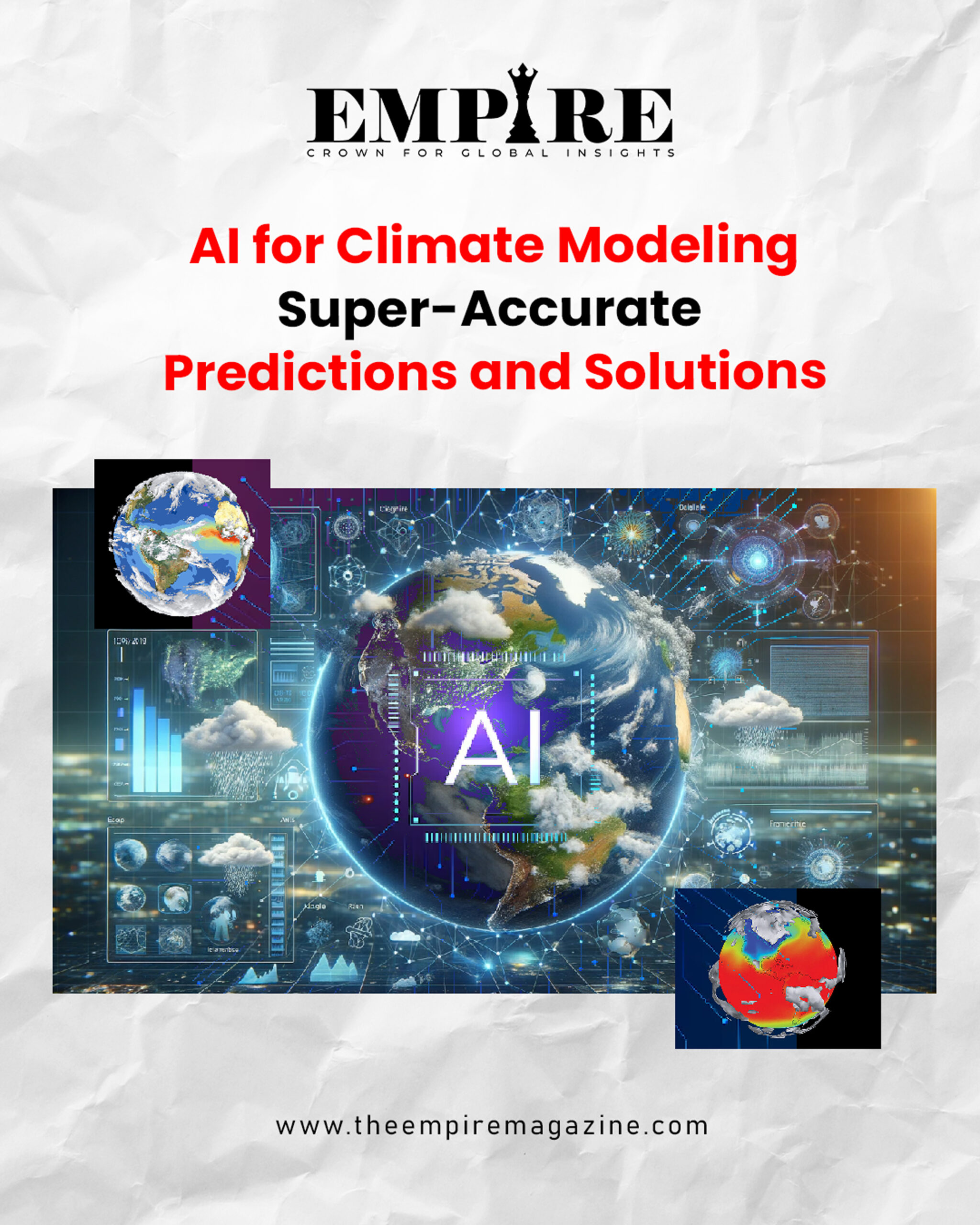
Artificial Intelligence is revolutionizing climate science. AI for Climate Modeling has emerged as one of the most powerful tools in humanity’s fight against climate change, delivering faster, more accurate, and highly detailed predictions than traditional methods. As of 2026, AI-powered models are helping governments, scientists, and businesses make better decisions to mitigate and adapt to climate challenges.
Why Traditional Climate Models Were Limited
For decades, climate modeling relied on complex physical equations and supercomputers running simulations that took weeks or even months to complete. These models often struggled with regional accuracy, extreme weather events, and long-term uncertainties.
The sheer complexity of Earth’s climate system — involving atmosphere, oceans, land, ice, and biosphere interactions — made precise forecasting extremely difficult. This is where AI for Climate Modeling is making a transformative impact.
How AI is Transforming Climate Modeling
AI and machine learning algorithms can process massive datasets from satellites, weather stations, ocean buoys, and historical records at unprecedented speeds. Key technologies driving this revolution include:
- Deep Learning Neural Networks that identify complex patterns humans might miss
- Reinforcement Learning for simulating future climate scenarios
- Generative AI for creating high-resolution climate projections
- Physics-Informed Neural Networks (PINNs) that combine scientific laws with data-driven learning
These tools allow scientists to run simulations in hours instead of months while achieving significantly higher resolution and accuracy.
Major Breakthroughs in 2026
In 2026, several groundbreaking developments have accelerated the adoption of AI for Climate Modeling:
- Google DeepMind’s GraphCast model continues to outperform traditional systems in weather forecasting, now extended to seasonal and decadal climate predictions.
- New hybrid AI models developed by NASA and the European Space Agency can predict extreme events like heatwaves, hurricanes, and floods with 30–40% higher accuracy than previous models.
- India’s own AI-driven climate initiative has successfully modeled monsoon patterns with improved regional precision, helping millions of farmers prepare for erratic rainfall.
- Private companies like IBM and Microsoft are deploying AI platforms that help cities and corporations forecast climate risks for infrastructure planning.
Key Advantages of AI for Climate Modeling
- Higher Resolution: AI models can generate predictions at the city or even neighborhood level, unlike traditional global models that worked at 100+ km scales.
- Speed: What once took weeks can now be completed in real-time or near real-time.
- Better Extreme Event Prediction: Improved ability to forecast rare but catastrophic events such as super-cyclones and prolonged droughts.
- Uncertainty Quantification: AI can better communicate confidence levels and multiple possible outcomes.
- Cost Efficiency: Reduces dependency on extremely expensive supercomputers.
Real-World Applications and Solutions
AI for Climate Modeling is not just about predictions — it is actively driving solutions:
- Early Warning Systems: Countries are using AI to provide days or weeks of advance notice for disasters, saving lives and reducing economic losses.
- Renewable Energy Optimization: AI models help predict solar and wind patterns more accurately, improving grid stability.
- Agriculture Adaptation: Farmers receive personalized advisories on crop selection, planting times, and water management based on hyper-local climate forecasts.
- Carbon Capture Planning: AI identifies optimal locations for large-scale carbon removal projects.
- Urban Planning: Cities use AI climate twins to design heat-resilient infrastructure and green spaces.
Challenges and Ethical Considerations
Despite its immense potential, AI for Climate Modeling faces several challenges:
- Data Bias: Models can inherit biases from historical data, especially in under-represented regions like Africa and small island nations.
- High Energy Consumption: Training large AI models requires significant electricity, creating a carbon footprint paradox.
- Interpretability: Some AI systems act as “black boxes,” making it difficult for scientists to fully understand their reasoning.
- Access Inequality: Advanced AI tools are currently concentrated in developed nations and large tech companies.
Researchers are addressing these issues through open-source models, federated learning, and more transparent AI architectures.
The Road Ahead: AI as a Climate Solution
By 2030, experts predict that AI-driven climate models will become the global standard. Integration with quantum computing and satellite networks is expected to further enhance accuracy.
Governments and international organizations are increasingly investing in AI climate initiatives. The United Nations and World Meteorological Organization have called for greater collaboration to ensure these powerful tools benefit all nations, especially vulnerable developing countries.
Conclusion
AI for Climate Modeling represents a historic leap in our ability to understand and respond to climate change. By delivering super-accurate predictions and practical solutions, artificial intelligence is becoming one of humanity’s strongest allies in building a sustainable future.
While AI alone cannot solve the climate crisis, its ability to provide faster insights, better forecasts, and smarter strategies makes it an indispensable tool. The coming years will determine how effectively we harness this technology to protect our planet.
For more inspiring stories of leadership, technology, and global innovation, read our detailed coverage here.
Follow The Empire Magazine for more updates on business, startups, technology, and global insights: Instagram | Facebook
– The Empire Magazine
Crown For Global Insights