
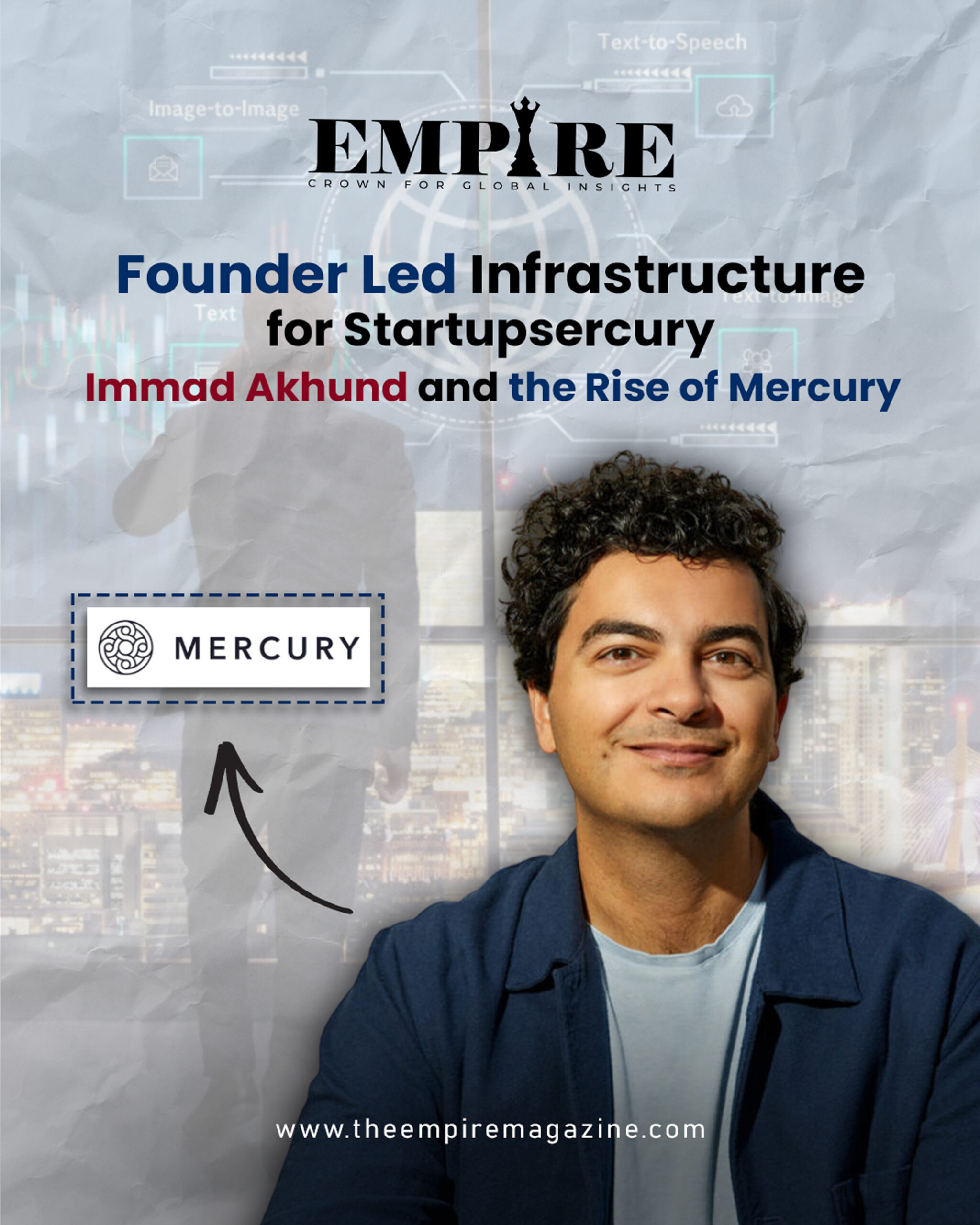
Founder-Led Infrastructure for Startups ecosystem depends heavily on speed, flexibility, and efficient financial operations. Traditional banking systems, however, were never designed for fast-growing startups, global founders, or digital-first businesses. This gap created enormous frustration for entrepreneurs worldwide and opened the door for a new generation of fintech innovation.
One of the most successful examples of this transformation is Mercury, the fintech platform co-founded by Immad Akhund. Under Akhund’s leadership, Mercury has rapidly evolved into one of the most trusted financial infrastructure companies serving startups and ambitious businesses across the United States.
By early 2026, Mercury serves more than 300,000 customers, processes hundreds of billions in transaction volume, and continues to grow while maintaining profitability. The company’s success demonstrates the increasing importance of founder-led infrastructure businesses that deeply understand customer pain points and solve them with modern technology.
For more business and innovation insights, visit this internal feature:
https://theempiremagazine.com/?p=6321
Immad Akhund Built Mercury From Real Startup Frustrations
Before launching Mercury, Immad Akhund had already experienced the challenges of entrepreneurship firsthand. He previously co-founded Heyzap, a mobile advertising and developer tools company that was later acquired in a deal valued at approximately $45 million.
During his startup journey, Akhund repeatedly faced problems with traditional banking systems. Opening business accounts often required endless paperwork, international transactions were slow, digital tools were outdated, and many banks simply did not understand how startups operated.
For founders trying to move quickly, these issues became major operational roadblocks.
Instead of accepting outdated financial systems, Akhund saw an opportunity to create a completely new banking experience tailored specifically for startups and modern businesses.
In 2017, he co-founded Mercury alongside Max Tagher and Jason Zhang with a clear mission: to build a financial operating system designed for how startups actually work.
Unlike many startups focused on rapid launches, Mercury spent significant time refining its product experience before going public. Akhund believed in building a “minimum delightful product” rather than rushing an unfinished solution to market.
That product-first philosophy became one of the company’s greatest strengths.
Mercury’s Rapid Rise in the Fintech Industry
Mercury officially launched in 2019 and quickly gained momentum among startups, venture-backed companies, and digital businesses.
The platform offered founders exactly what traditional banks failed to provide:
- Fast online account setup
- Intuitive and modern user interfaces
- Developer-friendly APIs
- Integrated payments and treasury tools
- International wire capabilities
- Multi-user permissions
- Expense management systems
- Scalable infrastructure for growing companies
Startups immediately responded to Mercury’s modern approach. During its early stages, the company reportedly experienced monthly growth rates between 30% and 40%.
By 2026, Mercury had become one of the most influential fintech companies serving the startup ecosystem.
Key performance highlights include:
- More than 300,000 customers
- Approximately $248 billion in transaction volume
- Around $650 million in annualized revenue
- Three consecutive years of GAAP profitability
- Over 35% penetration among early-stage U.S. startups
Mercury also expanded beyond venture-backed technology companies. A large percentage of new customers now come from industries such as ecommerce, agencies, consulting firms, and professional services businesses.
This diversification strengthened Mercury’s position as a broader financial infrastructure platform rather than simply a startup-focused fintech tool.
Why Mercury Became the Preferred Platform for Founders
Mercury’s success is rooted in its deep understanding of founder needs.
Traditional banks often treat startups as high-risk customers with unpredictable financial profiles. Mercury approached the market differently by building specifically for entrepreneurs and fast-growing businesses.
Speed and Simplicity
Modern startups operate quickly, and delays in banking operations can create serious business challenges. Mercury streamlined onboarding and account management to eliminate unnecessary friction.
Digital-First Infrastructure
Mercury’s platform was designed for the internet era. APIs, automation tools, and intuitive dashboards make the experience highly attractive to technical founders and digital businesses.
Global Accessibility
Startups increasingly operate across multiple countries and remote teams. Mercury supports international founders and cross-border financial operations more effectively than many traditional banks.
Scalability
The platform is designed to grow alongside businesses. Whether a startup is raising its first funding round or managing large transaction volumes, Mercury’s infrastructure can scale efficiently.
Long-Term Reliability
Mercury has also focused heavily on operational stability and customer trust. The company has explored obtaining a national bank charter to strengthen control over the customer experience and enhance long-term reliability.
This disciplined approach has helped Mercury stand out in a competitive fintech market.
Founder-Led Companies Often Build Better Infrastructure
Mercury’s rise also highlights the advantages of founder-led businesses.
Immad Akhund remains closely involved in Mercury’s strategy and product development. Because he personally experienced the frustrations faced by startup founders, he understands the customer perspective in a way many traditional executives cannot.
Founder-led companies often outperform because they:
- Solve authentic problems
- Focus deeply on product quality
- Prioritize long-term thinking
- Maintain strong customer alignment
- Innovate quickly without excessive bureaucracy
Mercury’s consistent execution reflects these strengths clearly.
Instead of chasing temporary fintech trends, the company focused on building durable infrastructure businesses depend on every day.
Mercury’s Expansion Beyond Startup Banking
While Mercury originally became popular among startups, the company is now expanding aggressively into broader financial services.
Recent growth initiatives include:
- Treasury and yield management products
- Expense and spending management systems
- Corporate cards
- Payroll and financial operations tools
- Services tailored for AI companies
- Mercury Personal financial offerings
These expansions position Mercury as a complete financial operating system for modern businesses.
The company’s evolution resembles how Stripe expanded beyond payments into broader internet infrastructure. Mercury is following a similar path in business finance and operational banking.
Profitability Strengthens Mercury’s Position
One of Mercury’s most impressive accomplishments is achieving profitability while continuing to scale rapidly.
Many fintech startups prioritized user growth at the expense of sustainable economics. Mercury chose a more disciplined strategy by balancing aggressive expansion with operational efficiency.
By maintaining multiple consecutive years of GAAP profitability, Mercury demonstrated that fintech companies can grow rapidly while building durable businesses.
This balance has significantly strengthened investor confidence.
In 2025, Mercury raised approximately $300 million in Series C funding at a valuation of around $3.5 billion. Reports in 2026 suggest the company may pursue additional financing at valuations exceeding $5 billion.
The Future of Founder-Led Financial Infrastructure
The rise of Mercury reflects a much larger transformation across the global business economy. Entrepreneurs and modern companies increasingly expect financial infrastructure to operate with the same intelligence, flexibility, and user experience as modern software platforms.
Immad Akhund identified this shift early and built Mercury around the realities of modern entrepreneurship rather than outdated banking models.
As AI startups, ecommerce companies, global teams, and remote-first businesses continue expanding, demand for scalable financial infrastructure will continue to grow.
Mercury is positioning itself not just as a digital banking alternative, but as essential infrastructure for the next generation of businesses.
Its combination of founder-led leadership, strong product execution, operational discipline, and customer-first thinking gives the company a powerful long-term advantage in the rapidly evolving fintech landscape.
The success of Mercury proves that founder-led infrastructure companies can reshape entire industries when they solve real operational problems with clarity, speed, and long-term vision.
Follow us for more business and innovation insights:
Instagram: https://www.instagram.com/the_empire_magazine/
Facebook: https://www.facebook.com/profile.php?id=61573749076160
– The Empire Magazine
Crown For Global Insights