AI Model Wars Introduction
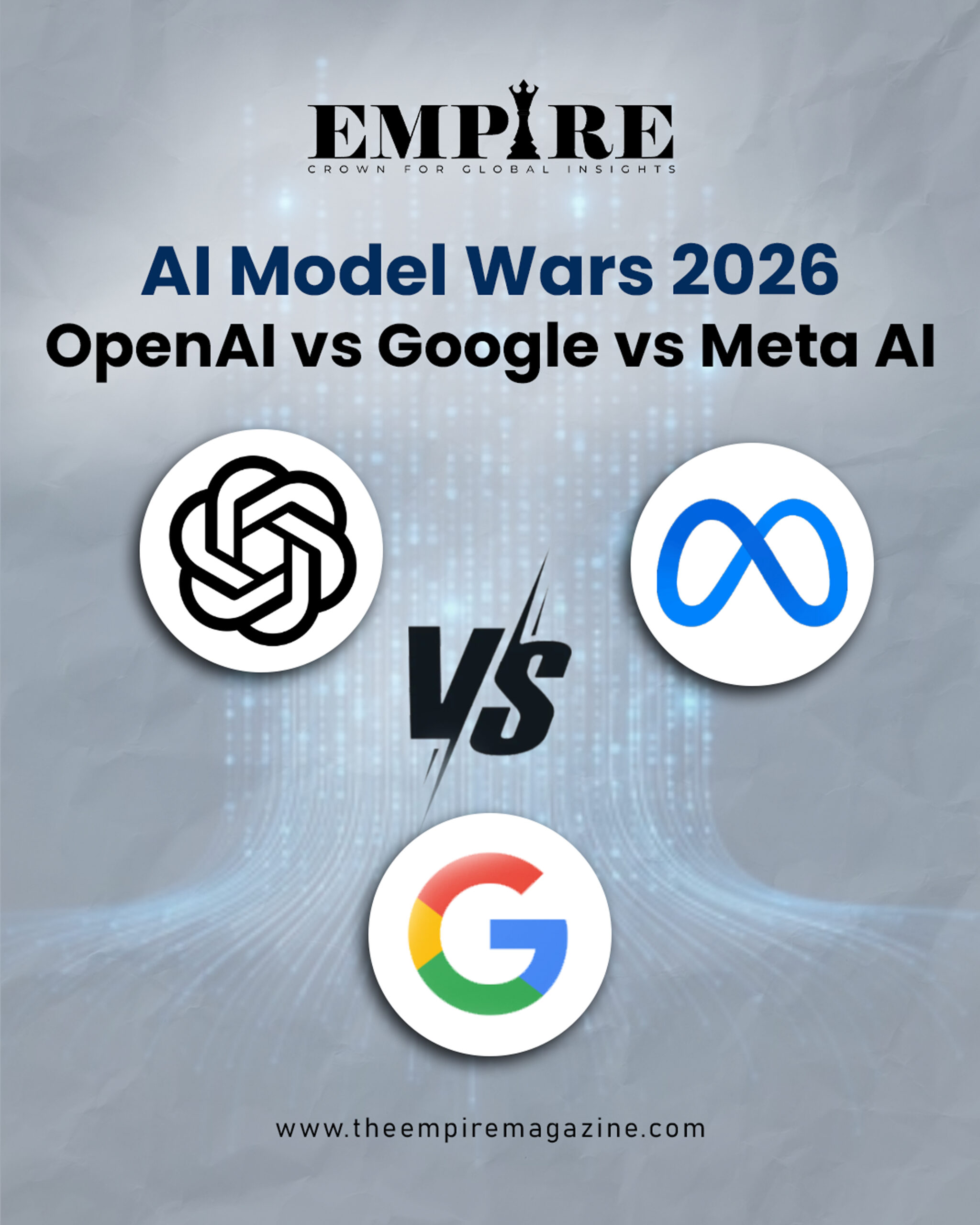
The global artificial intelligence race has evolved into one of the most intense technological battles of the modern era. Companies like OpenAI, Google, Meta, and Anthropic are competing to build the most powerful AI systems—often referred to as the “AI brain.”
This competition is not just about innovation; it is about shaping economies, influencing jobs, and defining how humans interact with technology. From conversational AI to multimodal intelligence and autonomous systems, each company brings a unique approach to this rapidly evolving landscape.
For more deep insights, explore:
https://theempiremagazine.com/?p=6254&preview=true
The Rise of the AI Arms Race
The AI boom accelerated when ChatGPT brought conversational AI into the mainstream. Since then, tech giants have been racing to push boundaries with new models, features, and capabilities.
This “AI arms race” is driven by:
- Demand for smarter digital assistants
- Monetization of data and services
- Advances in computing power and chips
- Competition for global technological dominance
The result is a continuous cycle of innovation, where each company is trying to outpace the others.
OpenAI: The Leader in Conversational Intelligence
OpenAI has established itself as a pioneer in general-purpose AI. Its models, including GPT-4 and beyond, are designed for natural, human-like interaction.
Strengths:
- Highly advanced conversational abilities
- Strong performance in writing, coding, and reasoning
- Wide accessibility across platforms
OpenAI’s focus is clear: build AI that can assist, create, and communicate effectively across industries. Its rapid innovation cycle keeps it ahead in user-facing AI experiences.
Limitations:
- Limited deep customization for general users
- Occasional inaccuracies in responses
Meta: The Open-Source Challenger
Meta is taking a different path with its LLaMA family of models, including newer versions like Scout, Maverick, and Behemoth.
Strengths:
- Open and flexible for researchers
- Strong multimodal capabilities
- Efficient performance with lower resource requirements
Meta’s strategy focuses on enabling developers and researchers to build customized AI solutions, making it a powerful force in experimentation and innovation.
Limitations:
- Less user-friendly for everyday consumers
- Requires technical expertise to deploy effectively
Google: The Multimodal Powerhouse
Google has entered the race with its advanced AI system, Gemini.
Strengths:
- Deep integration with search and real-time data
- Strong multimodal capabilities (text, images, video)
- Backed by a massive data ecosystem
Google’s AI excels in information retrieval and contextual understanding, making it ideal for research and knowledge-based tasks.
Limitations:
- Still evolving in conversational refinement
- Privacy concerns due to data integration
Anthropic: The Safety-Focused Innovator
Anthropic is quietly building powerful AI systems with a focus on safety and alignment.
Strengths:
- Emphasis on ethical AI development
- Reliable and controlled outputs
- Strong reasoning capabilities
Anthropic’s approach prioritizes long-term trust and safety over rapid feature releases.
The Multimodal Revolution
One of the biggest trends in the AI war is multimodal intelligence—AI systems that can understand text, images, audio, and video simultaneously.
For example:
- Google integrates AI with image recognition tools
- OpenAI enables advanced image generation
- Meta develops multimodal AI for immersive experiences
This shift is transforming AI from a text-based tool into a fully interactive digital assistant.
The Global AI Power Struggle
Beyond companies, the AI race has also become a global competition between nations. The United States leads in AI “brains” (software and models), while China is advancing rapidly in AI “bodies” such as robotics and automation.
Key factors shaping this competition:
- Access to advanced microchips
- Investment in research and infrastructure
- Open-source vs closed AI strategies
The combination of AI software and robotics will define the next phase of technological dominance.
Why This AI War Matters
This battle is not just about companies—it directly impacts everyday life.
1. Jobs and Careers
AI is transforming industries, automating tasks, and creating new opportunities while disrupting traditional roles.
2. Creativity and Content
From writing to design, AI tools are enhancing creativity but also raising questions about originality.
3. Business and Economy
Companies that adopt AI effectively gain a massive competitive advantage.
4. Daily Life
AI assistants are becoming part of everyday routines, from search to communication and decision-making.
Who Is Winning?
There is no single winner yet. Each company dominates a different area:
- OpenAI: Best for conversational AI and creativity
- Google: Strongest in search and real-time intelligence
- Meta: Leader in open-source flexibility and experimentation
- Anthropic: Focused on safe and reliable AI
The real winner may not be the company that builds the first powerful AI—but the one that scales it effectively across the world.
Stay updated with more insights:
Instagram: https://www.instagram.com/the_empire_magazine/
Facebook: https://www.facebook.com/profile.php?id=61573749076160
– The Empire Magazine
Crown For Global Insights