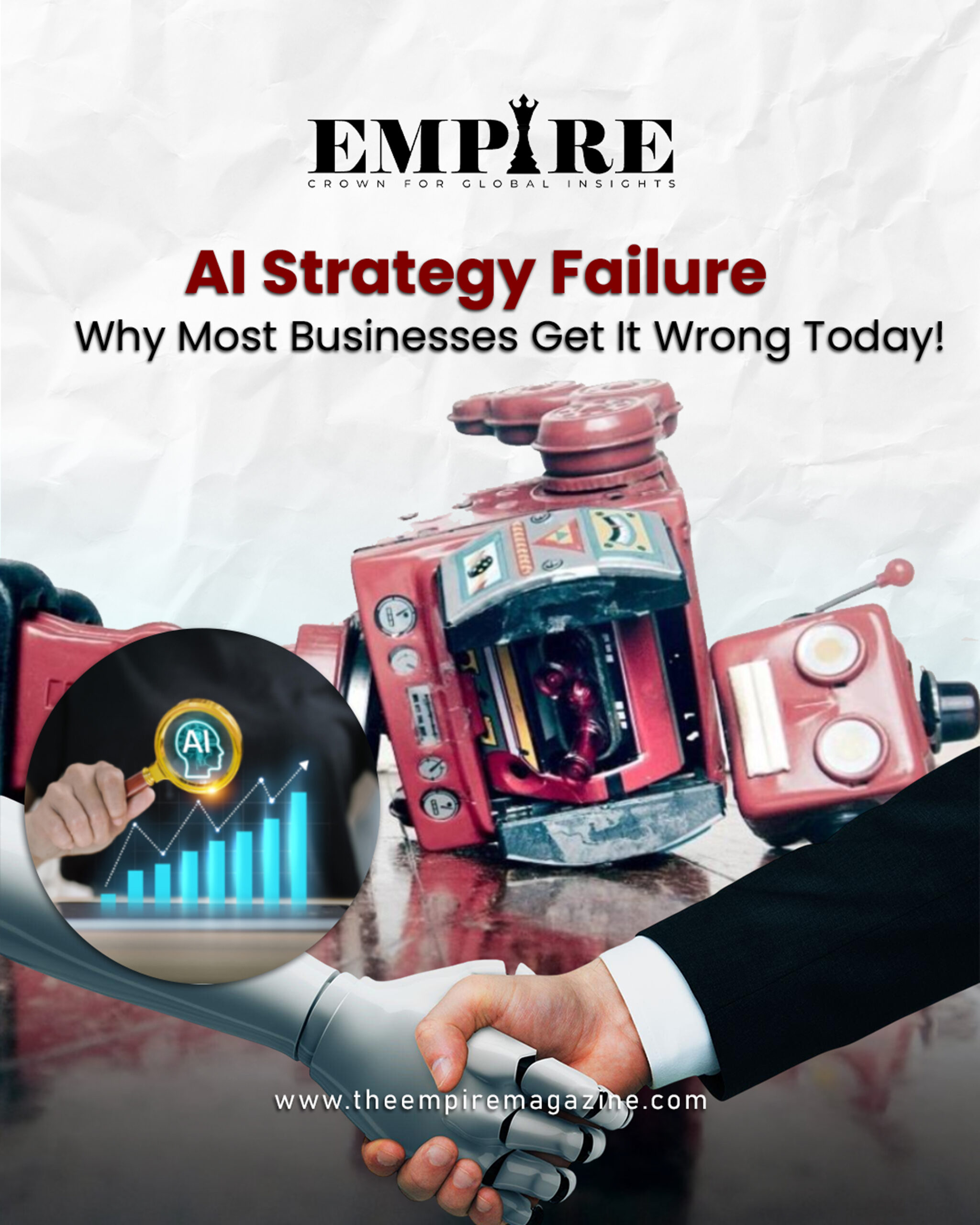
AI Strategy Failure: Why Most Businesses Get It Wrong as companies struggle with execution, data quality, and integration despite heavy AI investments.
Artificial intelligence is often seen as the ultimate competitive advantage in today’s digital economy. Businesses across industries are investing heavily in AI tools, automation platforms, and advanced analytics. However, despite this surge in adoption, a growing number of organizations are facing a common challenge—AI Strategy Failure.
AI Strategy Failure: Why Most Businesses Get It Wrong is not just about technology limitations. It is primarily about how companies approach AI, integrate it into their systems, and align it with real business objectives. While AI promises transformation, the reality for many organizations is underwhelming results, stalled projects, and wasted investments.
The Illusion of Easy AI Implementation
One of the biggest reasons behind AI strategy failure is the belief that AI is a plug-and-play solution. Many companies assume that simply purchasing AI tools or deploying models will automatically improve efficiency and performance.
In reality, AI is not a standalone product—it is a capability that needs to be deeply embedded within workflows, processes, and decision-making systems.
Without proper integration, organizations end up with disconnected systems, fragmented insights, and teams that struggle to use AI effectively. This creates a gap between expectations and actual outcomes.
Data: The Backbone That Is Often Ignored
Another critical factor contributing to AI strategy failure is poor data quality. AI systems rely entirely on data, yet many businesses operate with siloed, inconsistent, or outdated datasets.
When AI models are trained on unreliable data, the results become inaccurate and misleading.
This not only affects decision-making but also reduces trust in AI systems. Over time, organizations may abandon AI initiatives altogether because they fail to deliver reliable outcomes.
Successful companies understand that data is the foundation of AI. They invest in data governance, integration, and quality management before scaling AI initiatives.
The Execution Gap: Where Most Strategies Fail
Access to AI tools is no longer a competitive advantage—execution is. Many organizations have already adopted AI in some form, but very few are able to translate that adoption into measurable business impact.
A common pattern is that AI projects perform well during pilot phases but fail when scaled.
This happens because real-world conditions introduce complexities such as messy data, legacy systems, and operational constraints. As a result, promising AI initiatives often collapse before reaching full implementation.
The key takeaway is simple: AI success is not about experimentation—it is about operationalization.
The Human Factor: The Most Overlooked Element
While technology plays a significant role, the human factor is often the most overlooked aspect of AI adoption. Many organizations fail to prepare their workforce for AI integration.
Employees may lack the skills and understanding needed to use AI effectively. Without proper training, they struggle with basic interactions, leading to poor results and frustration.
This creates resistance to AI adoption and reduces overall productivity. Additionally, unclear ownership of AI initiatives can lead to confusion and lack of accountability.
Organizations that invest in AI literacy, training programs, and change management are far more likely to succeed.
The Rise of Shadow AI and Skills Gap
Another emerging challenge is the rise of “shadow AI.” Employees are increasingly using AI tools independently, outside official systems.
While this shows enthusiasm for AI, it also introduces risks such as:
- Data security issues
- Lack of alignment with business objectives
- Inconsistent outputs across teams
At the same time, there is a growing skills gap. Many organizations do not have structured programs to train employees in AI usage, making it difficult to scale adoption effectively.
Addressing this gap requires a company-wide approach to AI education and governance.
Lack of Clear Metrics and Business Goals
One of the most overlooked reasons behind AI strategy failure is the absence of clear success metrics. Many companies launch AI initiatives without defining what success looks like.
Without measurable KPIs tied to business outcomes—such as revenue growth, cost reduction, or customer satisfaction—it becomes impossible to evaluate the effectiveness of AI projects.
As a result, initiatives are often labeled as failures, even if they delivered value that was never properly measured.
Strategy Over Technology: The Real Solution
Many businesses adopt AI simply because competitors are doing it. This trend-driven approach leads to misaligned priorities and wasted investments.
Successful AI strategies always start with a clear business problem. Whether the goal is improving customer experience, reducing costs, or increasing efficiency, the focus must be on outcomes rather than tools.
Organizations that align AI initiatives with business objectives are far more likely to achieve meaningful results.
From Pilots to Scalable Impact
Transitioning from pilot projects to large-scale implementation is one of the most challenging aspects of AI adoption.
To achieve this, companies must:
- Redesign workflows to incorporate AI insights
- Define clear roles and responsibilities
- Establish governance frameworks
- Continuously monitor and optimize performance
Without these steps, AI initiatives remain stuck in experimental phases and fail to deliver long-term value.
Governance: The Missing Piece
As AI becomes more integrated into decision-making processes, governance becomes essential. Organizations must define:
- Who is responsible for AI-driven decisions
- When human oversight is required
- How risks and compliance are managed
Without governance, businesses face increased risks, reduced trust, and potential regulatory challenges.
Strong governance ensures that AI systems are used responsibly and effectively.
How Businesses Can Fix AI Strategy Failure
To overcome AI strategy failure, organizations need a structured and holistic approach:
- Start with clear business objectives
- Invest in high-quality data infrastructure
- Train employees and build AI literacy
- Define measurable success metrics
- Integrate AI into workflows and processes
- Establish governance and accountability
- Focus on continuous improvement
AI is not a one-time implementation—it is an ongoing transformation.
The Future of AI in Business
AI will continue to play a critical role in shaping the future of business. However, the companies that succeed will not necessarily be those with the most advanced tools.
Instead, success will belong to organizations that:
- Understand their business needs
- Execute effectively
- Empower their workforce
- Measure real outcomes
AI Strategy Failure: Why Most Businesses Get It Wrong serves as a reminder that technology alone is not enough. Strategy, execution, and people are the true drivers of success.
For more insights, visit:
https://theempiremagazine.com/?p=6053
Stay connected:
Instagram: https://www.instagram.com/the_empire_magazine/
Facebook: https://www.facebook.com/profile.php?id=61573749076160
– The Empire Magazine
Crown For Global Insights