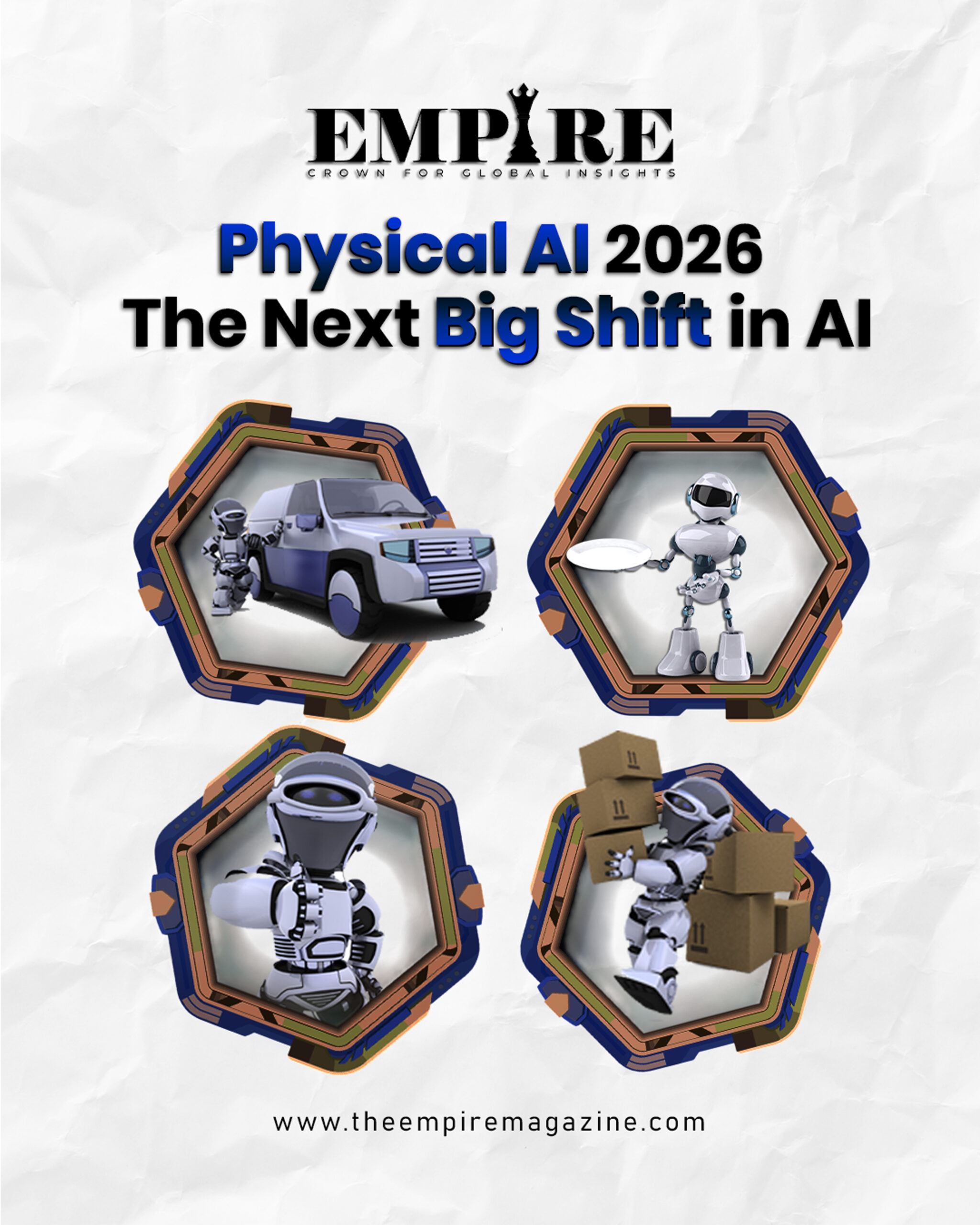
Physical AI 2026 marks a major turning point in the evolution of artificial intelligence. For the past few years, most people experienced AI through screens. It wrote emails, answered questions, generated images, created videos, and helped with coding. But now, AI is moving beyond digital interfaces and entering the physical world. This shift is changing how industries think about automation, safety, robotics, mobility, and intelligent machines.
The AI industry is also going through a strong phase of refocusing. Many companies that once pushed viral consumer-facing generative media products are now shifting toward more practical and business-centered tools. Instead of investing only in flashy public products, attention is moving toward enterprise solutions, coding systems, robotics research, real-time machine intelligence, and tools that can solve practical challenges in the physical world. This change shows that AI is no longer just about content generation. It is increasingly about action, decision-making, and performance in real environments.
That is why physical AI has become one of the most important conversations in 2026.
What Is Physical AI?
Physical AI refers to artificial intelligence embedded in machines that can sense, understand, decide, and act in the real world. Unlike chatbot systems that respond with text, physical AI systems are connected to hardware. They use cameras, microphones, lidar, environmental sensors, robotic arms, wheels, motors, and other mechanical systems to interact with physical surroundings.
In simple terms, physical AI gives intelligence a body.
This means AI can now do more than generate a response. It can navigate roads, pick up objects, move through warehouses, support surgery, deliver packages, monitor industrial systems, and respond to dynamic situations in real time. These systems are not operating in clean digital environments. They must function in messy, fast-changing, and unpredictable real-world conditions.
That is what makes physical AI both exciting and challenging.
Why the AI Industry Is Shifting in 2026
The direction of AI in 2026 shows a clear change in priorities. Public fascination with AI-generated media, especially video tools, made a strong impact earlier. However, the current phase is more focused on tools that deliver practical business value. Coding systems, enterprise productivity tools, robotics research, and real-world automation are getting greater attention.
This shift also reflects deeper industry realities. Generative media tools often attract attention quickly, but they also raise serious concerns around copyright, consent, misuse, deepfakes, and content reliability. Highly realistic AI video systems can easily create confusion, imitation, and misinformation. As a result, many companies are reassessing how much effort they should devote to public media-generation products compared with systems that solve operational or industrial problems.
At the same time, text-based AI experiences are also being examined more carefully. Features that allow more open-ended or adult interactions have generated internal debate around safety, access control, emotional dependence, and the effectiveness of safeguards for minors. These concerns highlight a broader truth about AI in 2026: innovation is moving forward, but trust, safety, and responsible deployment matter more than ever.
Against this backdrop, physical AI stands out because it aims to create value through direct real-world impact.
How Physical AI Works
Physical AI operates through a continuous loop of perception, decision, action, and learning.
First, the machine collects information from its environment. This can include visual data from cameras, distance measurements from lidar, sounds from microphones, and signals from sensors that track things like heat, movement, vibration, pressure, or location.
Next, AI models process that data. Computer vision helps the system understand what it sees. Machine learning identifies patterns and predicts what may happen next. Reinforcement learning helps the machine improve over time by learning which actions lead to better outcomes. Some advanced systems also use planning and reasoning to take multiple factors into account before acting.
Once a decision is made, the AI sends commands to hardware. That action could mean steering a vehicle, gripping an object, adjusting speed, avoiding an obstacle, or assisting with a precise mechanical movement.
This loop happens extremely fast and must remain reliable. In physical AI, a delayed or incorrect response does not just create a bad answer on a screen. It can create real-world risk.
Real-World Examples of Physical AI
Physical AI is already present in many forms, and its influence is growing rapidly.
1. Self-Driving Vehicles
Autonomous mobility is one of the clearest examples of physical AI. Vehicles use sensor data, mapping systems, and AI models to interpret roads, identify obstacles, and make driving decisions. These systems show how AI can act in complex public environments where timing and safety are essential.
2. Warehouse Robotics
AI-powered warehouse robots can sort packages, move inventory, and improve logistics efficiency. They are especially useful for repetitive and structured tasks, helping businesses reduce delays and increase speed.
3. Surgical Systems
In healthcare, physical AI supports precision, stability, and enhanced assistance during medical procedures. These systems are helping redefine how intelligent machines can work alongside human experts.
4. Home and Service Robots
Even basic cleaning robots show how AI can build maps, navigate spaces, and adapt to surroundings. More advanced service robots are now being designed for support tasks in homes, hospitals, and care environments.
5. Smart Cities and Digital Twins
Cities are increasingly using digital replicas and sensor-based infrastructure to simulate urban conditions, improve planning, and support intelligent operations. In the future, physical AI could play a major role in city-scale mobility, logistics, and environmental response.
For readers interested in the broader future of AI and innovation, explore this related insight here: The Empire Magazine internal feature.
Why Physical AI Is Different From Generative AI
Generative AI and physical AI may both use advanced models, but they operate in very different worlds.
Generative AI works mostly with digital information such as text, images, and audio. It predicts patterns and creates new outputs. Physical AI, however, must function in environments filled with uncertainty. Roads can be wet, lights can create glare, sensors can fail, and humans can behave unpredictably. A machine must understand not only data, but also motion, force, distance, timing, and risk.
Physical AI is also much harder to train. A text model can learn from vast online data. A physical system often needs real-world interaction, simulation environments, testing, and repeated correction before it becomes dependable.
This makes physical AI more demanding, but also more transformative.
Challenges That Will Shape Its Future
As promising as physical AI is, it still faces major challenges.
Reliability is the first and biggest issue. Even a small failure rate can be dangerous in the real world.
Safety is equally important because physical machines can directly affect people and environments.
Edge cases remain difficult, since unusual situations are hard to predict and train for.
Ethics and accountability also matter, especially when machines make decisions with physical consequences.
Simulation limits continue to be a problem because the real world is difficult to replicate perfectly.
These challenges mean physical AI will need stronger safeguards, better data, improved oversight, and more realistic testing before it can become fully mainstream.
The Future of AI Is Becoming Embodied
The most powerful idea behind physical AI is that intelligence becomes more useful when it can interact with the world. This is why embodied AI is gaining attention. Instead of only reading and responding, machines can learn by doing. They can navigate, adjust, react, and assist in physical settings.
In the coming years, physical AI could become central to elder care, agriculture, transportation, disaster response, logistics, healthcare support, and industrial automation. It is likely to appear first in structured environments where tasks are repetitive and predictable. Over time, as systems improve, AI will take on more complex and dynamic roles.
Conclusion
Physical AI 2026 is not just another trend. It represents a deeper shift in how artificial intelligence is being built and applied. The AI world is moving away from purely viral and screen-based experiences toward systems that deliver practical value, enterprise utility, and real-world action. While generative tools still matter, the future is increasingly about intelligent machines that can move, sense, decide, and respond.
This next phase of AI will demand more than creativity. It will require reliability, responsibility, safety, and real-world performance. That is exactly why physical AI may become one of the defining technologies of the decade.
Follow us for more updates and global insights:
Instagram: https://www.instagram.com/the_empire_magazine/
Facebook: https://www.facebook.com/profile.php?id=61573749076160
– The Empire Magazine
Crown For Global Insights