Will China Invade Taiwan? 7 Risks Shaping Global Outlook Now
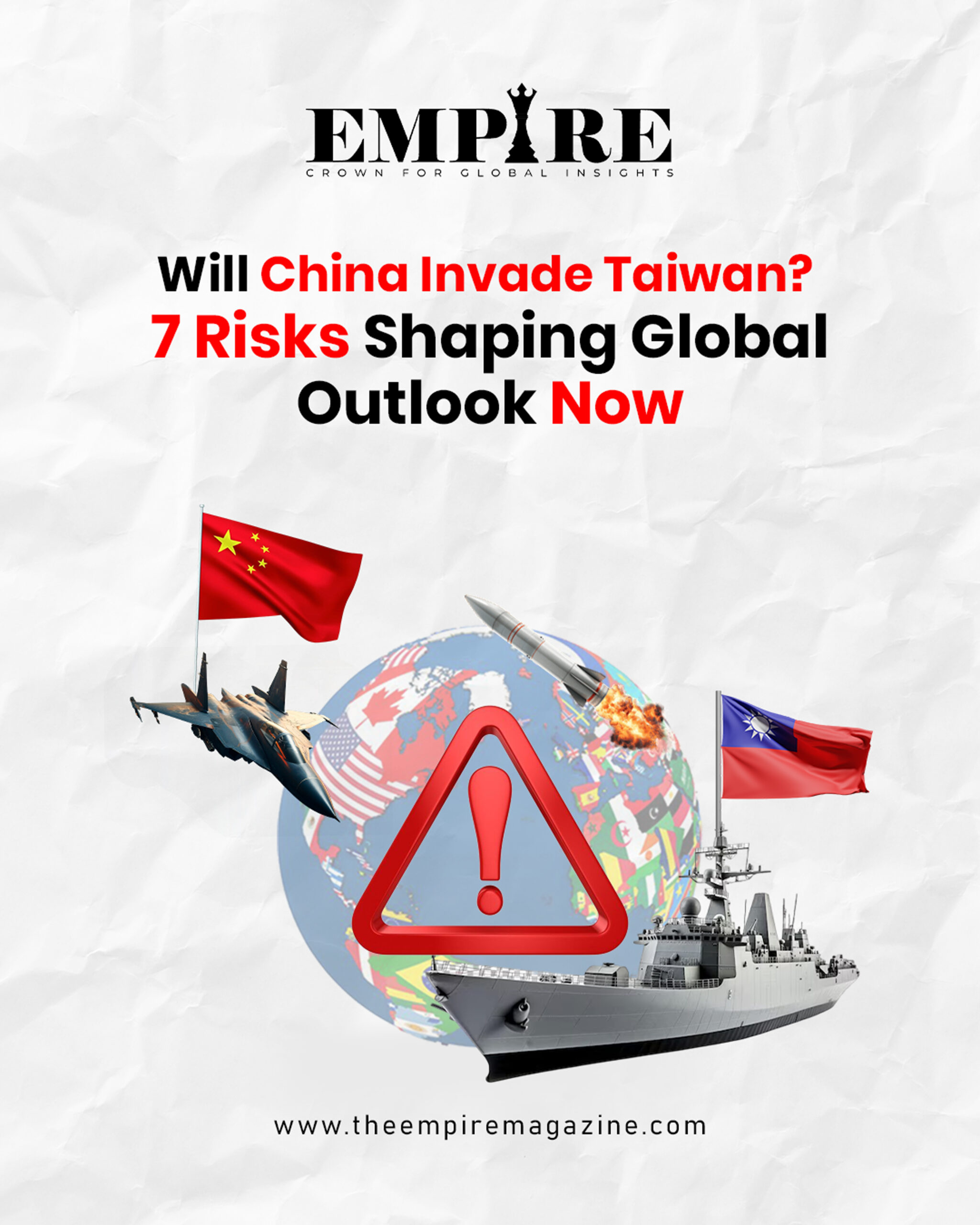
Table of Contents
- Why This Question Matters
- How Likely Is a Chinese Invasion
- Why the Risk Has Increased
- Possible Triggers for Conflict
- How an Invasion Could Begin
- What a War Would Mean for the World
- Final Thoughts
Will China invade Taiwan is no longer a distant geopolitical question. It has become one of the most important security concerns in the world. Tensions across the Taiwan Strait have risen as military activity, political pressure, and strategic rivalry continue to intensify. At the same time, the answer is still not simple. The risk is real, but an invasion would also be extraordinarily dangerous, expensive, and unpredictable for every side involved.
China continues to insist that Taiwan is part of its territory, while Taiwan operates with its own government, military, and democratic political system. The United States maintains a longstanding one-China policy guided by the Taiwan Relations Act and continues to support Taiwan’s self-defense capacity. That framework has helped preserve uneasy stability for decades, but it has not removed the possibility of conflict.
For readers interested in broader geopolitical analysis and global leadership trends, you can also read this internal feature from The Empire Magazine.
Why This Question Matters
The reason Will China invade Taiwan matters so much is that the consequences would extend far beyond East Asia. Taiwan is a major global economic and trade hub, and any military conflict around the island would likely disrupt shipping routes, financial markets, investment flows, and international supply chains. Official U.S. government materials describe Taiwan as a critically important market for regional and global trade and investment, which helps explain why a crisis there would quickly become a worldwide issue.
This is not only a regional military question. It is also about political credibility, economic stability, alliance commitments, and the future balance of power in Asia. That is why governments, companies, and investors watch developments in the Taiwan Strait so closely.
How Likely Is a Chinese Invasion
The most honest answer to Will China invade Taiwan is that no one can predict with certainty. However, the risk is widely treated as serious rather than hypothetical. Taiwan’s own defense reporting shows a sharp rise in military pressure from the People’s Liberation Army, including activity near the median line of the Taiwan Strait and around the island. Taiwan’s 2025 National Defense Report documents sustained PLA air and maritime pressure and describes gray-zone coercion as an ongoing challenge rather than a one-off event.
That said, a full invasion remains one of the hardest military operations possible. Amphibious warfare across the Taiwan Strait would require enormous coordination, sustained logistics, air and naval superiority, and readiness for a long conflict rather than a quick victory. Because of these risks, many analysts believe China may still prefer coercion, blockade pressure, cyber operations, and political intimidation over immediate full-scale invasion.
So the better question may not be only Will China invade Taiwan, but under what conditions China might decide the risks are worth taking.
Why the Risk Has Increased
Several trends have made the situation more dangerous. First, military modernization has continued at a rapid pace. Taiwan’s defense reporting highlights increasing joint operations capabilities by the PLA, combining air, naval, rocket, and coast guard activities in ways that appear designed to pressure and isolate Taiwan during a crisis.
Second, political timelines matter. The leadership in Beijing has repeatedly linked national rejuvenation to eventual unification, while U.S. and Taiwan policy communities have increasingly focused on the late 2020s as an important military readiness window. Even without a fixed invasion date, such timelines shape defense planning and raise anxiety across the region.
Third, the danger of miscalculation is rising. When aircraft, warships, drones, and coast guard vessels operate in close proximity over a long period, the chance of an accident or unintended escalation becomes much higher. A crisis does not always begin because one side chooses full war from the start. Sometimes it begins because pressure, signaling, and military movement spin out of control.
Possible Triggers for Conflict
If asking Will China invade Taiwan, it is useful to think in terms of triggers rather than a single timetable.
One possible trigger is a political red line. If Beijing concluded that Taiwan had moved irreversibly toward formal independence, pressure could intensify sharply. Another trigger could be strategic opportunity. If Chinese leaders believed the balance of military power had shifted enough in their favor, they might judge that waiting was riskier than acting.
A third trigger is miscalculation. This may be the most dangerous scenario because it does not require either side to intend a major war. A collision at sea, a mistaken strike, an overreaction during exercises, or a failure in communication could escalate far faster than leaders expect.
This uncertainty is exactly why Will China invade Taiwan remains such an urgent global question. The danger lies not only in deliberate planning, but also in the possibility of crisis spiraling from events that begin small.
How an Invasion Could Begin
If conflict ever moved from coercion to open war, it might not begin with a classic beach landing on day one. It could start with missile strikes, cyber disruption, air assaults, naval blockades, or attempts to isolate Taiwan from outside assistance. Taiwan has been investing in stronger defenses and military reforms, while the United States continues to emphasize support for Taiwan’s self-defense capacity under the Taiwan Relations Act.
A blockade is often discussed because it may appear less risky than immediate invasion. It could aim to cut trade, energy, and logistics while testing international resolve. Cyberattacks and disinformation could also be used to weaken communications, financial systems, and public confidence before or during military operations.
A full amphibious assault would still be the most dramatic option, but it would also be the most complex. Taiwan’s terrain, defenses, and population centers create major obstacles. That is one reason many observers believe that if Beijing chose force, it might first attempt to paralyze Taiwan politically, digitally, and economically before trying to occupy territory.
What a War Would Mean for the World
The stakes behind Will China invade Taiwan are immense. A war over Taiwan would not remain local for long. It would almost certainly trigger a severe global economic shock, especially because Taiwan is deeply tied to global trade and high-value technology supply chains. Official U.S. materials continue to describe Taiwan as critically important to regional and global investment and commerce. State+1
A conflict could also draw in other powers politically or militarily. It would test alliance structures, regional deterrence, and the willingness of major states to bear economic pain in response. Even if a wider war were avoided, sanctions, export controls, shipping disruption, and market panic would likely follow.
For businesses, policymakers, and ordinary citizens, the real significance of this issue is not only who controls Taiwan. It is the possibility that one regional conflict could reshape the world economy and international security order for years.
You can also follow The Empire Magazine for more business and global affairs updates on Instagram and Facebook.
Final Thoughts
So, Will China invade Taiwan? The best answer is that the risk is serious, but the outcome is not predetermined. China has increased military pressure and clearly wants stronger leverage over Taiwan, while Taiwan and its partners continue preparing for deterrence and defense. The situation is dangerous precisely because both capability and tension have increased at the same time. mnd.gov.tw+1
A full invasion is possible, but it is also one of the most hazardous decisions Beijing could make. The military, economic, and diplomatic costs would be enormous. That is why the most likely near-term reality may remain a mix of coercion, pressure, and crisis management rather than immediate all-out war.
Still, the fact that the question Will China invade Taiwan now feels plausible to so many governments and markets shows how much the strategic landscape has changed. The future of the Taiwan Strait may depend less on one dramatic announcement and more on whether deterrence, restraint, and careful diplomacy can hold under growing pressure.
–The Empire Magazine
Crown for Global Insights
Follow The Empire Magazine
Facebook | Instagram | LinkedIn