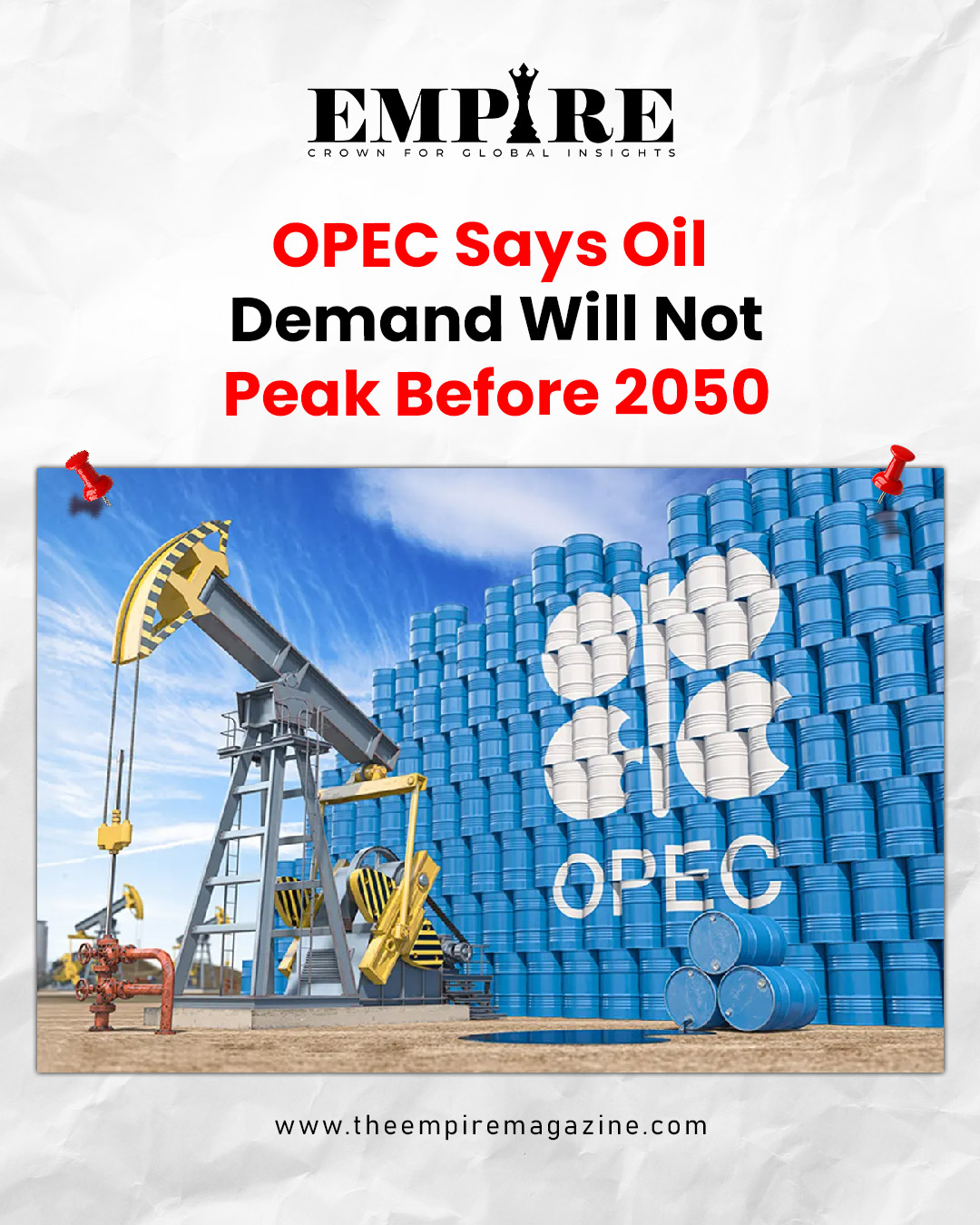
The Organization of the Petroleum Exporting Countries (OPEC) has once again challenged that widely held belief by stating that global oil demand will not peak before 2050. The global conversation around energy has long revolved around one question: when will the world stop relying on oil? For years, climate experts, investment firms and international agencies have projected that oil demand could reach its highest point sometime during the next decade before gradually declining as electric vehicles, renewable energy and cleaner technologies become mainstream. The announcement, made in OPEC’s latest long-term outlook, signals a fundamentally different vision of the world’s energy future, one where oil continues to play a dominant role despite the rapid growth of renewable energy. According to OPEC, global oil demand is expected to rise from roughly 103 million barrels per day in 2024 to around 123 million barrels per day by 2050, driven primarily by population growth, industrial expansion and rising living standards across developing economies. The organisation argues that while renewable energy will undoubtedly expand, the pace of global economic development, especially across Asia, Africa and the Middle East, will keep oil indispensable for transportation, manufacturing, aviation, petrochemicals and heavy industries. The forecast has reignited debates among economists, environmentalists and policymakers because it directly contrasts with projections made by several international institutions that expect demand to plateau much earlier. At its core, OPEC’s report is not merely about future fuel consumption—it is about how different regions of the world are likely to develop over the next quarter-century and what that means for energy security, economic growth and climate ambitions.
OPEC Forecasts: Why Developing Nations Are Driving Future Oil Demand
One of the strongest pillars supporting OPEC’s forecast is the expected economic transformation of developing nations. While many developed countries have already begun reducing their dependence on fossil fuels through aggressive investments in renewable energy and electric mobility, billions of people living in emerging economies are only beginning to experience rapid industrialisation and urbanisation. Countries such as India, Indonesia, Nigeria, Vietnam and several African nations are witnessing rising incomes, expanding manufacturing sectors and growing transportation needs, all of which require reliable and affordable energy. OPEC argues that these economies cannot realistically abandon oil overnight because critical sectors such as freight transport, shipping, aviation, construction equipment and petrochemical production still rely heavily on petroleum products. Moreover, global population is projected to exceed 9.7 billion by 2050, creating greater demand for food production, consumer goods, healthcare infrastructure and logistics, each of which has significant energy requirements. Petrochemicals, which are used in plastics, medical equipment, packaging, textiles and countless industrial products, are expected to remain one of the largest drivers of oil demand over the coming decades. OPEC also believes that energy transitions will occur at different speeds across countries depending on their financial capabilities, technological readiness and infrastructure. While Europe and parts of North America may significantly reduce oil consumption, developing regions are likely to offset those declines through continued economic expansion. This uneven pace of transition, according to the organisation, explains why global demand is expected to continue rising instead of entering a sustained decline. The report also highlights that ensuring affordable energy remains a priority for governments seeking economic development, particularly where access to electricity and modern transportation is still improving.
OPEC’s Challenge Can Renewable Energy Replace Oil Anytime Soon?
The biggest challenge to OPEC’s outlook comes from supporters of the clean energy transition, who argue that technological innovation could reduce oil demand much faster than anticipated. Over the past decade, the cost of solar panels, wind power and battery storage has fallen dramatically, while electric vehicle adoption has accelerated in many major markets. Governments across the world have announced ambitious climate targets, stricter vehicle emission standards and significant investments in hydrogen, carbon capture and renewable infrastructure. These developments have prompted organisations such as the International Energy Agency to project that oil demand could reach its peak before the end of this decade under current policy trends. Yet OPEC remains unconvinced that renewable energy alone can satisfy the world’s rapidly expanding energy needs. The organisation acknowledges that clean energy technologies will continue growing but argues they are more likely to complement rather than completely replace fossil fuels over the next several decades. One reason is that several industries remain extremely difficult to electrify. Long-distance aviation, global shipping, heavy mining equipment, steel manufacturing and chemical production continue to depend heavily on liquid fuels because viable large-scale alternatives remain expensive or technologically immature. Furthermore, building renewable infrastructure requires enormous investments in transmission networks, battery storage, critical minerals and manufacturing capacity, creating challenges that vary widely between developed and developing countries. OPEC also warns against underinvestment in oil production, arguing that declining investment could lead to supply shortages and price volatility even if demand growth slows. According to its outlook, maintaining sufficient upstream investment remains essential to ensuring stable energy markets while the transition gradually unfolds. This perspective reflects OPEC’s broader argument that energy security and affordability should remain as important as climate objectives in shaping future energy policies.
OPEC’s long term outlook: What This Means for the Global Economy and Investors
OPEC’s long-term outlook extends far beyond the oil industry, carrying significant implications for governments, investors and businesses worldwide. If global oil demand continues rising until 2050, as the organisation projects, energy markets will require trillions of dollars in fresh investments to ensure adequate production and supply. OPEC estimates that the upstream oil sector alone will need investments exceeding $18 trillion over the coming decades to prevent supply shortages and maintain market stability. This presents both opportunities and challenges. Oil-producing nations in the Middle East, Africa and parts of Latin America could continue benefiting from strong export revenues, allowing them to invest further in infrastructure, economic diversification and sovereign wealth funds. International oil companies may also find renewed confidence to expand exploration, develop new oil fields and invest in advanced extraction technologies. At the same time, businesses operating in renewable energy, battery manufacturing and electric mobility are unlikely to slow down. Instead, the world could witness a prolonged period where fossil fuels and clean energy coexist, with each serving different sectors of the economy. Investors are increasingly recognising this reality by diversifying their portfolios rather than making an all-or-nothing bet on either oil or renewables. Energy companies themselves are adapting to this changing landscape. Several major oil producers are investing in carbon capture technologies, low-carbon fuels, hydrogen projects and renewable power while continuing to expand conventional oil and gas operations. This dual strategy reflects the industry’s expectation that the global energy transition will be gradual rather than abrupt. However, uncertainty remains a defining factor. Geopolitical conflicts, technological breakthroughs, stricter environmental regulations or unexpected shifts in consumer behaviour could significantly alter future demand patterns. Electric vehicle adoption, for instance, is accelerating in some regions but remains constrained in others by high costs, limited charging infrastructure and supply chain challenges. Likewise, developing nations must balance climate commitments with the urgent need to provide affordable energy to growing populations. As a result, investors are increasingly focusing on resilience and flexibility rather than relying solely on one long-term energy scenario.
The Road Ahead for Governments and Energy Companies
The debate surrounding OPEC’s forecast ultimately highlights a larger truth: the future of energy is unlikely to follow a single, predictable path. Governments across the globe face the difficult task of balancing economic growth, energy security and environmental sustainability at a time when each objective often competes with the others. While many developed economies continue introducing stricter emissions regulations and encouraging renewable energy investments, emerging nations argue that access to affordable and reliable energy remains essential for lifting millions of people out of poverty and supporting industrial growth. OPEC maintains that policy decisions should recognise these differing realities instead of assuming that every country can move at the same pace toward net-zero emissions. For energy companies, the coming decades will demand unprecedented adaptability. Traditional oil producers are expected to improve operational efficiency, reduce methane emissions and adopt cleaner production methods while continuing to meet global demand. Simultaneously, renewable energy developers must scale technologies faster, improve energy storage solutions and expand electricity grids capable of supporting growing demand. The competition is therefore evolving into a race not between oil and renewables, but between different technologies working together to deliver affordable, secure and sustainable energy. Consumers, too, are likely to experience this transition in practical ways. Electric vehicles may become more common, solar power installations could expand rapidly and energy-efficient technologies will continue entering homes and industries, yet petroleum products are still expected to remain deeply embedded in aviation, shipping, manufacturing, petrochemicals and countless everyday goods for years to come. This mixed energy landscape suggests that the transition will be defined more by evolution than by revolution. Rather than replacing one source of energy overnight, the global economy may gradually reshape its energy mix while responding to technological innovation, economic realities and changing geopolitical priorities.
Reshaping OPEC’s assertion
OPEC’s assertion that global oil demand will not peak before 2050 has once again reshaped one of the world’s most important economic and environmental debates. Whether its projection ultimately proves accurate remains uncertain, but it serves as a powerful reminder that the global energy transition is far more complex than a simple shift from fossil fuels to renewables. Population growth, industrial expansion, rising living standards and the energy needs of developing economies continue to reinforce oil’s role in the global economy even as governments accelerate investments in cleaner alternatives. At the same time, rapid technological advancements in renewable energy, battery storage, hydrogen and electric mobility could reshape demand faster than many traditional forecasts anticipate. The future, therefore, is unlikely to be defined by a single winner. Instead, it will be shaped by how effectively nations balance economic development, climate action and energy security. For businesses, policymakers and investors, the message is clear: flexibility, innovation and long-term planning will determine success in an energy market that is becoming increasingly diverse and interconnected. As the world moves toward 2050, the question may no longer be whether oil or renewable energy will dominate, but how both can coexist while supporting sustainable economic growth and meeting the needs of a rapidly changing global population.
For more business and retail insights, read more on The Empire Magazine
Previous article: South Korea Stock Market
Magazine Feautures | Podcasts: Empire Global Talks
Follow The Empire Magazine on Facebook | Instagram | LinkedIn
The Empire Magazine | Crown for Global Insights