
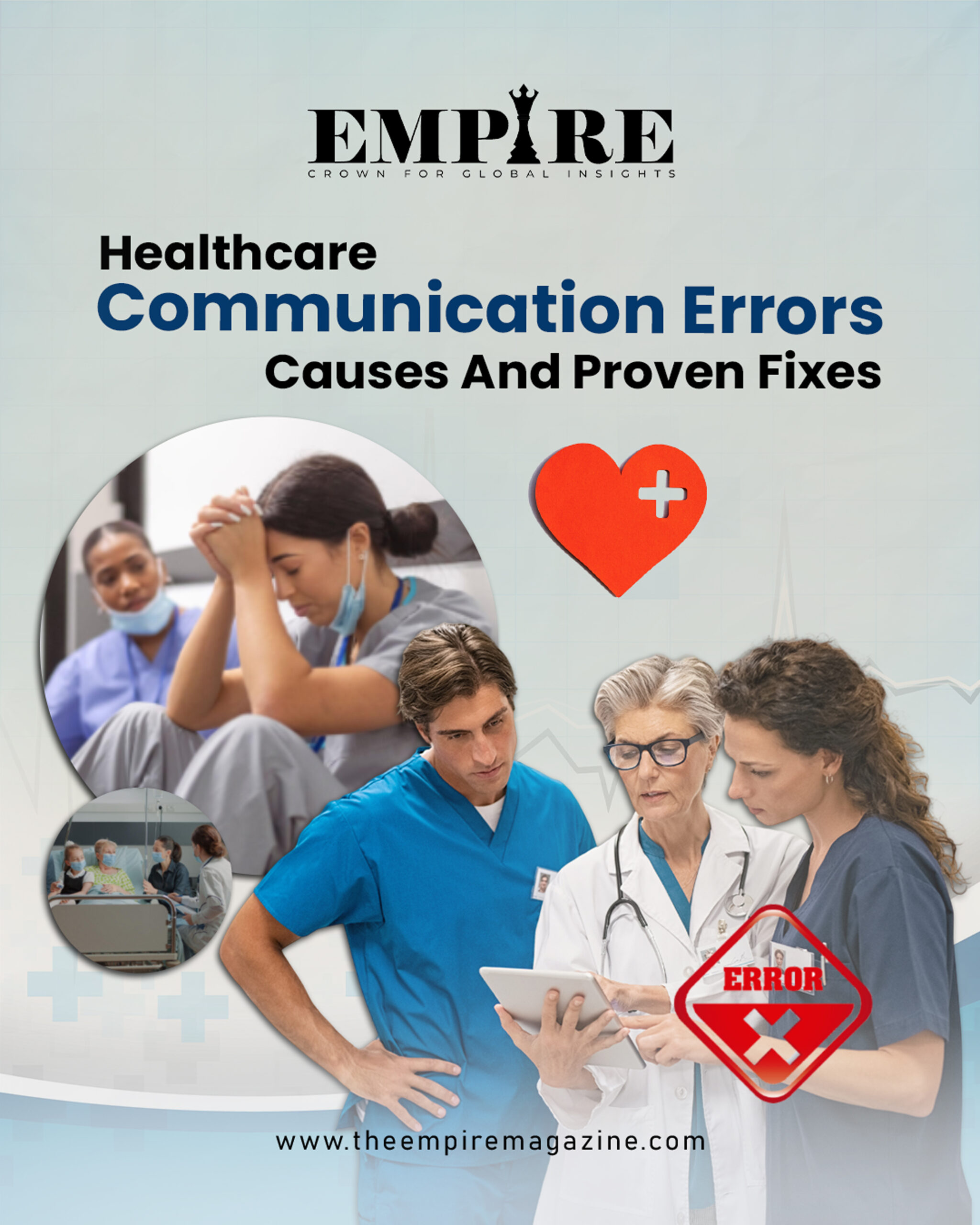
Healthcare communication errors are one of the most critical, yet frequently overlooked, threats to patient safety today. When an individual’s life hangs in the balance, every single second and every spoken syllable counts. We exist in an era of immense advancements in clinical technology, robotic surgery, and procedural expertise. However, despite these modern marvels, the simple transfer of information between human beings remains one of the most vulnerable points in the continuum of patient care.
Extensive reviews of medical safety data and hospital operational records reveal a terrifying truth: a staggering number of malpractice claims, preventable medical complications, and tragic fatalities are not caused by a lack of medical knowledge. Instead, they are caused by fundamental failures in communication. Whether it is a missed detail during a routine shift handover, a misunderstood directive in a chaotic trauma bay, or inadequate instructions given to a discharged patient, the negative effects of poor communication are profound. Addressing and eliminating these errors is no longer just an administrative or operational goal; it is a fundamental necessity for preserving human lives and ensuring system-wide clinical excellence.
The Cascading Effect in Emergency and Trauma Care
The high-pressure environment of emergency and trauma care serves as a stark magnifying glass for the dire consequences of miscommunication. In trauma centers, teams must make split-second decisions based on rapidly changing data. In these environments, communication failures frequently emerge as the absolute leading cause of adverse events, easily surpassing both technical skill deficits and procedural delays.
Crucially, these communication gaps rarely exist in isolation. Instead, they trigger a dangerous cascading effect of subsequent errors. For example, when crucial imaging findings are not clearly and immediately relayed by the radiology department to the attending surgical team, the result can be a missed diagnosis—such as an undetected internal laceration or a severe hairline fracture. Furthermore, incomplete handovers from paramedics to emergency room staff can lead to under-triage, where a critically injured patient is assigned a lower level of urgency than their trauma actually requires. In emergency rooms, a chaotic environment filled with loud, incomprehensible conversations can disrupt vital procedures, cause care teams to deviate from established treatment algorithms, and even prevent the timely administration of life-saving interventions.
The Danger of Shift Changes and Handovers
While emergency trauma situations highlight the acute, immediate dangers of miscommunication, the most frequent healthcare communication errors across the broader medical spectrum occur during routine shift changes. It is widely estimated by healthcare administrators that a vast majority of serious medical errors are directly linked to the miscommunication of critical information when patient care is handed over from one caregiver to another.
Transitions of care demand absolute, meticulous documentation. In specialized and high-risk environments like senior care facilities, where patients often have complex, overlapping medical histories and intricate medication regimens, the transfer of information must be exact. When incomplete, ambiguous, or entirely inaccurate information is passed along to the next shift, the risk of a patient receiving the wrong medication, undergoing an incorrect procedure, or facing delays in essential treatment skyrockets. This inefficiency not only directly endangers the patient but also decreases overall hospital throughput, prolongs in-patient stays, and massively inflates healthcare costs.
Interpersonal Dynamics: Clinicians, Nurses, and Patients
The inherent hierarchical structure of medical teams can sometimes act as an invisible barrier to clarity. Hospital hierarchies occasionally place nurses, technicians, or junior medical staff at a perceived power disadvantage. This dynamic creates a tense environment where they may hesitate to voice urgent concerns or ask for clarification on ambiguous orders from senior physicians. If a nurse observes subtle, yet critical changes in a patient’s condition—such as early signs of internal bleeding post-surgery—but fails to communicate the absolute urgency of these symptoms to the attending surgeon out of intimidation, the outcome can be fatal.
Furthermore, healthcare communication errors heavily impact the clinician-patient relationship itself. Medical professionals must gather accurate information, listen actively, and relay complex medical advice in a way that non-experts can easily understand. When doctors fail to ensure their patients completely comprehend follow-up instructions, physical therapy requirements, or strict medication schedules, it frequently leads to poor recovery outcomes and exceptionally high hospital readmission rates. It can also result in inadequate informed consent, thereby opening the door to severe legal and ethical liabilities for the hospital.
For more deep-dive analyses on optimizing organizational, leadership, and operational frameworks to prevent these issues, explore our comprehensive business strategy guide here.
Integrating Communication into Medical Training
To combat these pervasive, systemic issues, modern healthcare systems must fundamentally shift how they prepare and train their personnel. Clear communication can no longer be viewed as a secondary “soft skill”; it must be treated as a clinical intervention that is just as vital as a scalpel or a stethoscope.
In high-stakes medical training scenarios—such as rigorous CPR certifications or advanced life support drills—closed-loop communication is taught as a life-saving fundamental. This practice, where an instruction is explicitly given, repeated back by the receiver, and then confirmed by the sender, must be expanded far beyond the resuscitation room. It needs to be integrated into daily hospital operations. Implementing mandatory “time-outs” before procedures and adopting structured handoff protocols (such as the SBAR or STICC methods) ensures that everyone on the care team shares the exact same mental model of the patient’s current status and treatment plan.
Technological Solutions for a Modern Era
Finally, completely overcoming healthcare communication errors requires upgrading the outdated tools that many clinicians are still forced to use. Relying on antiquated technology like traditional pagers, fax machines, and fragmented charting systems creates unnecessary, dangerous silos of information.
The rapid adoption of modern Clinical Communication and Collaboration (CC&C) platforms is successfully revolutionizing hospital workflows. These secure, HIPAA-compliant text and voice messaging platforms integrate seamlessly with Electronic Health Records (EHR). They ensure that the right information reaches the exact right specialist instantly, regardless of their physical location within the hospital complex. By creating a permanent, trackable digital record of handovers, lab results, and patient alerts, these sophisticated platforms completely eliminate the dangerous ambiguity of “he said, she said” disputes.
When communication flows without friction, clinical errors plummet, staff burnout decreases, and overall patient outcomes improve dramatically. By prioritizing structural communication training and investing in the right technological infrastructure, the healthcare industry can finally break the silence that has compromised patient safety for far too long.
Stay connected with us for more exclusive content, global insights, and industry updates:
- Follow our visual updates on Instagram: Instagram – The Empire Magazine
- Join our growing community on Facebook: Facebook – The Empire Magazine
- Website Link: www.theempiremagazine.com
– The Empire Magazine
Crown For Global Insights