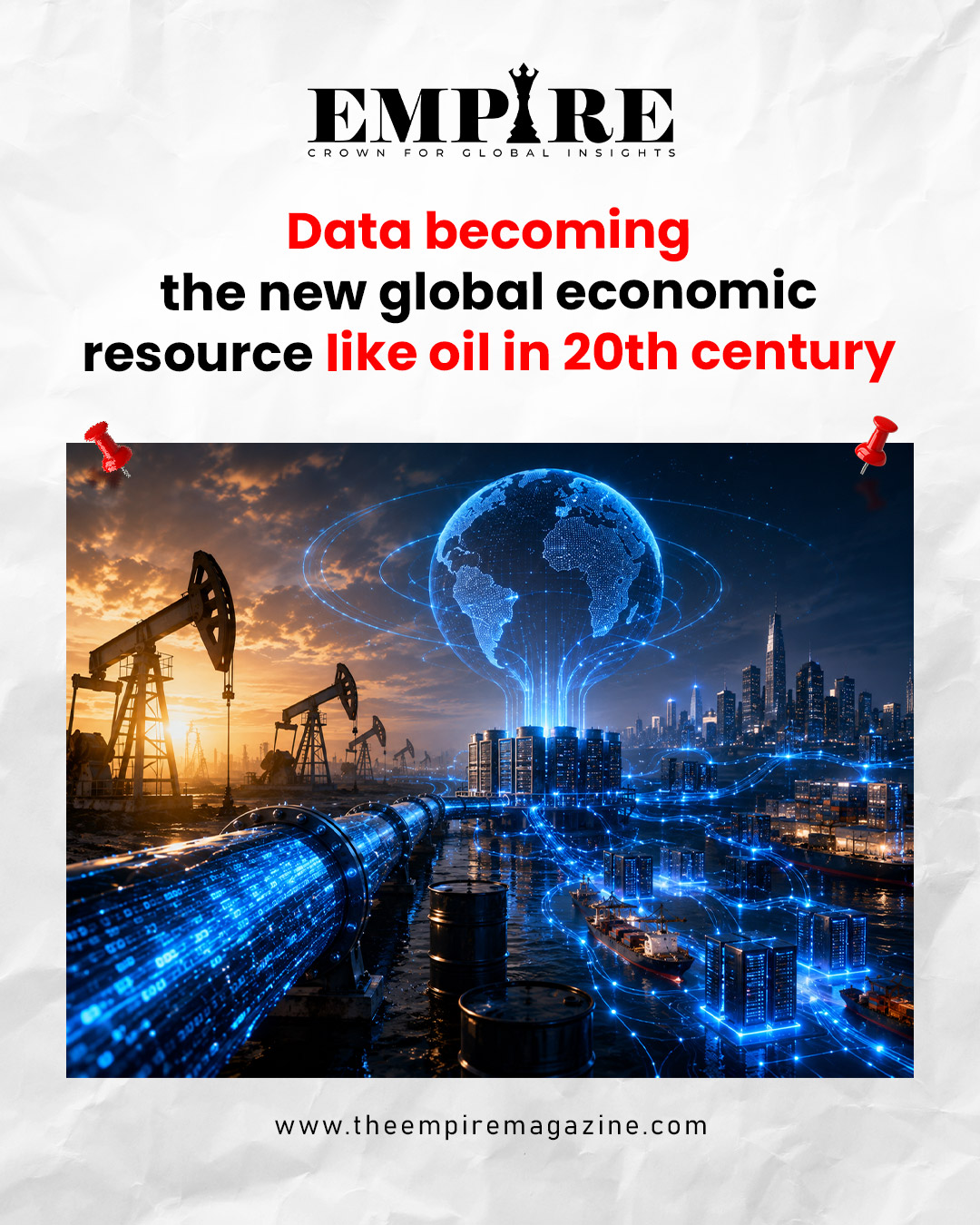
Discover why data is becoming the world’s most valuable economic resource, replacing oil as the driver of innovation, AI, business growth, and global power. Data is the new global economic resource, replacing oil as the world’s most valuable asset. Businesses, governments, and technology companies are leveraging data to power artificial intelligence, economic growth, innovation, healthcare, finance, and smart governance, making data the foundation of the modern digital economy.
Data Is the New Global Economic Resource: Why Information Is Replacing Oil in the Digital Age
For over a century, oil determined the fortunes of nations. Countries rich in petroleum reserves controlled global trade, geopolitical influence, and industrial expansion. Today, however, another resource is quietly surpassing oil in strategic importance, data.
The phrase “Data is the New Global Economic Resource” is no longer just a Silicon Valley slogan. It has become an economic reality shaping international business, government policies, artificial intelligence, healthcare, manufacturing, finance, and even national security.
Every digital interaction from online shopping and social media activity to financial transactions, healthcare records, GPS navigation, and industrial sensors creates valuable information. Organizations capable of collecting, analyzing, and utilizing this information gain a competitive advantage that often exceeds the value of physical assets.
According to industry estimates, the global data sphere is projected to exceed 390 zettabytes by 2028, driven by AI adoption, cloud computing, connected devices, and enterprise digitization. This unprecedented growth is transforming data into the most strategic economic asset of the 21st century.
Data Is the New Global Economic Resource Driving the Digital Economy
The modern digital economy revolves around data rather than traditional commodities. Unlike oil, data is not depleted when used. Instead, it becomes increasingly valuable when analyzed, shared responsibly, and combined with artificial intelligence. Every customer interaction generates insights that help organizations improve products, personalize services, reduce operational costs, and predict future demand.
Technology giants including Google, Microsoft, Amazon, Meta, and Apple have built trillion-dollar businesses primarily by collecting, processing, and monetizing data. Their competitive strength lies less in physical infrastructure and more in sophisticated data ecosystems that power search engines, cloud platforms, recommendation systems, and AI applications.
Governments have also recognized that data represents strategic national infrastructure. Countries worldwide are investing heavily in digital public infrastructure, national data exchanges, cybersecurity, and AI research to strengthen economic resilience.
The data-driven economy has expanded far beyond the technology sector. Agriculture now uses satellite imagery and sensor data for precision farming. Manufacturers optimize production lines through Industrial IoT data. Retailers forecast consumer demand using purchasing patterns. Banks assess financial risk through advanced analytics. As industries digitize operations, data becomes the common currency connecting every sector.
Why Data Has Become More Valuable Than Oil
Oil powered factories, transportation, and industrialization. Data powers intelligence.
The biggest distinction is that oil loses value once consumed, whereas data can be reused repeatedly for multiple purposes without diminishing its usefulness.
Organizations today utilize data to:
- Improve customer experiences
- Detect fraud in real time
- Develop AI-powered applications
- Predict equipment failures
- Optimize supply chains
- Personalize healthcare treatments
- Enhance financial decision-making
- Accelerate scientific research
Artificial Intelligence has dramatically increased the value of data. Machine learning algorithms require enormous volumes of high-quality information to learn patterns, improve predictions, and automate complex tasks.
As AI becomes integrated into every business function, demand for reliable datasets continues to surge. The explosion of connected devices further accelerates this trend. Smart cities, wearable technology, autonomous vehicles, industrial machinery, and Internet of Things (IoT) sensors continuously generate enormous streams of information that fuel real-time decision-making. The world’s largest companies increasingly compete not merely on products but on the quality, scale, and uniqueness of their data assets.
Data Is the New Global Economic Resource Fueling Artificial Intelligence
Artificial Intelligence has transformed data from a business asset into a strategic necessity.
Generative AI models, predictive analytics systems, autonomous robots, recommendation engines, fraud detection platforms, and intelligent virtual assistants all depend on vast quantities of structured and unstructured data. Without quality data, AI cannot deliver accurate outcomes.
Organizations are investing billions in data engineering, cloud storage, data governance, and analytics infrastructure to ensure AI systems receive reliable information.
Healthcare provides one of the strongest examples. Hospitals now analyze millions of patient records to identify disease patterns, improve diagnoses, personalize treatments, and predict health risks. Pharmaceutical companies leverage clinical datasets to accelerate drug discovery while reducing research timelines. Similarly, financial institutions monitor millions of daily transactions to detect suspicious activities within seconds.
Manufacturers deploy predictive maintenance systems that analyze equipment data to prevent costly breakdowns before they occur. The relationship between AI and data is becoming inseparable. As AI capabilities advance, the economic value of data continues to rise.
The Global Data Economy Is Reshaping Business Competition
The emerging global data economy is changing how organizations create value. Traditional competitive advantages such as physical infrastructure, manufacturing capacity, or natural resources remain important, but access to high-quality data increasingly determines market leadership.
Companies now compete on their ability to generate actionable insights from customer behavior, operational performance, logistics networks, and digital interactions.
Retail businesses analyze purchasing histories to recommend products. Streaming platforms personalize entertainment recommendations. E-commerce companies optimize pricing dynamically. Airlines predict maintenance schedules. Insurance providers evaluate risk more accurately using behavioral analytics.
Small businesses are also benefiting from affordable cloud computing and AI-powered analytics tools that were once available only to multinational corporations. Governments are encouraging responsible data sharing across industries to stimulate innovation while protecting privacy. Open data initiatives support research, transportation planning, climate monitoring, disaster response, and public healthcare. However, this rapid expansion has also intensified concerns around cybersecurity, misinformation, cross-border data transfers, and digital sovereignty. As nations establish new regulations governing personal information, businesses must balance innovation with ethical data management.
Challenges of Treating Data as the World’s Most Valuable Resource
Although data offers enormous economic opportunities, it also introduces significant challenges. Privacy remains one of the biggest concerns. Consumers increasingly expect transparency regarding how organizations collect, store, and utilize personal information.
Major regulations including Europe’s General Data Protection Regulation (GDPR), California’s Consumer Privacy Act (CCPA), and India’s Digital Personal Data Protection Act reflect growing efforts to strengthen individual rights over personal data. Cybersecurity threats have also become more sophisticated.
Data breaches can expose millions of sensitive records, resulting in financial losses, reputational damage, regulatory penalties, and declining consumer trust. Organizations must therefore invest heavily in encryption, secure cloud infrastructure, identity management, and continuous threat monitoring. Another challenge is ensuring data quality.
Incomplete, inaccurate, or biased datasets can produce flawed AI decisions with serious consequences in healthcare, hiring, lending, and law enforcement.
Responsible governance, ethical AI practices, and transparent algorithms will become increasingly essential as data assumes greater economic significance.
Future Outlook: Data Is the New Global Economic Resource Powering the Next Industrial Revolution
The next decade will likely witness an unprecedented expansion of the data-driven economy. Emerging technologies including quantum computing, edge computing, 6G connectivity, digital twins, autonomous transportation, smart factories, and intelligent robotics will generate exponentially larger volumes of information.
Analysts predict that nearly every organization will become a data company regardless of its primary industry. Manufacturers will rely on digital twins to simulate production. Energy providers will optimize electricity grids using real-time analytics. Cities will manage traffic, water, and waste systems through connected sensors. Farmers will maximize crop yields using AI-powered precision agriculture. Financial institutions will continue automating investment strategies with advanced predictive models.
Data marketplaces are also expected to expand, enabling organizations to securely exchange anonymized information for research, innovation, and commercial purposes. Countries investing in digital infrastructure, cloud computing, AI education, cybersecurity, semiconductor manufacturing, and responsible data governance are likely to emerge as leaders in the next phase of global economic development.
Just as oil defined industrial power during the twentieth century, data is poised to define economic influence throughout the twenty-first century.
Data is the New Global Economic Resource
The statement “Data is the New Global Economic Resource” captures one of the most profound economic transformations of our time. Information has become the foundation upon which businesses innovate, governments govern, researchers discover, and artificial intelligence evolves. Unlike oil, data grows in value when responsibly collected, shared, analyzed, and transformed into actionable intelligence. Yet its immense potential also demands robust governance, cybersecurity, ethical AI, and privacy protections to ensure sustainable growth.
As digital technologies continue reshaping every sector, organizations that invest in high-quality data infrastructure, analytics capabilities, and responsible stewardship will be best positioned to thrive in the global economy. The nations and enterprises that successfully harness data today are likely to define the economic, technological, and geopolitical landscape of tomorrow.
For more business and retail insights, read more on The Empire Magazine
Previous article: https://theempiremagazine.com/central-bank/
Magazine Feautures | Podcasts: Empire Global Talks
Follow The Empire Magazine on Facebook | Instagram | LinkedIn | YouTube
The Empire Magazine | Crown for Global Insights