
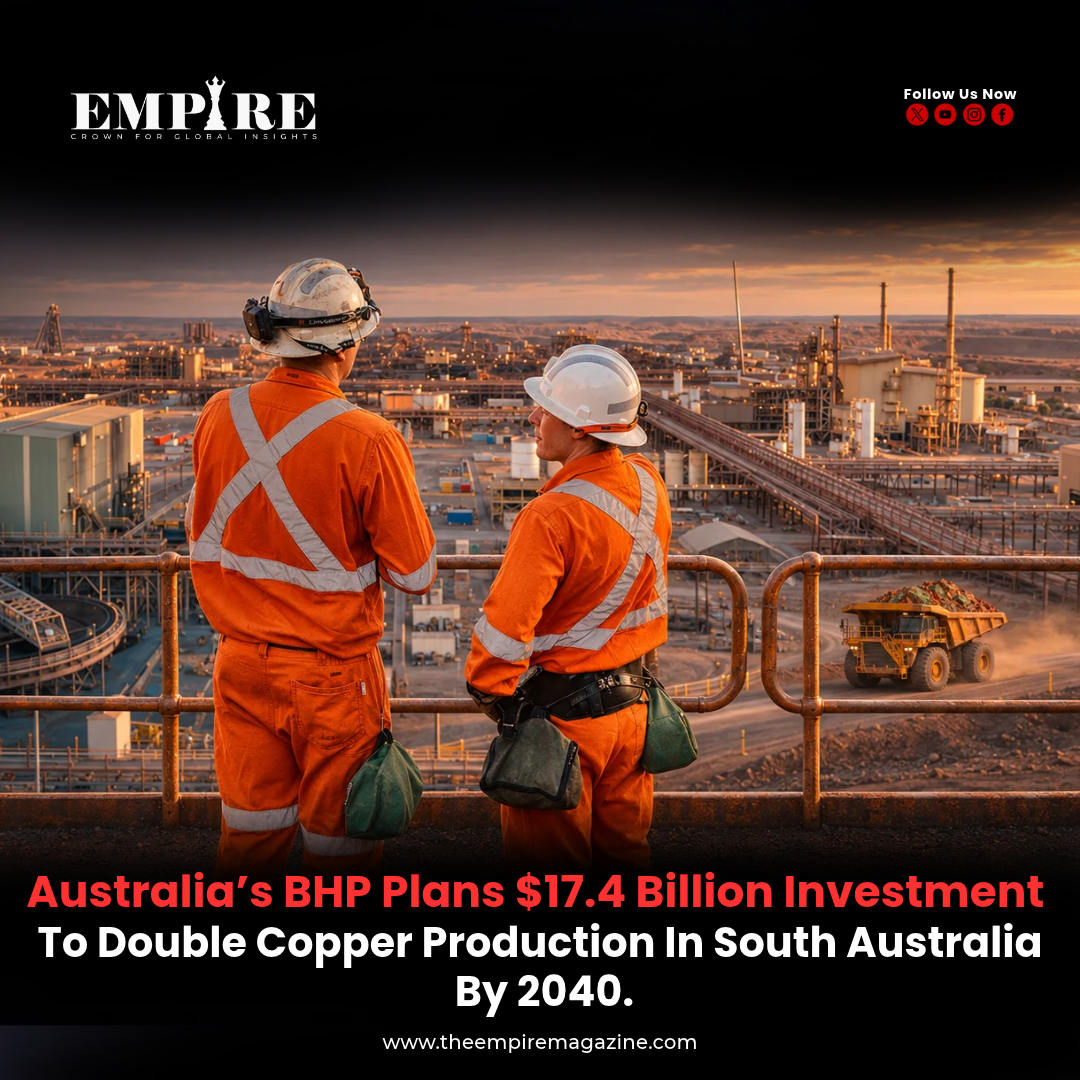
The proposed investment would expand mining and processing capacity, with major projects still requiring separate approvals.
The BHP copper expansion in South Australia could involve up to US$17.4 billion across four major growth packages, supporting the company’s ambition to approximately double annual copper production to 650,000 tonnes by 2040.
The strategy, presented during an investor update on 23 November 2026, outlines a phased approach to developing the region’s mineral resources. Spending would occur over several years, with individual projects progressing through studies and final investment decisions.
For South Australia, the proposal represents a potential expansion of its role in supplying the metals needed for electricity networks, industrial equipment and digital infrastructure.
Understanding the BHP Copper Expansion Budget
Adding the cost ranges for four major growth packages in BHP’s presentation produces an estimated US$13.6 billion to US$17.4 billion investment range:
| Growth package | Estimated capital expenditure |
|---|---|
| Carrapateena expansion | US$1.8 billion–US$2.1 billion |
| Olympic Dam mine and concentrator growth | US$4.1 billion–US$5.4 billion |
| Smelter and refinery expansion | US$3.2 billion–US$4.1 billion |
| Second-phase mine and concentrator development | US$4.5 billion–US$5.8 billion |
These estimates use real July 2026 dollars. The total is a calculation from the listed packages, rather than a complete budget for every associated infrastructure, maintenance and future expansion requirement.
That distinction matters when assessing the headline figure. Final commitments will depend on the scope approved for each project and the arrangements for supporting facilities.
A Phased Path to Higher Production
The BHP copper expansion targets approximately 500,000 tonnes of annual production by 2035, followed by up to 650,000 tonnes by 2040.
Staging the investment allows the company to develop mining capacity alongside the facilities needed to process additional material. It also creates opportunities to reassess costs and delivery schedules before committing to later stages.
The commercial challenge is coordination. Additional ore has limited value if processing capacity, electricity or water supplies cannot support it. A successful programme therefore requires several connected investments to progress together.
Existing Mines Form the Foundation
The BHP copper expansion builds on an established operating network that includes Olympic Dam, Carrapateena and Prominent Hill. Olympic Dam provides a central smelting and refining hub for the province.
This structure gives the company a foundation of operating assets and infrastructure from which to pursue growth. It also makes processing capacity an important part of the expansion strategy.
Preparatory work has already included a design and supply contract with China Nerin Engineering. Announced in July 2026 and valued at more than A$200 million, the agreement covers key facilities for the proposed smelter and refinery expansion.
BHP said the contract would proceed in stages, with its supply component dependent on a final investment decision. Engineering preparation can therefore advance while the broader investment remains under review.
Mining and Processing Changes
Block caving and two-stage smelting are central to the BHP copper expansion. BHP expects these changes to increase productive capacity and improve operating economics.
The broader business objective is to handle greater volumes efficiently while making better use of the mineral resource. Achieving that requires reliable performance across underground operations and surface processing facilities.
Gold, uranium and silver recovered alongside copper also contribute to the investment case. Revenue from these additional products can support the economics of a deposit containing several valuable minerals.
However, the value of those products remains exposed to commodity prices, recovery rates and operating costs. Higher planned output alone does not establish the profitability of a completed project.
Copper Demand Strengthens the Strategic Case
The BHP copper expansion comes as electricity networks and new technologies increase demand for the metal.
The International Energy Agency’s Global Critical Minerals Outlook 2026 identifies copper as the critical mineral with the largest projected increase in demand by volume through 2040. Under its Stated Policies Scenario, demand rises by around seven million tonnes.
The agency also estimates that existing and announced mining projects could leave a supply gap of approximately 25% against primary copper requirements in 2035 under that scenario.
These are projections based on policy assumptions and the project pipeline. They illustrate why additional mine development matters, while leaving room for changes in investment, recycling, demand and technology to alter the eventual balance.
Water and Infrastructure Remain Essential
Reliable water supply is an important consideration for the BHP copper expansion.
South Australia’s proposed Northern Water project would supply industry through a desalination plant and pipeline network. Current project information identifies Mullaquana Station, near Whyalla, as the plant location, with connections proposed to Olympic Dam and Carrapateena.
The project is intended to provide an alternative to existing water sources, including the Great Artesian Basin and River Murray. Construction remains dependent on approvals, commercial agreements, environmental assessment and consultation.
This illustrates the wider infrastructure challenge surrounding large mining developments. Expanding industrial capacity requires coordination with governments, Traditional Owners, landholders, communities and infrastructure providers.
Potential Benefits for South Australia
If approved and delivered, the BHP copper expansion could create opportunities across engineering, construction, equipment supply, maintenance and specialist services.
Local businesses would have time to prepare for procurement opportunities across successive development stages. Training providers could also help build the skills needed to construct and operate more complex facilities.
These are potential benefits rather than confirmed employment or contract commitments. Their scale would depend on approved designs, construction schedules, sourcing decisions and the share of work undertaken locally.
For the state, the longer-term opportunity lies in retaining more expertise and industrial capability alongside increased mineral production.
The Next Investment Milestones
The next steps for the BHP copper expansion are project-specific investment decisions. BHP’s published timetable identifies a potential smelter decision in the second half of 2027, followed by Carrapateena in the first half of 2028.
Those decisions will provide a clearer view of committed spending, construction schedules and the conditions attached to delivery.
The proposed programme gives South Australia a substantial growth opportunity. Its success will depend on converting that opportunity into reliable production through disciplined spending, coordinated infrastructure and consistent operational performance.
Explore more global business, technology and innovation coverage in The Empire Magazine’s article archive.
Read our related coverage: apple-outage-icloud-gmail-google-reports/
Follow The Empire Magazine:
Facebook | Instagram
The Empire Magazine | Crown For Global Insights