China | World News & Diplomacy
By The Empire Magazine | 17 November 2026
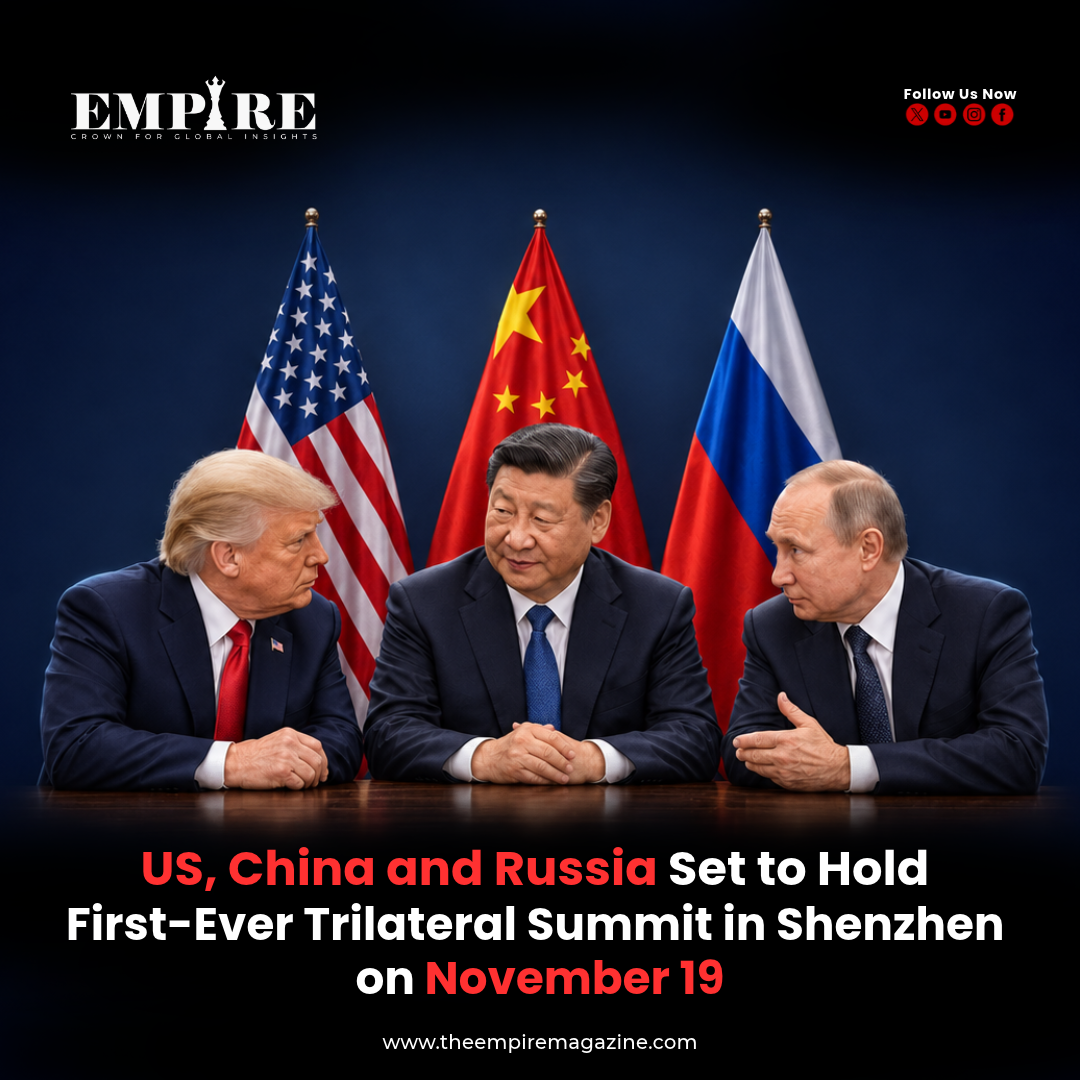
The US-China-Russia summit is scheduled for 19 November 2026 in Shenzhen, bringing together US President Donald Trump, Chinese President Xi Jinping and Russian President Vladimir Putin for a joint meeting on the sidelines of APEC.
China’s Foreign Ministry announced the meeting on 16 November. Spokesperson Mao Ning described it as the first face-to-face gathering involving the heads of state of all three countries.
Nuclear arms control and Iran are among the subjects US officials say Trump intends to raise. Beijing has described the meeting more broadly in terms of world peace and strategic stability.
US-China-Russia summit: confirmed meeting details
The gathering will take place during a week of international meetings in Shenzhen, the southern Chinese city hosting this year’s Asia-Pacific Economic Cooperation events.
| Detail | Confirmed information |
|---|---|
| Scheduled date | Thursday, 19 November 2026 |
| Host city | Shenzhen, China |
| US participant | President Donald Trump |
| Chinese participant | President Xi Jinping |
| Russian participant | President Vladimir Putin |
| Setting | On the sidelines of the APEC leaders’ meeting |
| Status | Announced; talks have not yet taken place |
The Kremlin had confirmed the arrangement on 14 November. Spokesperson Dmitry Peskov said the three presidents had agreed to meet during the APEC gathering.
US officials also confirmed the planned meeting ahead of China’s formal announcement. Their briefings identified nuclear arms control and Iran as subjects Trump intended to discuss.
Why the three-way format matters
The US-China-Russia summit would put the three leaders in the same discussion, giving each an opportunity to hear the others’ positions directly.
China’s description of a historic first refers specifically to this joint leaders’ meeting. It should not be confused with the many separate bilateral contacts involving these countries.
All three are permanent members of the United Nations Security Council. Their decisions affect international security, making communication among them consequential even when substantial disagreements remain.
The practical significance will depend on what follows the meeting. A commitment to further talks, a clearer understanding of each side’s concerns or a mechanism for continued communication would be different outcomes from a signed agreement.
How the meeting fits into APEC week
The US-China-Russia summit is a separate engagement alongside the 33rd APEC Economic Leaders’ Meeting, scheduled for 18–19 November.
APEC brings together 21 member economies and focuses on economic cooperation, trade and investment. Its broader programme should therefore be distinguished from the security discussions expected in the three-leader meeting.
China’s Foreign Ministry says Xi will chair the APEC leaders’ meeting. The APEC CEO Summit is scheduled for 17–18 November, adding business discussions to the diplomatic programme.
The wider programme brings government and business representatives together around regional economic priorities, while the trilateral meeting provides a separate setting for the three presidents’ discussions.
Nuclear arms control is a planned US priority
The US-China-Russia summit is expected to provide Trump with an opportunity to raise nuclear weapons reductions, according to US officials.
The discussion comes after New START expired on 5 February 2026. That treaty had placed binding limits on specified categories of deployed strategic nuclear weapons and delivery systems held by the United States and Russia.
At its expiration, UN Secretary-General António Guterres urged Washington and Moscow to negotiate a successor framework that would restore verifiable limits and reduce risks.
Washington’s interest in involving Beijing faces a significant difference in negotiating positions. China has argued that the United States and Russia, with their much larger nuclear arsenals, should take the lead in reductions.
Participation in the Shenzhen meeting does not itself mean China has agreed to join a three-country arms-control treaty. Establishing a negotiating process would be a separate development requiring further announcements.
Iran is expected to feature in the discussions
The US-China-Russia summit is also expected to include discussion of Iran, based on US briefings reported ahead of the meeting.
A senior US official said Trump intended to raise the issue, but did not provide details of a proposed arrangement involving Moscow and Beijing. The available statements do not establish a jointly agreed approach to ending the conflict.
Russia’s war against Ukraine has been treated differently in those briefings. US officials said it was being addressed through a separate diplomatic process and was not intended to be an explicit subject of the trilateral discussion.
China emphasises stability and communication
China has framed the US-China-Russia summit around world peace, managing differences and stability in relations among major powers.
At the 16 November foreign ministry briefing, Mao Ning said the leaders would exchange views on important issues affecting global peace. When asked about specific topics, she did not publish a detailed joint agenda.
The distinction between an individual government’s priorities and a collectively agreed programme is important. US briefings explain what Washington wants to raise, while China’s statements describe broader objectives.
Separately, Peskov rejected comparisons between the planned gathering and the 1945 Yalta Conference. According to Reuters, he said Russia and China supported a multipolar order without decisions being imposed on other countries.
Expectations remain limited
The US-China-Russia summit has attracted attention because of its format, but US officials have cautioned against expecting an immediate agreement.
A senior official described the intended arms-control discussion as an opening conversation that could support further engagement. No completed treaty or settlement has been announced in connection with the planned meeting.
From an analytical perspective, the most useful measure of progress will be whether the leaders establish specific next steps. Follow-up meetings, agreed subjects for negotiation or instructions to officials would provide more evidence of sustained diplomacy than broad statements alone.
What to watch after November 19
After the US-China-Russia summit, attention will turn to the official accounts released by Washington, Beijing and Moscow.
The key points will be whether the governments describe the same priorities, identify areas of agreement and announce a timetable for further discussions. Any joint statement would need to be read alongside those separate accounts.
For now, the confirmed development is the decision to hold the meeting. Its longer-term importance will depend on the commitments made in Shenzhen and the diplomatic work that follows.
Explore more global business, technology and innovation coverage in The Empire Magazine’s article archive.
Read our related coverage: vulcan-rocket-failure-amazon-satellites/
Follow The Empire Magazine:
Facebook | Instagram
The Empire Magazine | Crown For Global Insights