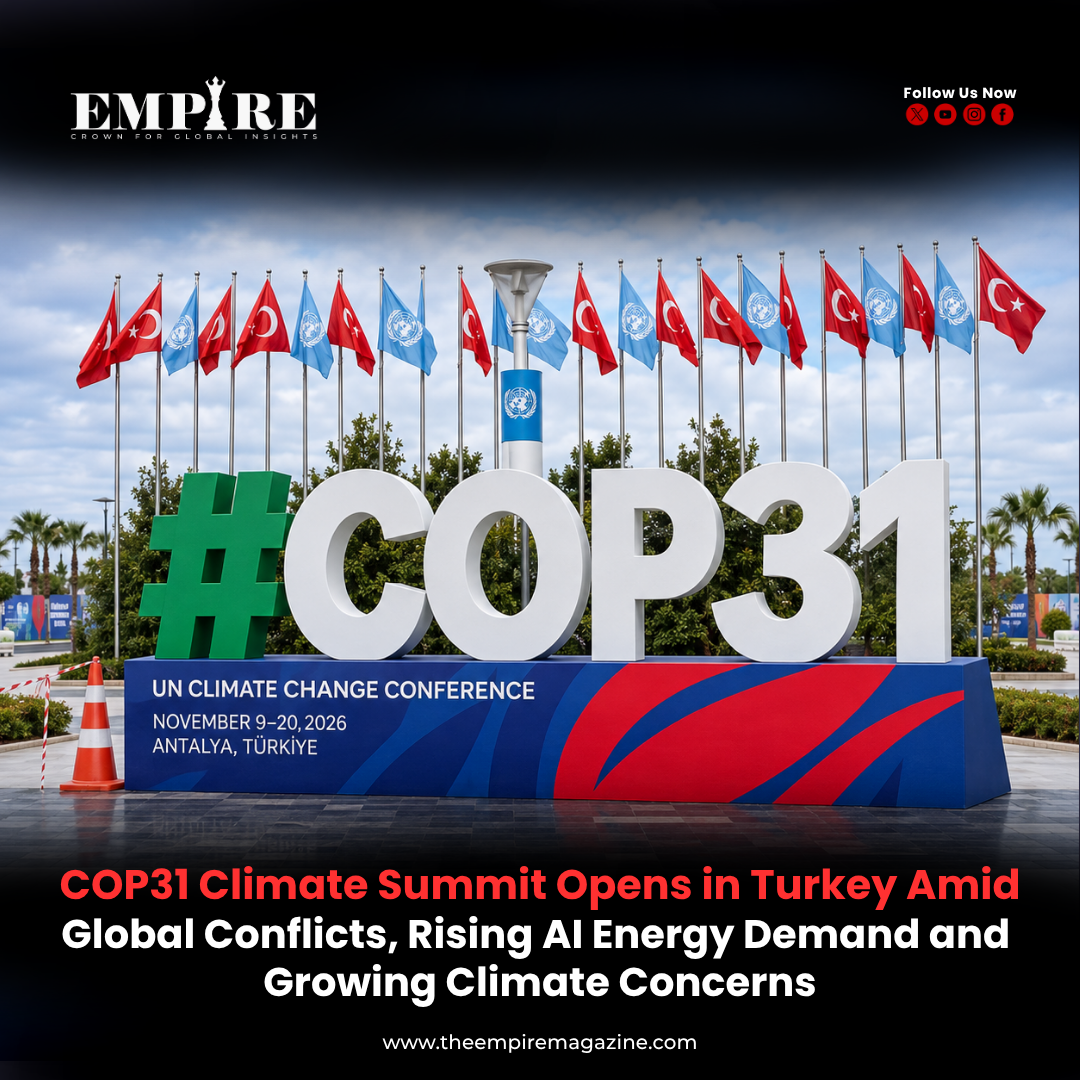
Energy security, the expansion of artificial intelligence and climate finance will shape discussions as governments gather in Antalya.
Turkey | Climate, Energy and Global Business
Information checked on 9 November 2026.
The COP31 climate summit is set to open in Antalya, Turkey, on 9 November 2026, bringing governments together as global conflicts, growing electricity demand and worsening climate risks complicate international cooperation.
Scheduled to continue until 20 November, the United Nations conference will address emissions reductions, adaptation, finance and the implementation of national climate commitments.
This year’s discussions also place greater attention on artificial intelligence. As data centres expand, policymakers face questions about how to meet additional electricity demand while reducing emissions and maintaining affordable, reliable power.
Where COP31 Is Taking Place
COP31 will be held at the Antalya Expo Center. A World Leaders’ Summit is scheduled for 11–12 November.
Turkey is hosting the conference, with Murat Kurum nominated as COP31 president. Australia’s Chris Bowen is designated president of negotiations.
The gathering brings together government negotiators alongside representatives from business, science, Indigenous communities, youth organisations and civil society.
Its central challenge is implementation: translating climate commitments into policies, infrastructure and projects that deliver measurable results.
Global Conflicts Complicate Energy Decisions
Conflicts involving Iran and Ukraine have intensified concerns about fuel supplies and energy security.
Reuters reports that disruptions have prompted governments to seek alternative oil supplies and, in some cases, increase reliance on coal. These pressures complicate efforts to agree on the pace of the energy transition.
At the same time, exposure to imported fuel disruptions strengthens the argument for expanding domestic clean-energy supplies.
For negotiators, affordability and reliability remain closely connected to climate policy. Governments must explain how their energy plans will reduce emissions while meeting households’ and businesses’ immediate needs.
Turkey Promotes Its 35-by-35 Electrification Pledge
A flagship initiative of the Turkish presidency aims to increase electricity’s share of global final energy consumption to 35% by 2035.
The proposed shift concerns how energy is used across buildings, transport and industry. It includes replacing suitable fuel-based equipment with electric alternatives, supported by improvements to grids and other infrastructure.
The presidency has also outlined initiatives involving industrial decarbonisation and access to finance and technology.
The climate benefits of electrification depend partly on the electricity supplying those systems. Expanding demand therefore needs to be considered alongside generation, efficiency, storage and grid capacity.
The pledge is a presidency initiative seeking support. Its announcement should not be presented as a completed agreement among all COP31 parties.
Why AI Energy Demand Is Part of the COP31 Debate
Artificial intelligence is becoming an increasingly important consideration in electricity planning.
The International Energy Agency’s 2026 analysis reports that global data-centre electricity consumption increased by 17% in 2025, while consumption at AI-focused data centres rose by 50%.
Its central projection puts total data-centre electricity use at approximately 950 terawatt-hours in 2030, compared with 485 terawatt-hours in 2025. That would represent around 3% of global electricity demand in 2030.
These totals cover data centres serving multiple purposes, including AI.
The IEA also finds that efficiency improvements per AI task are occurring alongside rapid growth in usage and more demanding applications. Better efficiency therefore needs to be assessed together with the scale of deployment.
AI can also support energy systems by helping monitor equipment and improve the use of existing grid capacity. Its environmental contribution depends on both how it is powered and how it is applied.
What the Antalya AI Pledge Seeks to Address
The COP31 presidency has developed the Antalya Artificial Intelligence Pledge in cooperation with the International Telecommunication Union.
The initiative concerns how AI is designed, purchased, powered, deployed and assessed in support of climate and sustainable-development objectives.
ITU’s COP31 programme includes a high-level AI roundtable and discussions on digital infrastructure, early-warning systems and measuring environmental impacts.
For governments and technology companies, this creates an opportunity to establish clearer expectations around energy use and the practical benefits of AI applications.
The important questions include whether proposed measures produce reliable information, improve operational efficiency and support additional clean-energy investment. These will help determine whether commitments translate into measurable progress.
New Climate Findings Increase the Urgency
The United Nations Environment Programme’s Emissions Gap Report 2026, published on 21 October, warns that current policies could lead to approximately 2.8°C of warming this century.
Full implementation of national climate pledges, followed by comparable continuing efforts, would limit warming to around 2.6°C, according to the report.
UNEP says rapid emissions reductions are needed to minimise how far and for how long warming exceeds 1.5°C.
These projections depend on future policy and emissions choices. Faster reductions would help limit peak warming and the associated risks.
The report also identifies evidence that climate policies and renewable-energy deployment have reduced emissions in particular countries and sectors. COP31’s challenge is to accelerate and expand that progress.
Climate Finance and Adaptation Remain Central
Climate finance for developing countries and adaptation to climate impacts are part of the negotiations.
Adaptation concerns practical measures that help communities withstand changing conditions. These include resilient infrastructure, stronger early-warning systems and improvements to food, water and health systems.
COP31’s wider Action Agenda includes work on resilient cities, agriculture, industrial development and turning national climate plans into projects that can secure investment.
For countries facing limited financial capacity, delivery depends on more than announcing a project. They need accessible funding, technical support and institutions able to implement and maintain it.
The summit will therefore be assessed partly on whether it helps connect climate priorities with workable financing and implementation arrangements.
What COP31 Means for Businesses
From a business perspective, clearer climate policies can help companies plan long-term investments.
Electricity producers, industrial manufacturers and data-centre operators need to understand how governments intend to develop grids, support cleaner generation and manage rising demand.
Businesses also face physical climate risks affecting facilities, logistics and supply chains. Adaptation planning can therefore influence investment decisions alongside emissions-reduction requirements.
The distinction between negotiated decisions and voluntary initiatives matters. Companies will need to examine the scope, participants and follow-up arrangements behind announcements before assessing their practical implications.
What to Watch During the Summit
Several developments will indicate how the talks are progressing:
- Support for the presidency’s electrification and AI initiatives.
- Progress on finance and adaptation.
- Decisions concerning national climate-plan implementation.
- The relationship between energy-security priorities and emissions reductions.
- Clear responsibilities and mechanisms for tracking delivery.
The outcomes will emerge through negotiations and announcements over the coming days. The practical test will be whether countries and institutions connect their commitments with funding, implementation schedules and measurable results.
Explore more global business, technology and innovation coverage in The Empire Magazine’s article archive.
Read our related coverage: nvidia-jensen-huang-probe/
Follow The Empire Magazine:
Facebook | Instagram
The Empire Magazine | Crown For Global Insights