
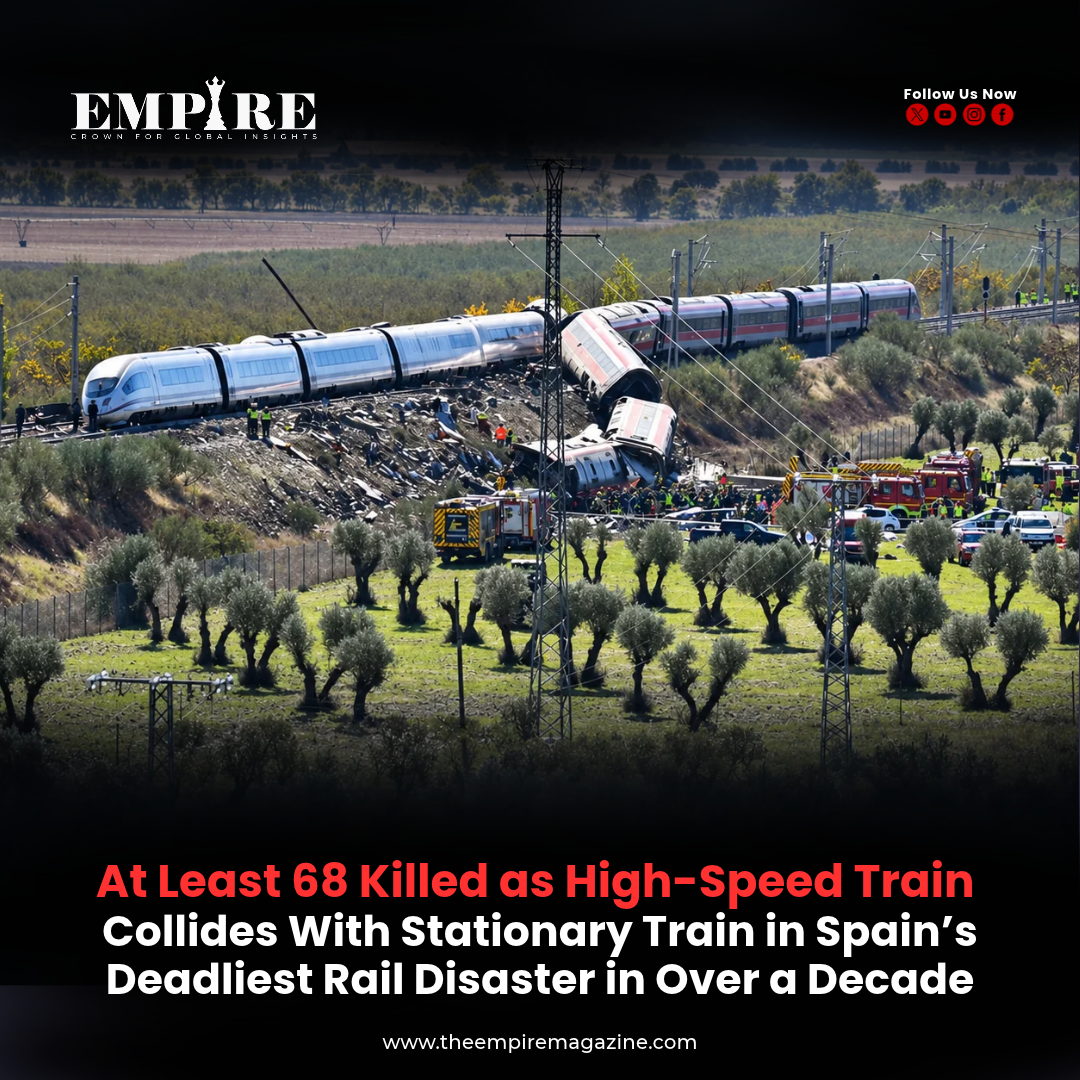
A Renfe service struck a stationary Iryo train near Urda, prompting a major emergency response, disruption to the Madrid–Andalusia railway corridor and an investigation into the events preceding the collision.
Spain | World News and Transport
Information checked on 29 October 2026. Casualty figures remain provisional.
The Spain train crash near Urda in Toledo province killed at least 68 people and left more than 100 injured, according to a provisional update from the regional government of Castilla-La Mancha.
The collision occurred on the morning of 28 October 2026, when a high-speed train operated by Renfe struck the rear of a stationary Iryo service. Both trains were travelling from Madrid towards Seville.
Emergency teams were deployed to rescue passengers, treat the injured and search the damaged carriages. The disaster also interrupted a major rail connection between the Spanish capital and southern Spain.
Officials have begun examining the signalling problem and operating instructions that preceded the impact. Their early accounts provide an outline of events, but the complete sequence and responsibility remain under investigation.
What Happened in the Spain Train Crash?
The collision took place shortly before 9 a.m. local time, near Urda in the Castilla-La Mancha region.
Spain’s railway infrastructure manager, Adif, located the incident at kilometre 118 of the Madrid–Andalusia high-speed line. It confirmed that a Renfe train and an Iryo train were involved in a rear-end collision.
According to passenger figures provided by regional authorities and reported by EL PAÍS, 544 passengers were travelling on the two services: 397 on the Renfe train and 147 on the Iryo train.
Several carriages derailed, with damaged vehicles coming to rest down an embankment. The condition and position of the carriages complicated efforts to reach those inside.
Key Facts About the Collision
| Detail | Information available |
|---|---|
| Date | 28 October 2026 |
| Location | Near Urda, Toledo province, Castilla-La Mancha |
| Railway corridor | Madrid–Andalusia high-speed line |
| Operators involved | Renfe and Iryo |
| Reported passengers aboard | 544 across both trains |
| Provisional fatalities | At least 68 |
| Injuries | More than 100, according to the regional government |
| Investigation status | Ongoing |
The casualty figures describe the information available during the emergency response. They should not be treated as a final accounting of everyone affected.
Emergency Services Mobilise Around Urda
Castilla-La Mancha activated its territorial emergency plan, known as PLATECAM, at 9:15 a.m. following the collision.
At 10:30 a.m., authorities raised the operational emergency level and requested assistance from Spain’s Military Emergency Unit, or UME.
The response brought together medical personnel, firefighters, Civil Protection teams and security services. Temporary facilities were established to support emergency operations and assist people affected by the disaster.
Regional authorities also organised information and assistance arrangements for relatives. Alongside rescue work, families needed help locating passengers and obtaining reliable updates about their condition.
Assistance for Victims and Their Families
Renfe activated its crisis team and its assistance plan for railway accident victims and their families.
The company said family assistance centres in Madrid, Córdoba and Seville included psychological support. Adif also established assistance points at major stations, including Málaga.
These arrangements address needs extending beyond the accident site, including information, emotional support and help for relatives travelling to reach those affected.
What Officials Have Said About the Cause
Transport Minister Óscar Puente said a computer problem affected the railway’s LZB safety system, causing trains in the area to stop.
According to his preliminary account, the Renfe service was subsequently authorised to resume its journey despite an active red signal. The Iryo train ahead remained stationary.
Puente questioned the instruction to restart the Renfe train and said the interval between that instruction and the collision required further examination.
These statements describe the minister’s initial reconstruction. They do not constitute a completed investigation or a final finding of responsibility.
Recorded Communications Provide Further Details
Spanish public broadcaster RTVE reported obtaining extracts of communications between the control centre and the train drivers.
According to its account, the Renfe driver received instructions to resume normal running. In another exchange, the Iryo driver reported that the train remained stopped and that its LZB system could not be restarted.
RTVE noted that it was unclear whether additional communications existed beyond the extracts it had obtained.
The recordings provide information about instructions and reported equipment problems. Establishing their full significance requires investigators to place them alongside the complete operational record.
Questions That Remain Unanswered
The investigation will need to clarify the train’s precise speed, the sequence of communications and the circumstances that allowed one train to approach another that remained stationary.
It must also establish how the equipment problem was managed and whether the relevant operating procedures were followed.
The term “high-speed train” identifies the type of service involved. It does not, by itself, establish the train’s speed at the moment of impact.
Madrid–Andalusia Rail Services Disrupted
Adif confirmed that the collision interrupted traffic on the Madrid–Andalusia high-speed corridor.
In its 28 October update, the infrastructure manager said trains on the affected line had been held at stations. It separately reported that the Madrid–Toledo and Málaga–Seville high-speed sections were operating normally.
That distinction matters for passengers: disruption to the accident corridor did not mean every high-speed route in Spain had stopped.
Renfe Announces Alternative Transport Arrangements
Renfe announced special services using conventional railway lines to connect Madrid, Ciudad Real and Puertollano. It said these journeys would take approximately 90 minutes longer.
The operator also announced an alternative transport plan for journeys between Madrid and Andalusia beginning Friday, 30 October. At the time of its statement, detailed routes and schedules were still being finalised.
Renfe said affected passengers could make changes or cancellations without charge.
Passengers planning travel on the affected corridor should check their individual service status and the arrangements offered by their operator before departing.
Spain Declares Three Days of National Mourning
Spain declared three days of official mourning, beginning at midnight on 29 October and continuing through 31 October 2026.
Under the official decree, national flags are to fly at half-mast on public buildings and naval vessels during that period.
Prime Minister Pedro Sánchez visited the emergency command post near Urda and expressed support for victims, injured passengers and their families.
He said the authorities would investigate the disaster fully and respond to any negligence or safety failures identified. He also emphasised the need to strengthen confidence in the high-speed railway system.
Spain’s Deadliest Rail Disaster Since 2013
Reuters described the Urda collision as Europe’s deadliest rail accident since the 2013 Santiago de Compostela derailment, which killed 80 people.
The latest disaster also follows the January 2026 collision near Adamuz, which killed 46 people and involved services operated by Renfe and Iryo.
Sánchez said the two accidents appeared to have different causes, while making clear that investigators would determine the findings.
The earlier disaster provides context for renewed scrutiny of railway safety. It does not establish why the Urda collision occurred.
What Comes Next in the Investigation?
The next stage is to establish a complete account of the events before the impact, including equipment performance, train movements and communications between railway personnel.
A reliable explanation will need to show how the initial disruption developed into a collision and identify any measures necessary to prevent a recurrence.
Further updates will also be needed on the casualty total, the condition of injured passengers and the restoration of affected services.
For the families involved, the immediate priorities remain accurate information, medical care and sustained support as the consequences of the disaster become clearer.
Explore more global business, technology and innovation coverage in The Empire Magazine’s article archive.
Read our related coverage: microsoft-voluntary-buyouts-60000-employees/
Follow The Empire Magazine:
Facebook | Instagram
The Empire Magazine | Crown For Global Insights