United States | Startups, Space Technology & Innovation
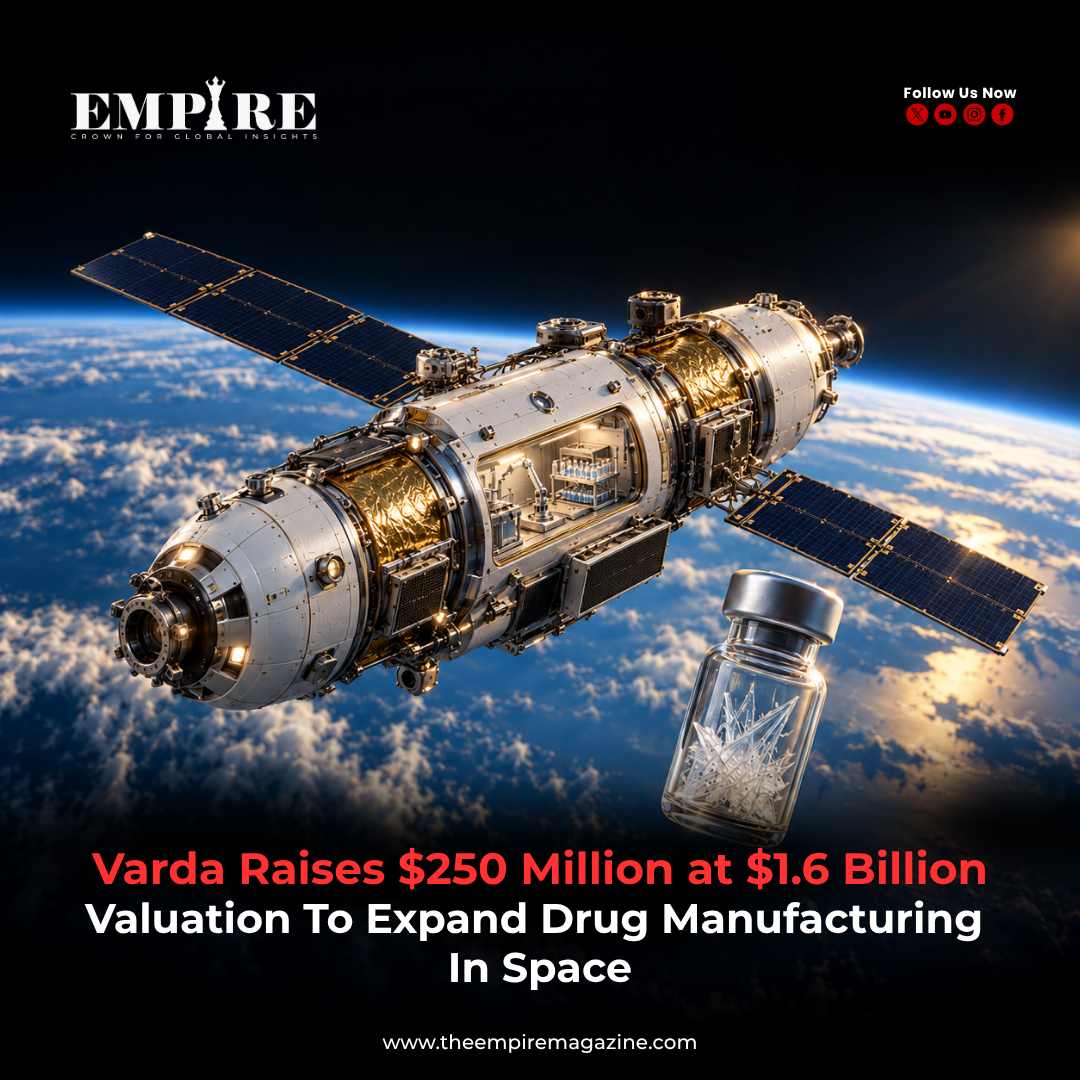
Varda Space Industries has raised $251 million in a Series D funding round, giving the California-based space manufacturing company fresh capital to expand its efforts to develop pharmaceutical materials in orbit and return them safely to Earth.
Announced on 30 September 2026, the round was led by Lux Capital and Natural Capital and brings Varda’s total capital raised to approximately $598 million.
Reuters reported the financing as a roughly $250 million round at a $1.6 billion valuation, while Varda’s own announcement lists the more precise funding figure of $251 million.
The investment highlights growing commercial interest in one of the space industry’s more unusual opportunities: using microgravity as a pharmaceutical processing environment.
Rather than manufacturing conventional products in orbit, Varda is focused on understanding whether the unique physical conditions of space can produce pharmaceutical materials with properties that may be difficult to achieve on Earth.
The commercial opportunity, however, depends on more than successful spaceflight. Varda must demonstrate that useful pharmaceutical materials can be produced consistently, returned safely and ultimately provide a meaningful advantage within drug development or manufacturing.
What Varda’s Latest Funding Will Support
Varda says the new capital will help the company increase the frequency of its missions while expanding partnerships with pharmaceutical companies.
Other investors participating in the round include Founders Fund, Khosla Ventures, Caffeinated Capital, General Catalyst, 8090 Industries, Giant Step and Also Capital.
Increasing mission frequency could be particularly important for pharmaceutical research.
Drug-development programmes typically require repeated experiments, comparisons between batches and adjustments to manufacturing processes. More frequent orbital missions could allow pharmaceutical partners to test materials in microgravity, analyse returned samples and refine subsequent experiments more quickly.
For Varda, the long-term value of a higher mission cadence will therefore depend not simply on how many spacecraft it launches, but on the quality and repeatability of the pharmaceutical results produced through those missions.
The funding gives Varda additional resources to pursue this model, but it does not yet determine whether space-processed formulations will become commercially viable medicines or what the eventual economics of orbital pharmaceutical manufacturing will look like.
How Varda’s Orbital Processing Platform Works
Varda’s W-Series spacecraft combines an independent orbital platform with a re-entry capsule designed to return processed materials to Earth.
Unlike experiments that depend on docking with a space station, the spacecraft can operate independently in orbit.
Its onboard processing systems are designed to perform operations such as heating, mixing and cooling materials in microgravity. Once orbital processing is complete, the capsule separates from the spacecraft, re-enters Earth’s atmosphere and descends by parachute for recovery.
Varda’s first mission, W-1, returned to the Utah Test and Training Range on 21 February 2024, demonstrating the company’s ability to recover material that had undergone processing in orbit.
The service extends beyond the spacecraft itself.
For pharmaceutical customers, Varda describes a broader process involving laboratory development, sample preparation, mission operations, orbital processing, recovery and post-flight analysis.
That creates a complex operational chain.
A successful pharmaceutical experiment requires the material to be prepared correctly before launch, processed under suitable conditions in orbit and returned in a state that allows researchers to compare it meaningfully with laboratory controls.
Successful launch and re-entry are therefore only part of the challenge.
Why Microgravity Could Matter for Drug Development
One of the most closely studied applications of microgravity involves crystallisation.
On Earth, gravity influences how fluids move and how particles settle. In microgravity, effects such as sedimentation and buoyancy-driven convection are significantly reduced.
NASA has studied how these changes can affect crystal growth and how microgravity research could potentially contribute to drug development, formulation and delivery.
For pharmaceutical researchers, this environment may provide opportunities to investigate differences in crystal structure, particle size and material behaviour.
Varda has identified several areas of interest, including controlling particle size, studying different crystal forms and investigating formulations that could potentially offer improved stability or delivery characteristics.
The company also conducts ground-based testing to identify which materials and processes may benefit most from orbital experiments.
However, the value of these changes must ultimately be demonstrated on a compound-by-compound basis.
Producing a different crystal structure in orbit is scientifically interesting, but it becomes commercially important only when that difference translates into a useful pharmaceutical advantage.
What Varda’s Ritonavir Research Demonstrated
One example of Varda’s scientific work involves ritonavir, an antiviral pharmaceutical compound.
A study published in npj Microgravity on 8 April 2026 examined ritonavir Form III that had been processed in orbit and subsequently returned to Earth.
Researchers also analysed control samples involving other ritonavir forms that travelled through the spaceflight environment.
The study reported successful recovery of the orbit-produced Form III and found physical and chemical stability in the tested samples when compared with reference materials on Earth.
This finding addresses an important question for orbital pharmaceutical manufacturing: whether processed materials can survive the conditions associated with launch, orbital operations, atmospheric re-entry and recovery.
These are demanding environments, and demonstrating material stability is an essential step toward determining whether orbital processing can become part of a practical pharmaceutical development workflow.
The scope of the research should nevertheless be kept clear.
The study demonstrated material recovery and stability. It did not establish that patients receiving a space-processed drug formulation would experience better clinical outcomes.
Instead, the research provides evidence supporting one stage in a much longer pharmaceutical development process.
United Therapeutics Partnership Expands the Pharmaceutical Opportunity
Varda strengthened its pharmaceutical development strategy in May 2026 when it announced a collaboration with United Therapeutics.
The companies plan to investigate improved formulations of medicines used for rare pulmonary diseases by processing small-molecule pharmaceutical materials during multiple missions to low Earth orbit.
Research areas identified by the companies include potential improvements related to stability, bioavailability and drug-delivery characteristics.
Bioavailability refers to the proportion of an administered drug that becomes available to produce its intended effect in the body.
The partnership is significant because it combines Varda’s orbital processing capabilities with the pharmaceutical development expertise of an established drug company.
This provides a defined therapeutic context in which researchers can evaluate whether differences observed in microgravity have practical value for specific medicines.
However, the collaboration remains a research programme.
It does not yet represent an approved medicine or a completed clinical programme based on Varda’s manufacturing platform.
Future scientific and development results will determine whether the work progresses toward commercial pharmaceutical products.
Space Research Could Also Improve Manufacturing on Earth
The commercial value of pharmaceutical research in space does not necessarily require medicines to be manufactured permanently in orbit.
Research conducted in microgravity can also generate insights that improve manufacturing processes back on Earth.
NASA highlighted one example in January 2026, when it discussed International Space Station research conducted with Merck involving particle structure and size relevant to an injectable formulation of pembrolizumab.
According to NASA, insights from the space-based research helped scientists refine aspects of production on Earth.
The example is unrelated to Varda’s own pharmaceutical products, but it illustrates an important distinction within the emerging space-manufacturing industry.
In some cases, microgravity may serve primarily as a research environment that helps scientists discover better manufacturing techniques that can later be reproduced terrestrially.
In other cases, the benefits of microgravity may be substantial enough that a particular processing step continues to take place in orbit before the material is returned to Earth.
The economics of these two approaches are very different.
The Economics Behind Drug Manufacturing in Space
The central business question facing Varda is whether the additional value created through orbital processing can justify the complete cost and complexity of performing pharmaceutical work in space.
Those costs extend well beyond launch.
A commercial assessment would need to consider laboratory development, sample preparation, spacecraft hardware, launch services, mission operations, re-entry, recovery and post-flight analysis.
Another critical factor is usable output.
The relevant measure is not simply how much material is sent into space, but how much recovered material meets the scientific and pharmaceutical requirements of a development programme.
Several indicators could help determine whether Varda’s model is progressing toward commercial viability:
- Repeatability: Comparable results across multiple missions and production batches.
- Material quality: Returned samples consistently meeting defined physical and chemical specifications.
- Useful output: Sufficient quantities of suitable material being recovered from each mission.
- Development progress: Space-processed formulations advancing through clearly defined pharmaceutical research milestones.
- Customer demand: Pharmaceutical companies committing to repeat programmes and long-term partnerships.
- Economics: The value created by orbital processing justifying the cost of delivering the service.
These factors are measures for evaluating Varda’s future commercial performance rather than outcomes already established by the latest funding announcement.
What Will Define Varda’s Next Phase
Varda’s next stage of development will depend on how effectively it connects spaceflight operations with repeatable pharmaceutical results.
More missions will increase experimental capacity, but the strongest evidence of commercial progress would be reproducible scientific findings that help pharmaceutical partners solve specific formulation or manufacturing problems.
If that happens, the implications could extend beyond Varda itself.
For the wider commercial space industry, pharmaceutical manufacturing could become a source of demand tied to practical applications on Earth rather than space exploration alone.
For pharmaceutical companies, orbital processing could become another research and manufacturing tool for compounds that are difficult to optimise using conventional terrestrial methods.
Varda now has substantially more capital to pursue that opportunity.
Its long-term success will depend not merely on launching more spacecraft, but on demonstrating that microgravity processing can deliver consistent, scientifically meaningful and economically valuable pharmaceutical outcomes.
The next few years will reveal whether drug manufacturing in space can move from an experimental capability into a dependable commercial service.
Explore more global business, technology and innovation coverage in The Empire Magazine’s article archive.
Follow The Empire Magazine for global business, technology, innovation, and leadership insights: tabby-233m-funding-6-5-billion-valuation/
Facebook: The Empire Magazine
Instagram: @the_empire_magazine
The Empire Magazine | Crown For Global Insights