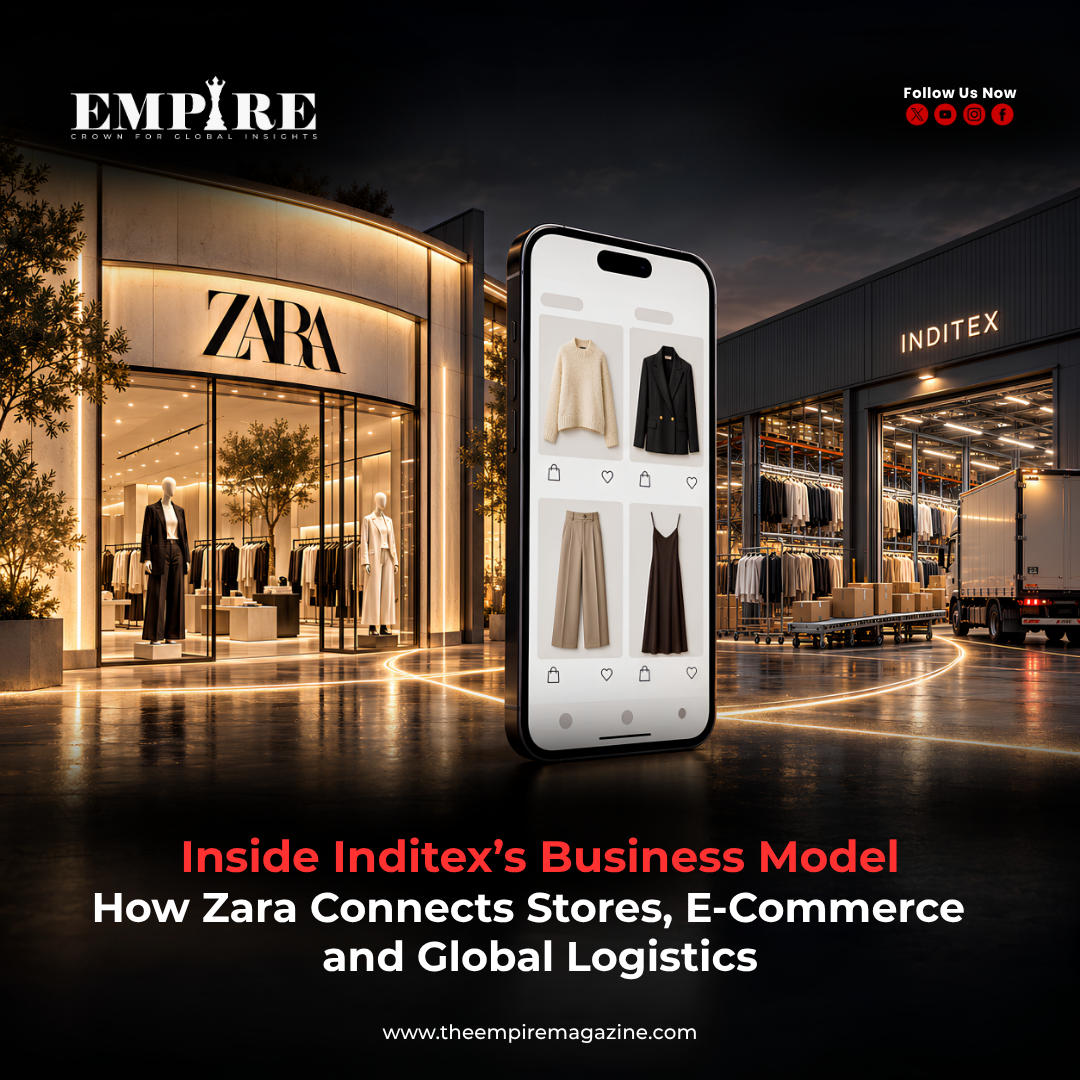
The Inditex business model has become one of the most studied examples of modern retail transformation.
The Spanish fashion group behind Zara, Pull&Bear, Massimo Dutti, Bershka, Stradivarius, Oysho and Zara Home has built a global retail system that connects physical stores, online shopping, customer data, design teams and a highly coordinated supply chain.
Unlike traditional fashion companies that often rely on long-term seasonal planning, Inditex has developed a more flexible approach that allows it to respond quickly to changing consumer preferences.
At the centre of this strategy is Zara’s ability to combine creativity, technology and logistics into one integrated business system.
Inditex: The Company Behind Zara’s Global Expansion
Founded in Spain in 1985, Inditex grew from a regional clothing company into one of the world’s largest fashion retailers.
The group operates thousands of stores across international markets while also serving customers through digital platforms.
Its growth has been supported by a business philosophy focused on:
- Understanding customer demand quickly
- Producing relevant fashion collections
- Managing inventory efficiently
- Connecting online and offline shopping experiences
The company’s approach differs from traditional fashion retail models where products may be designed many months before reaching customers.
Instead, Inditex built a system where customer feedback influences future designs and production decisions.
How Zara’s Fast Fashion Model Works
Zara’s business model is often associated with speed.
The company monitors customer preferences through multiple channels, including:
- Store sales data
- Online purchasing behaviour
- Customer feedback
- Market trends
- Social media conversations
Design teams analyse this information and adjust product decisions based on changing demand.
This allows Zara to introduce new products regularly rather than depending only on fixed seasonal collections.
The result is a retail model designed around responsiveness rather than simply producing large quantities in advance.
The Connection Between Zara Stores and E-Commerce
A major part of the Inditex business model is the integration between physical stores and digital platforms.
Modern customers may discover products online, visit a store to experience them physically, or purchase through an app and receive delivery at home.
Inditex has invested in an integrated retail strategy, where stores and online channels support each other.
Examples include:
- Online ordering with store pickup options
- Digital inventory visibility
- Mobile shopping applications
- Store-based fulfilment systems
This approach allows Zara to operate as a connected global retail network rather than separate online and offline businesses.
Technology Behind Inditex’s Retail Operations
Technology plays an important role in managing millions of customer interactions and products worldwide.
Inditex uses digital tools to improve:
Inventory Management
Real-time information helps the company understand product availability across stores and online platforms.
This helps reduce unnecessary inventory and improves product distribution.
Customer Experience
Digital platforms allow customers to browse collections, check availability and purchase products from different locations.
Data-Driven Decision Making
Customer behaviour provides insights into:
- Popular products
- Regional preferences
- Shopping patterns
- Demand changes
This information supports faster business decisions.
Zara’s Global Logistics Network
A key strength of the Inditex business model is its logistics infrastructure.
Unlike many global retailers that depend heavily on long-distance supply chains, Inditex maintains a highly coordinated distribution system centred around its logistics facilities in Spain.
The company uses these centres to:
- Receive products from suppliers
- Organise distribution
- Manage inventory movement
- Deliver products to stores worldwide
This structure allows Zara stores to receive new collections frequently.
The ability to move products quickly helps the company respond to market demand and reduce excess stock.
The Role of Supply Chain Flexibility
Fashion demand can change quickly.
A product that becomes popular may require additional production, while a less successful item can be reduced before creating excessive inventory.
The Inditex business model focuses on flexibility by combining:
- Internal design coordination
- Supplier relationships
- Regional production capabilities
- Advanced logistics
This creates a balance between speed and operational control.
Why Zara Produces Smaller Initial Quantities
One distinctive element of Zara’s strategy is producing smaller initial quantities compared with traditional retailers.
This approach creates several advantages:
Reducing Inventory Risk
Producing less at the beginning helps avoid large amounts of unsold stock.
Creating Customer Interest
Limited availability can encourage customers to purchase products quickly.
Testing Market Response
Sales performance provides information about whether additional production is needed.
This creates a continuous learning cycle between customers and the company.
Inditex’s Global Store Strategy
Physical stores remain an important part of Inditex’s business.
Rather than viewing stores only as sales locations, the company increasingly treats them as:
- Customer experience spaces
- Product discovery points
- Digital fulfilment centres
- Brand communication platforms
Large flagship stores in major cities help strengthen brand visibility, while digital channels expand customer access.
Sustainability and Supply Chain Transformation
The fashion industry faces increasing pressure to improve environmental performance.
Inditex has introduced sustainability initiatives focused on areas such as:
- More responsible materials
- Energy efficiency
- Waste reduction
- Circular fashion programmes
- Supply chain transparency
The company has also invested in technologies and processes designed to improve resource efficiency.
However, sustainability remains a broader challenge across the global fashion industry, requiring changes in production, consumption and recycling systems.
Challenges Facing the Inditex Business Model
Although Inditex has built a strong global retail system, the company operates in a highly competitive environment.
Major challenges include:
Changing Consumer Expectations
Customers increasingly expect:
- Faster delivery
- More personalised shopping
- Sustainable products
- Competitive pricing
Competition From Digital Fashion Platforms
Online-first companies have changed expectations around speed, pricing and digital engagement.
Supply Chain Complexity
Managing thousands of suppliers and global operations requires continuous investment in technology and logistics.
Sustainability Pressure
Fashion companies face increasing demands from consumers, investors and regulators regarding environmental impact.
How Zara’s Model Influenced Global Retail
The Inditex business model has influenced how many companies think about modern retail.
Its approach demonstrated that successful fashion businesses need more than attractive products.
They also require:
- Fast information flow
- Flexible production
- Strong logistics
- Digital integration
- Customer understanding
Many retailers have studied Zara’s approach as they attempt to build more responsive supply chains.
The Future of Inditex and Zara
The future of Zara’s business model will likely depend on how effectively Inditex combines technology, sustainability and customer experience.
Artificial intelligence, automation and advanced analytics may further improve:
- Demand forecasting
- Inventory management
- Personalised recommendations
- Supply chain efficiency
As retail continues to evolve, Inditex’s ability to connect physical stores, digital platforms and global logistics will remain central to its strategy.
The company’s biggest competitive advantage is not only the speed of producing fashion products.
It is the ability to create a complete system where customer insights, design, manufacturing and distribution work together.
Explore more global business, technology and innovation coverage in The Empire Magazine’s article archive.
Read our related business coverage: L’Oréal and LVMH in France’s corporate landscape.
Follow The Empire Magazine for global business, technology, innovation, and leadership insights:
Facebook: The Empire Magazine
Instagram: @the_empire_magazine
The Empire Magazine | Crown For Global Insights