1. A Career Built Around Connecting Worlds
For more than 25 years, Agnès Studer has moved through professional environments that, at first glance, might seem to belong to very different worlds. International conferences, arts and culture, professional integration, coaching, corporate training and art therapy have each shaped a different chapter of her career. Yet when she looks back, she sees a consistent thread beneath the surface. Her work has always been about people, perspectives and the moments when one chapter of life gives way to another.
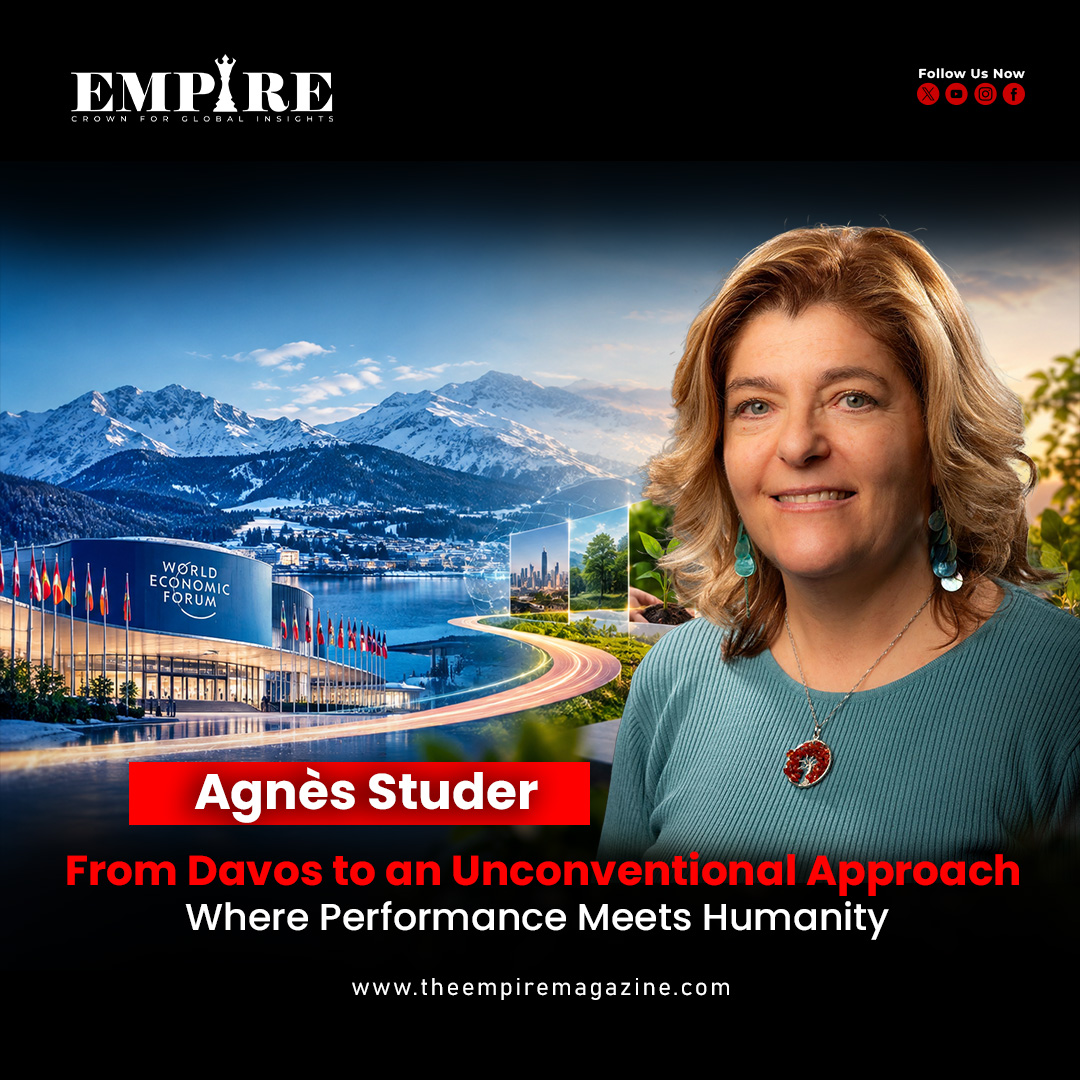
Agnès Studer professional journey includes an unusual chapter at the World Economic Forum in Davos, where she had the opportunity to create and coordinate the arts and culture programme of the Annual Meeting, while also introducing and managing a bookshop in Davos. In the 1990s, this placed her in contact with artists, writers, scholars and thinkers from different parts of the world, inside an environment largely associated with economics, politics and business.
It was an experience that broadened her understanding of what happens when different disciplines are allowed to meet. The conversations around her were not limited to markets, institutions or political questions. They also touched on culture, ideas, creativity and the way people understand the world. For Agnès, this became an important lesson. Progress does not always come from staying inside one discipline. Sometimes it comes from creating a bridge between worlds that rarely speak to one another.
Her later work in professional integration brought her much closer to individual human stories. Working with people from different professions, cultures and personal circumstances, she began to see how easily a person can be reduced to a professional profile. A CV can describe experience, qualifications and responsibilities, but it cannot always reveal the persons beneath the career path – their strengths, fears, aspirations or unrealised potential.
That observation became central to the way she understands work. Behind every professional profile is a person trying to find direction, belonging and meaning. Sometimes the qualities that can help someone move forward are precisely those that cannot be measured on a CV.
2. Discovering Another Language Through Art
Agnès Studer did not begin her career with a plan to become an art therapist. In fact, the idea emerged gradually, through her own experience of stress, creativity and self-discovery.
While she enjoyed her work at the World Economic Forum, particularly the arts and culture programme, the intensity of the environment also exposed her to a level of pressure that was difficult to ignore. Running and fitness classes were already part of her routine, yet they did not seem to quiet the constant flow of thoughts, ideas and connections in her mind. At the time, she did not yet recognise this as a highly creative, branching way of thinking. At one point, a therapist intuitively recognised a strong artistic side in her and encouraged her to explore it through painting.
A few months later, Agnès Studer began attending painting classes. What started as an experiment became something much more significant. Through colour, abstract painting and fluid drawing, she discovered a different relationship with herself. Painting did not require her to explain everything intellectually. It allowed her to experience something directly, through movement, colour and expression. For the first time, she realised that she did not have to understand everything before she could express it.
For someone who had always tended to live strongly in her mind, this was an important discovery. There was another way of processing experience – a language that did not depend entirely on words.
Gradually, a question began to emerge. If creativity could help someone like her, someone accustomed to analysing and thinking deeply, perhaps it could also help other people who found themselves trapped in constant thought.
The idea of art therapy began to take shape.
When Agnès Studer eventually left the World Economic Forum in search of work that felt more human and meaningful, Agnès Studer enrolled in continuing education in art therapy. At the time, she did not know exactly where this new knowledge would take her. She simply knew that it was something she wanted to carry with her into the next stage of her professional life.
Looking back, that decision appears less like a sudden change than the beginning of a long journey that is still unfolding.
3. When Creativity Becomes a Resource for Resilience
In 2003, when Agnès Studer began working in professional integration, she deliberately maintained a space for painting at home. It became more than a personal hobby. When professional or personal difficulties arose, she could turn to colours and creative expression as a way of regulating her emotions and regaining focus.
There was no requirement to produce something beautiful. The value was in the process itself. Allowing colour to move across a canvas created a space where thoughts could slow down and emotions could take another form.
In 2020, Agnès Studer went through a period of burnout herself. The experience deepened her understanding of the impact that prolonged pressure and professional misalignment can have on both wellbeing and performance. It also gave her a personal perspective on the process of rebuilding and moving forward. At the time, painting, which had already become a personal resource for her, combined with coaching to help rebuild her professional path. Today, as she supports people returning to employment for health-related reasons, this lived experience helps her meet others with empathy and a deeper understanding of the challenges involved.
Agnès Studer own experience also reinforced a conviction she had been developing for years: sustainable performance cannot be separated from the conditions in which people work. Recovery is not simply about returning to work; it’s about understanding what needs to change for people to remain engaged, healthy and able to contribute over time.
Modern organisations invest heavily in productivity, efficiency, technology and measurable results. Yet the human costs of prolonged stress and disengagement can be harder to quantify. When people suffer, the consequences do not remain outside the organisation. For Agnès, this is why isolated wellbeing initiatives are not enough. A meditation session, a wellness activity or an occasional workshop can be valuable, but cannot replace a genuine approach to preventing psychosocial risks within the workplace.
Agnès Studer perspective combines professional observation with lived experience. She understands workplace wellbeing not only as an organisational issue, but as something that can affect a person’s relationship with themselves.
4. Bringing the Intellectual and Emotional Self Together
Today, Agnès Studer methodology combines coaching and creative therapeutic tools. Rather than treating them as separate disciplines, she sees them as complementary ways of helping people understand and reconnect with themselves.
Coaching can encourage a person to examine their values, strengths, motivations and sense of direction. Among her job-coaching tools, she uses the Multiple Nature Alignment Test (MN Test) to support this exploration, helping individuals reflect on their natural talents, what genuinely motivates them, and whether their professional life is aligned with what truly matters to them.
But intellectual understanding is only one part of the picture.
Creativity creates another entry point. Through colours, images, clay and other materials, people can express aspects of their experience that may be difficult to articulate through conversation alone.
This is particularly important for people who have spent a long time trying to solve their problems through thought. Sometimes more thinking does not create greater clarity. It simply produces another circle of thoughts.
Creative expression can interrupt that circle.
In Agnès Studer workshops, Agnès has encountered people who have already spent considerable time analysing their professional difficulties. They may know what the barriers are. They may have discussed them repeatedly. Yet knowing the problem does not always mean knowing what to do next.
When those same people are invited to represent their experience by cutting and pasting images or other materials, drawing, painting, or modelling clay, something different can happen. An emotion may surface. A new perspective may emerge. Something that was difficult to express verbally may suddenly become visible. What matters is the creative process, not the aesthetic result.
Agnès Studer does not present creativity as a direct solution. Its value is more subtle. It creates a space in which people can temporarily stop trying to think their way out of every problem and allow another kind of awareness to emerge.
5. The Human Being Behind the Professional Role
Perhaps the most important idea running through Agnès’ work is her belief that emotional wellbeing, creativity and professional performance cannot truly be separated.
Organisations may divide these subjects into different departments, programmes or initiatives. People do not.
An employee does not leave fear, exhaustion, self-doubt or personal concerns outside the office door. These experiences inevitably influence how people communicate, make decisions, collaborate and respond to pressure.
The same is true of creativity.
In highly structured environments, creativity can sometimes be treated as something belonging to artists or creative departments. Agnès sees it differently. Creativity is also the ability to adapt, reconsider assumptions, approach problems from another angle and imagine possibilities that were not visible before.
This does not mean abandoning structure. It means recognising that people need both structure and space: the stability to perform and the freedom to think, explore and create.
For Agnès, sustainable performance cannot come from treating people simply as resources. People are emotional, creative and complex. When organisations acknowledge this complexity, they can create conditions in which performance becomes more sustainable rather than simply more demanding.
Her experience at Davos had already taught her the importance of connecting different perspectives. Her later professional experience showed her the importance of seeing the individual behind the professional profile. And her own experience of burnout showed her the consequences of neglecting the human dimension.
Together, these lessons have shaped the philosophy she brings into her work today.
6. Bringing Creativity Into Organisations
Agnès Studer now wants to take her work further into the corporate world. Much of her current work is connected to professional integration in Switzerland, but she sees a wider opportunity for organisations to rethink how they support people through change, uncertainty and pressure. Her goal is not to introduce creativity as an occasional wellbeing activity, but to help organisations recognise it as a meaningful resource for human development.
For Agnès, creativity is not limited to painting or artistic ability. It is a way of seeing, expressing and approaching situations from another perspective. In her workshops, people do not need to know how to draw or paint. The process is not about producing something beautiful. It is about creating enough space for thoughts and emotions to emerge in a different form, especially when words alone are not enough.
This is also where she sees a potential place for creative practice in the corporate world.
Work environments often require people to respond quickly, make decisions under pressure, adapt to change, and find new ways forward when familiar solutions no longer seem to work. In such situations, the ability to step back, shift perspective, and access forms of awareness beyond analytical thinking can be valuable.
This is where her workshops can contribute. They offer a space to slow down, explore an experience differently, and give form to thoughts, emotions, or questions that may be difficult to articulate. This can be particularly relevant during periods of stress, transition, organisational change, or uncertainty – but also when teams are looking for new perspectives and more creative ways of approaching a challenge.
She does not see creativity as a solution to these challenges in itself. Rather, she sees it as a practice that can create the conditions for people to relate to them differently.
7. The Question Leaders Should Be Asking
Her years around the World Economic Forum gave Agnès a perspective shaped by two worlds. She experienced an environment where political, economic and technological questions dominated conversations, while she was given the opportunity to develop an artistic and cultural dimension that did not always receive the same attention.
This experience reinforced something that has always been part of the way Agnès thinks: an ability to make connections between fields that are not usually considered together. Where others may see separate subjects, she often sees relationships and possibilities between them. This way of thinking has sometimes been perceived as unconventional, but it has also allowed her to bring different perspectives together and notice possibilities that might otherwise remain unseen.
It also left her with a question that continues to guide her work: what happens when organisations focus so strongly on performance, efficiency and technology that they pay less attention to the human conditions needed to sustain them ?
For Agnès, this is not an argument against performance or technology. On the contrary, it is a recognition that sustainable progress depends on people who are emotionally engaged, adaptable, and able to think differently.
8. Lessons From an Unconventional Career
Looking back, Agnès sees a common thread running through what might initially appear to be very different chapters of her professional life. International work exposed her to different cultures, disciplines and ways of thinking. Professional integration brought her closer to individual stories and showed her that a person’s abilities cannot always be understood through a CV. Her experience of burnout later deepened her understanding of what happens when professional environments become disconnected from human needs.
Each chapter added something to the next. Her work at international conferences taught her organisation, independence and openness. Her experience supporting people through professional transitions taught her to look beyond conventional definitions of success. Her own difficult periods showed her the importance of self-awareness, creativity and emotional balance. Coaching and art therapy eventually gave her a framework through which these experiences could come together.
This is also why she does not describe success as a perfectly planned journey. Her path changed direction several times, but each transition revealed something important about what she wanted to contribute.
Today, she encourages others to pay attention not only to what they are good at, but also to what gives them energy, meaning and a sense of connection.
9. When performance meets humanity: the added value of an unconventional approach
Agnès now wants to bring her work further into organisations, first in Switzerland and eventually internationally. Over the next three to five years, she would like to move beyond professional integration and work more closely with organisations on some of the challenges facing today’s workplaces.
Her aim is to create spaces where people can step back from pressure, see things differently, and reconnect with their capacity to think, create and adapt. One area she is particularly interested in is the prevention of psychosocial risks and the creation of healthier, more human working environments. She also sees strong potential in bringing creativity, emotional awareness and new perspectives into leadership and management.
For Agnès, the impact does not need to be dramatic. It can be as simple as someone leaving with a new perspective, a sense of possibility, or a different way of approaching a challenge. Meaningful success would therefore not simply mean growing her practice, but creating a sustainable impact : helping organisations rethink how they support their people, while giving individuals practical tools to navigate change, uncertainty and professional transitions.
She would like her work to contribute to workplaces where performance and humanity are no longer seen as opposites. She believes creativity can be part of that equation, not as an occasional wellbeing activity, but as a genuine resource for individuals and organisations alike.
Ultimately, this is where an unconventional approach can create real value: not by replacing existing ways of working, but by opening up new possibilities within them.
Connect with Agnès Studer: LinkedIn
Explore more global business, technology and innovation coverage in The Empire Magazine’s article archive.
Read our related business coverage: Yoco Startup Story: How the South African Company Builds Payment and Business Management Tools for Independent Businesses.
Follow The Empire Magazine for global business, technology, innovation, and leadership insights:
Facebook: The Empire Magazine
Instagram: @the_empire_magazine
The Empire Magazine | Crown For Global Insights