
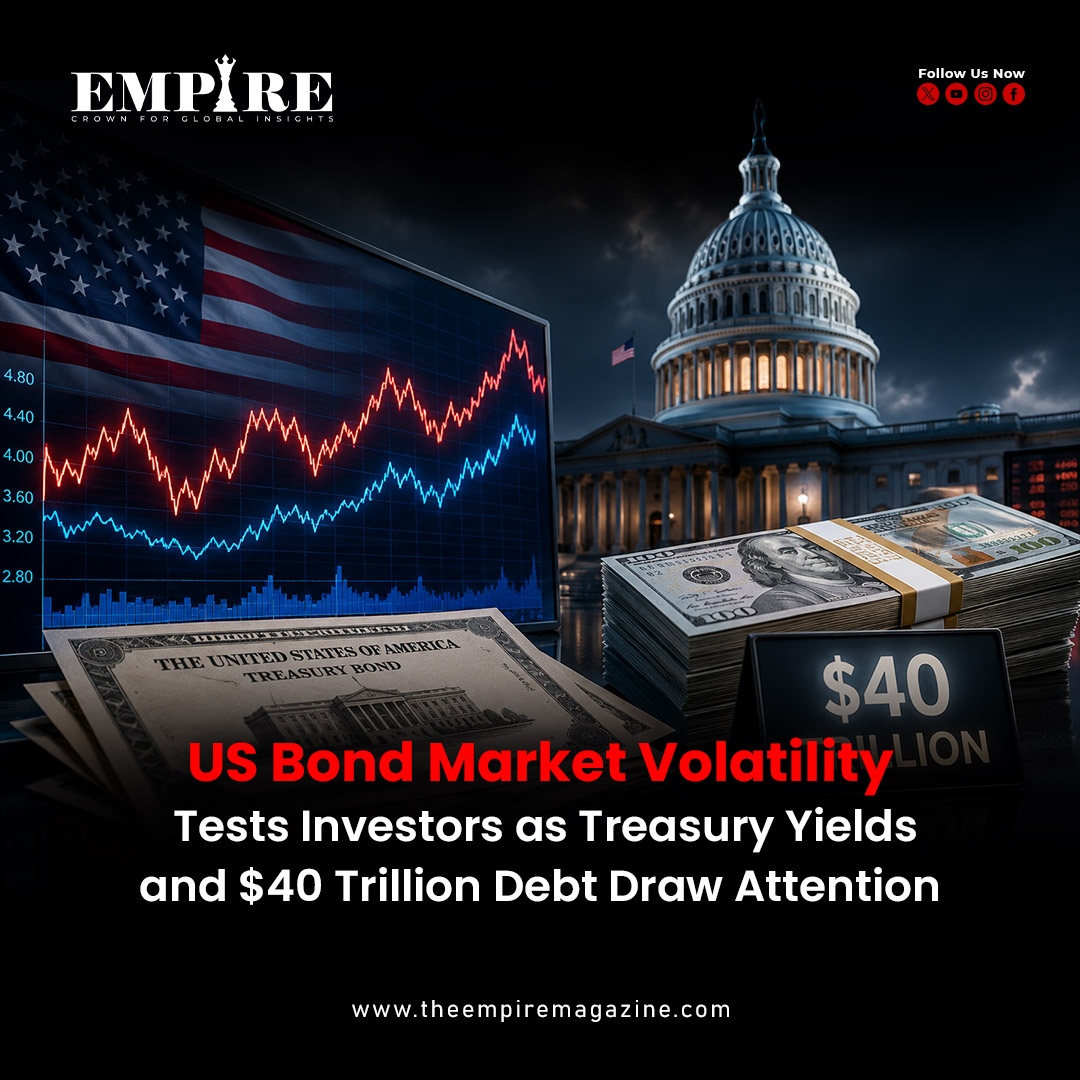
The US bond market volatility has moved back into focus as investors reassess the outlook for interest rates, inflation, government borrowing and the enormous size of America’s federal debt. The United States recently crossed the $40 trillion debt mark, adding another layer to a market already dealing with elevated long-term Treasury yields. For investors, the issue is not simply how high yields can go. The bigger question is what sustained borrowing costs could mean for government finances, businesses, households, equities and the broader global financial system.
US Bond Market Volatility Reflects a Changing Investment Landscape
For years, US Treasury securities were widely viewed as one of the most dependable assets in global finance. They remain central to international markets, but the environment surrounding them has become more complicated. Investors are now weighing inflation, economic growth, monetary policy and government borrowing at the same time.
Long-term Treasury yields have recently attracted particular attention. The 30-year Treasury yield moved to levels not seen in roughly two decades, while the 10-year yield has also remained elevated. BlackRock noted that the 30-year yield reached 5.28%, a 19-year high, during the recent sell-off in longer-dated Treasuries.
That matters because longer-term yields influence borrowing costs throughout the economy. Mortgage rates, corporate financing, infrastructure projects and other forms of long-term borrowing are all affected by the direction of government bond yields.
The Federal Reserve’s published Treasury yield data provides a daily picture of how the market is pricing securities across different maturities. These yields are based on actively traded Treasury securities and form an important reference point for financial markets worldwide.
What makes the current environment unusual is that investors are not reacting to one single problem. Instead, several forces are operating at once.
Inflation remains an important consideration. Economic growth has not disappeared, which means the Federal Reserve has to balance price stability with the risk of keeping monetary policy too restrictive for too long. At the same time, the government needs to finance a very large stock of outstanding debt.
That combination has made the bond market much more sensitive to economic data and policy expectations.
Treasury Yields Are Becoming a Bigger Concern for Investors
Treasury yields do more than determine the return investors receive from government securities. They also represent the price investors demand for lending money to the US government over a particular period.
When yields rise, the market value of existing bonds generally falls. This is especially important for investors holding longer-duration securities because their prices are more sensitive to changes in interest rates.
For an investor who bought a long-term Treasury when yields were lower, a sharp rise in market yields can result in a meaningful decline in the bond’s market value. Investors who hold the security until maturity may still receive the promised principal and interest, assuming no default, but institutions that regularly adjust portfolios have to deal with the price movement.
This is one reason the recent rise in long-term yields has attracted so much attention.
The market is also watching the difference between short-term and long-term borrowing costs. When long-term yields remain high while expectations for short-term rates change, it can indicate that investors are demanding more compensation for inflation, fiscal uncertainty or the risk of holding long-duration assets.
Recent market commentary has pointed to a widening gap between two-year and 30-year Treasury yields. BlackRock reported that this spread had widened by roughly 20 basis points since the previous Federal Reserve meeting.
For investors, this means that simply predicting the next Federal Reserve rate decision may not be enough. Long-term bond yields can respond to a much wider range of factors, including fiscal policy, Treasury issuance, inflation expectations and demand for US government debt.
The $40 Trillion Debt Question
The size of US government debt has become impossible to ignore.
On August 19, 2026, total US government debt crossed the $40 trillion threshold for the first time, according to the US Treasury Department data cited by Reuters. The Treasury’s Debt to the Penny dataset tracks the total outstanding public debt on a daily basis, including debt held by the public and intragovernmental holdings.
The headline number is enormous, but the more important issue for financial markets is the cost of servicing that debt.
Government debt is not a one-time expense. As securities mature, the Treasury needs to refinance them, while continuing to finance budget deficits. When new borrowing takes place at higher interest rates, the cost of that financing can gradually increase.
That creates a feedback loop worth watching.
Higher debt can mean greater interest expenses. Greater interest expenses can increase future financing requirements. Larger financing needs can require continued Treasury issuance. If investors demand higher yields to absorb that supply, borrowing costs can remain under pressure.
This does not automatically mean a debt crisis is around the corner. The US Treasury market remains one of the deepest and most important financial markets in the world. But the scale of borrowing means that relatively small changes in average interest costs can eventually translate into substantial changes in government spending.
Recent data has already highlighted the size of the interest burden. Reuters reported that net interest payments on publicly held federal debt had reached hundreds of billions of dollars during the fiscal year.
The challenge is therefore less about one dramatic moment and more about the cumulative effect of higher borrowing costs over time.
US Bond Market Volatility Can Spread Beyond Wall Street
The Treasury market does not operate in isolation.
US government bonds sit at the centre of the global financial system. They are held by banks, pension funds, insurance companies, investment managers, foreign institutions and central banks. Treasury yields are also used as a reference point for pricing many other financial assets.
When Treasury yields rise sharply, the impact can move across markets.
Higher government bond yields can make stocks appear less attractive because investors have a relatively safer alternative offering a higher return. Growth-oriented companies can be particularly sensitive because their valuations often depend heavily on expectations of future earnings.
Corporate borrowers can also feel the pressure. If government bond yields rise, companies may have to offer higher interest rates to attract investors. For highly leveraged businesses, that can increase financing costs and make refinancing more difficult.
Emerging markets can experience another layer of pressure. Higher US yields can encourage global investors to shift money toward dollar-denominated assets, potentially putting pressure on emerging-market currencies and increasing the cost of dollar borrowing.
The effects can therefore travel from Washington to New York, London, Mumbai, Singapore and other major financial centres.
Recent developments have already shown how Treasury market pressure can influence international bond markets. Rising US long-term yields have been accompanied by pressure in European government bond markets, highlighting the interconnected nature of global fixed-income markets.
This is why investors around the world pay close attention to US Treasury auctions, inflation data and Federal Reserve policy.
What Is Driving the Pressure on Long-Term Bonds?
There is no single explanation for the recent rise in long-term Treasury yields.
One factor is the sheer amount of government borrowing. The Treasury needs to issue securities to finance deficits and refinance existing obligations. More supply can place pressure on prices if demand does not increase at the same pace.
Inflation expectations are another factor. Investors purchasing a 20-year or 30-year bond want to know whether the return they receive will retain its purchasing power over time. If they believe inflation could remain higher than expected, they may demand higher yields.
Economic growth also matters. A stronger economy can keep interest rates higher for longer because policymakers have less reason to move aggressively toward lower rates.
There is also uncertainty around future monetary policy.
Markets constantly adjust their expectations based on employment figures, inflation reports, consumer spending and other economic indicators. A single data release can change expectations about where interest rates may be heading.
That can lead to sudden movements in bond prices and yields.
The recent Jackson Hole period has been particularly important for investors because Federal Reserve Chair Kevin Warsh’s first major speech at the annual gathering came as bond markets were already facing heightened uncertainty. Reuters reported that bond market anxiety had raised the stakes surrounding his appearance.
For investors, the message is clear: interest rate expectations remain a major driver of bond prices, but fiscal concerns are increasingly part of the conversation.
Why Long-Term Treasury Yields Matter to Everyday Businesses
It is easy to view Treasury market movements as something relevant only to professional investors. In reality, changes in government bond yields can gradually reach everyday businesses and consumers.
Consider a company planning to build a new factory. If long-term borrowing costs rise, the financing cost of that project increases. Management may decide to delay the investment, reduce its size or look for alternative sources of capital.
A similar calculation takes place when companies refinance existing debt.
For households, mortgage rates are one of the clearest examples. While mortgage rates are not directly identical to Treasury yields, long-term government bond yields influence broader borrowing conditions.
Higher borrowing costs can reduce demand for housing, business expansion and other major purchases.
That is why the bond market can sometimes provide an early warning about broader financial conditions.
If yields remain elevated for a long period, the effect can gradually move from financial markets into corporate decisions, employment plans and consumer spending.
US Bond Market Volatility Creates Both Risks and Opportunities
Market volatility is not automatically negative for every investor.
Higher Treasury yields can make government bonds more attractive to investors who are looking for income. After years in which investors often had to accept relatively low yields, a higher-rate environment can create opportunities in fixed income.
The challenge is timing.
Buying a bond today at an attractive yield can be beneficial if rates eventually fall, because the market value of that bond could rise. But if yields continue moving higher, prices can decline further.
This makes duration management increasingly important.
Investors with shorter-duration bonds generally face less price sensitivity when interest rates move compared with investors holding very long-duration securities. A diversified fixed-income strategy can therefore help reduce exposure to sudden moves in one part of the yield curve.
For equity investors, the situation is more complicated.
Higher yields can pressure valuations, but not every company responds in the same way. Businesses with strong balance sheets, consistent cash flow and lower refinancing needs may be better positioned than highly leveraged companies.
The current environment therefore rewards investors who look beyond headline market movements and examine the underlying financial structure of the assets they own.
What Investors Should Watch Next
The bond market is likely to remain highly sensitive to several indicators over the coming months.
First is inflation. A sustained decline in inflation could create more room for monetary policy to become less restrictive. Persistent inflation, however, could keep long-term yields elevated.
Second is economic growth. A sharp slowdown could encourage investors to seek safer assets, potentially supporting Treasury prices. A stronger-than-expected economy could have the opposite effect if it pushes expectations for interest rates higher.
Third is Treasury issuance. Investors will be watching how much debt the government needs to bring to market and whether demand is strong enough to absorb that supply without pushing yields significantly higher.
Fourth is the Federal Reserve. Policy signals will remain important, but investors should remember that long-term Treasury yields are influenced by more than the federal funds rate.
Finally, the fiscal outlook will remain central.
The $40 trillion debt milestone is significant as a symbol, but the more important story is how the debt evolves relative to economic growth, government revenue and interest costs. The US Treasury market can absorb enormous amounts of debt, but investors will continue to assess the price at which they are willing to finance it.
The Bigger Picture for Global Markets
The current bond market environment is a reminder that government borrowing, monetary policy and investment markets cannot be viewed separately.
For decades, Treasury securities have served as a foundation for global finance. That role has not disappeared. But investors are now paying closer attention to the fiscal backdrop supporting the market.
The central question is not whether the United States can borrow money. It clearly can. The question is how much it will cost to continue doing so and how markets respond if that cost remains elevated.
A period of higher yields does not necessarily signal financial instability. It can also reflect a healthy repricing of risk, stronger economic conditions or changing expectations about inflation.
The concern emerges when several pressures persist at the same time: high debt, large deficits, rising interest expenses, heavy Treasury issuance and elevated inflation expectations.
That combination can make markets more sensitive to relatively small changes in economic or policy expectations.
For investors, the lesson is not to react to every movement in Treasury yields. It is to understand why those movements are happening.
The $40 trillion debt milestone has brought renewed attention to a problem that has been building for years. Meanwhile, elevated long-term yields have shown that the bond market is demanding careful attention.
As the global financial system moves into the next phase of the interest-rate cycle, Treasury yields will remain one of the most important signals for investors.
The bond market may not always make headlines when stocks are rising, but its movements often tell a deeper story about the cost of money, confidence in economic policy and the risks building beneath the surface.
For investors, understanding that story may prove just as important as watching the next move in the stock market.
Previous article: David Heacock’s Filterbuy Story Shows How a Family Business Can Scale
Magazine Feautures | Podcasts: Empire Global Talks
Follow The Empire Magazine on Facebook | Instagram | LinkedIn | YouTube
The Empire Magazine | Crown for Global Insights