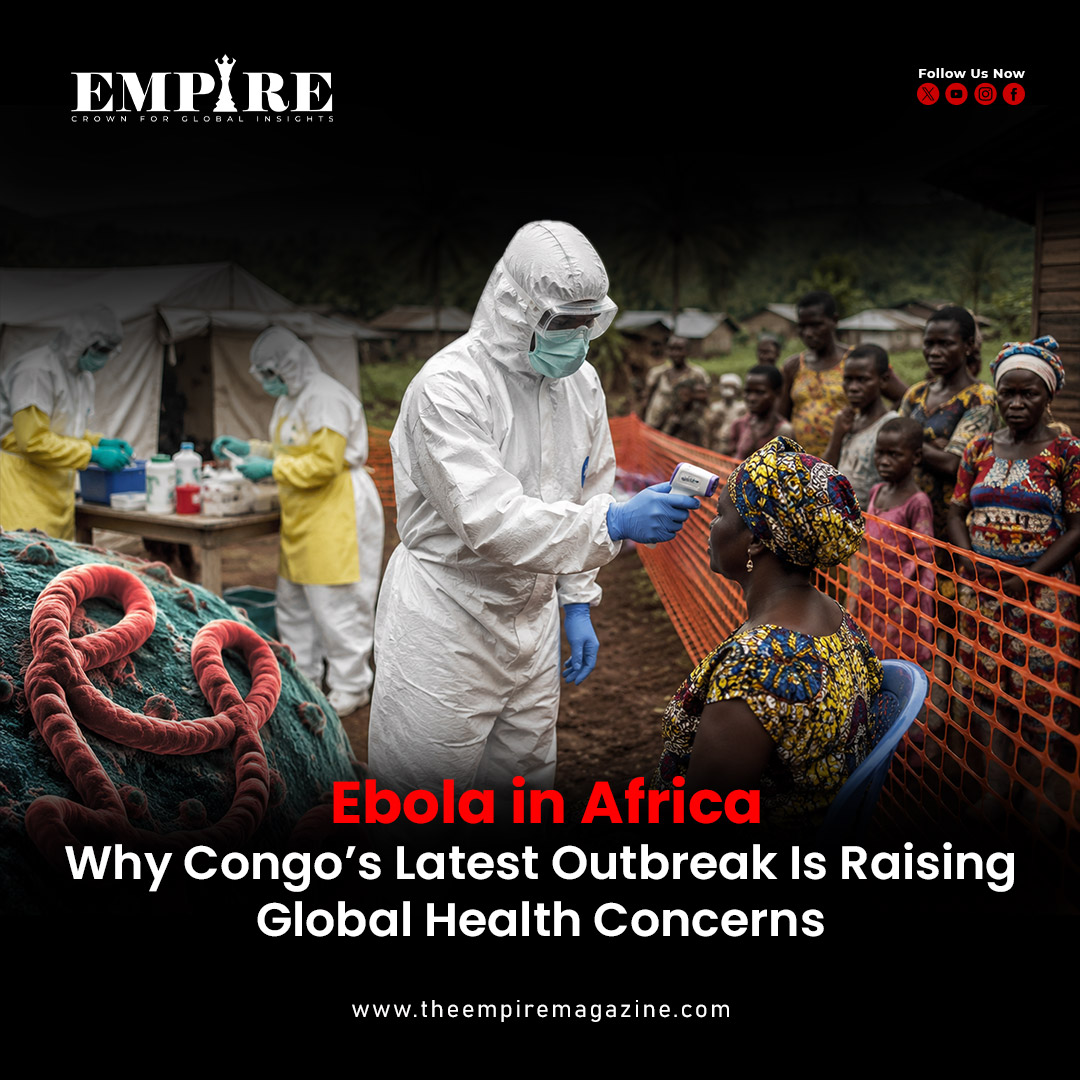
Ebola in Africa is back in the global spotlight as Congo battles its largest outbreak, driven by the rare Bundibugyo virus and rising deaths. Ebola in Africa has become a major global health concern after the Democratic Republic of Congo reported its largest Ebola outbreak on record. The outbreak is being driven by the rare Bundibugyo virus, which currently has no approved vaccine or specific treatment, while conflict, population movement and weak healthcare access are making containment harder.
Ebola in Africa: What Is Happening in Congo?
The Democratic Republic of Congo (DRC) is facing its largest Ebola outbreak on record, turning a regional health crisis into a growing global health concern. The outbreak was officially declared on May 15, 2026, after cases emerged in Ituri Province. Since then, the disease has moved far beyond the initial epicentre, reaching 54 health zones across six provinces.
As of August 20, official figures reported by international news agencies put the outbreak at more than 5,200 confirmed cases and roughly 2,400 deaths, making it the second-largest Ebola outbreak ever recorded globally after the devastating 2014–2016 West Africa epidemic.
The speed of transmission is particularly worrying. During one recent reporting week, the World Health Organization recorded 579 new confirmed cases and 304 deaths — the highest weekly figures recorded during this outbreak.
Behind those numbers are families, healthcare workers and communities already dealing with insecurity, displacement and limited access to medical services. For Congo, Ebola is not occurring in isolation. It is unfolding inside a much larger humanitarian crisis.
The Rare Bundibugyo Virus: rare Ebola species
One reason the Congo Ebola outbreak is so difficult to control is the virus itself. Unlike the Zaire species responsible for many of the world’s most prominent Ebola epidemics, the current outbreak is being caused by the Bundibugyo virus, a comparatively rare Ebola species first identified in Uganda in 2007.
The distinction matters because there is currently no vaccine or specific treatment approved for Bundibugyo virus disease. WHO says researchers are testing promising candidates, while doctors and health authorities continue to depend heavily on early diagnosis, isolation, supportive care, contact tracing and infection prevention measures.
The current outbreak has therefore created an uncomfortable race against time. Every unidentified infection can potentially create another chain of transmission, while every delayed diagnosis makes contact tracing more difficult.
For communities, this also creates fear and uncertainty. Ebola is already associated with severe illness and death. When people hear that the strain responsible for the outbreak does not have an approved vaccine or treatment, anxiety can quickly become another obstacle to an effective public-health response.
Why the Congo Ebola Outbreak Is Spreading Fast
The geography of the Congo Ebola outbreak tells only part of the story. The deeper challenge is the environment in which the virus is spreading.
Ituri remains the epicentre, but infections have expanded into North Kivu, South Kivu, Haut-Uélé, Tshopo and Bas-Uélé. WHO has warned that population displacement, insecurity, cross-border movement and high mobility are making surveillance and contact tracing increasingly difficult.
Some of the affected areas are remote, densely populated or difficult to reach. Roads and healthcare infrastructure are limited, while conflict has disrupted access to communities. WHO has also reported attacks affecting healthcare facilities and response operations since the international emergency was declared.
Another concern is that a significant share of new infections is being identified among people who were not previously being monitored as known contacts. That suggests transmission chains are being missed.
The lesson from previous Ebola outbreaks is clear: the earlier health teams identify infections and trace contacts, the greater the chance of stopping transmission before it becomes entrenched.
Healthcare Workers on the Front Line, fighting Ebola in Africa
For the people fighting Ebola in Africa, the outbreak is not simply a medical emergency. It is a daily battle against exhaustion, insecurity and limited resources.
Doctors, nurses, laboratory specialists, ambulance teams, burial teams and community health workers are operating in some of the most difficult conditions imaginable. Their work involves treating patients, collecting samples, identifying contacts and educating communities while protecting themselves from a highly dangerous infectious disease.
WHO and Africa CDC have repeatedly emphasized the need to strengthen support for frontline health workers. During a joint mission in early August, officials highlighted delayed detection, shortages of essential supplies, limited access to care and resistance to some response activities as major barriers.
The human dimension is impossible to ignore. A disease outbreak can be contained only when communities trust the people asking them to change their behaviour. When healthcare systems are already under pressure, maintaining that trust becomes as important as laboratory testing or hospital capacity.
Why the World Is Watching Africa surrounding Ebola
The question surrounding Ebola in Africa is no longer only about what happens inside Congo. It is about how quickly the virus could move through regional networks of travel, trade and migration.
Uganda has already recorded infections linked to the Congo outbreak, while imported cases have also reached Europe. WHO reported that Uganda remained at risk of reintroduction because transmission continues in neighbouring Congo. France, meanwhile, reported no secondary transmission after an imported case detected in June.
That does not mean the world is facing another COVID-19-style pandemic. Ebola spreads differently and generally requires closer contact with infected people or their bodily fluids. But infectious diseases do not respect political borders.
The concern is therefore about preparedness. A disease that is difficult to detect, deadly when untreated and spreading through areas with limited healthcare capacity can quickly become an international emergency if response systems fall behind.
This is why neighbouring countries and international health agencies are increasing surveillance, strengthening border preparedness and monitoring possible cases.
Vaccines and the Race Against Time
The vaccine question has become one of the most important developments in the Congo Ebola outbreak.
On August 20, WHO and partners announced that Congo is set to receive 70,000 doses of Merck’s Ervebo vaccine. The vaccine is licensed for protection against Zaire ebolavirus, not the Bundibugyo virus responsible for the current outbreak. However, preliminary laboratory and animal evidence suggests it could provide some protection against the current strain.
Of the 70,000 doses, 20,000 are intended for a Phase 3 clinical trial examining the vaccine’s effectiveness against Bundibugyo virus, while 50,000 will be allocated to frontline and healthcare workers.
It is an important development, but it is not a simple solution. A vaccine cannot replace surveillance, isolation, treatment capacity, community engagement and contact tracing.
The immediate goal is to slow transmission while researchers gather evidence. In an outbreak moving this quickly, scientific progress and emergency response have to happen simultaneously.
Global Health Response to Ebola in Africa
The international response to Ebola in Africa is now focused on moving faster than the virus.
WHO, Africa CDC and Congo’s health authorities are expanding surveillance, laboratory testing, treatment centres, contact tracing and community engagement. WHO has stressed that community participation will be critical because health teams cannot successfully contain Ebola without the cooperation of people living in affected areas.
This is one of the biggest lessons from previous outbreaks. Technology can identify a virus, vaccines can protect people and hospitals can treat patients, but none of these measures works effectively if communities do not trust the response.
The international community must therefore look beyond emergency supplies. Sustainable healthcare infrastructure, trained medical workers, reliable laboratories and stronger disease surveillance systems are essential for preventing future outbreaks from becoming global emergencies.
Congo’s current crisis is a reminder that global health security begins with local health systems.
What Happens Next in the wider Ebola response?
The next few weeks will be crucial for Congo and for the wider Ebola response in Africa. The number of cases is rising rapidly, geographic spread is continuing and the Bundibugyo virus has created a major gap in approved medical countermeasures.
Yet the situation is not without hope. Uganda has demonstrated that local transmission can be contained, while Congo and international partners are scaling up surveillance and response operations. The arrival of vaccine doses and the launch of clinical research could also provide valuable evidence for fighting future Bundibugyo outbreaks.
The biggest challenge is speed. Every day of delayed detection can create new transmission chains. Every disrupted healthcare service can leave communities more vulnerable. And every missed contact can make containment harder.
The Congo Ebola outbreak is therefore more than another chapter in Africa’s long struggle with infectious diseases. It is a test of how quickly the global health system can respond when a dangerous virus emerges in a region already burdened by conflict and humanitarian crisis.
For now, the world is watching Congo not because Ebola guarantees a global pandemic, but because the outbreak demonstrates how quickly a local health emergency can become an international concern when surveillance, healthcare access and medical preparedness are pushed to their limits.
Previous article: https://theempiremagazine.com/australia-law-publishers/
Magazine Feautures | Podcasts: Empire Global Talks
Follow The Empire Magazine on Facebook | Instagram | LinkedIn | YouTube
The Empire Magazine | Crown for Global Insights