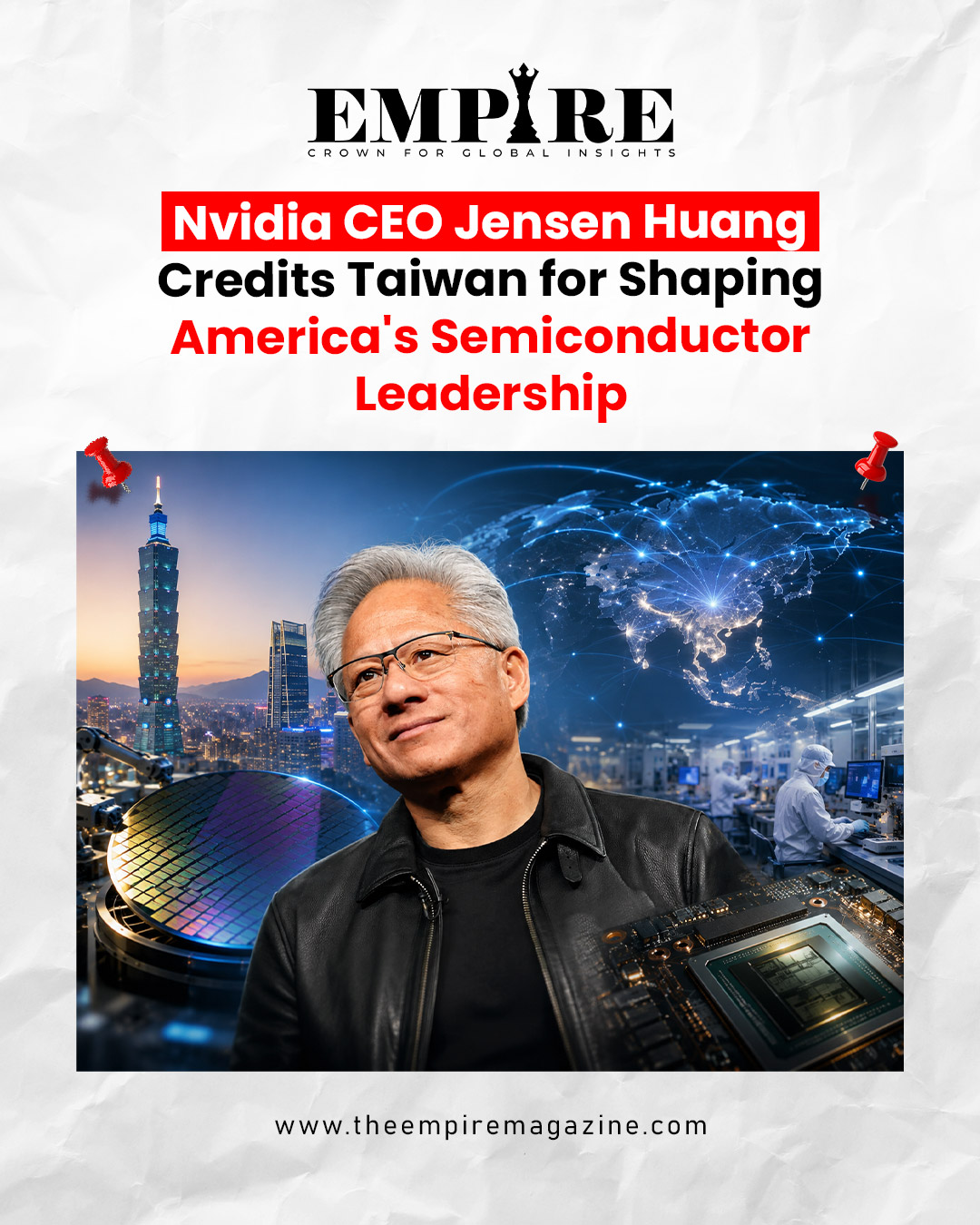
Nvidia CEO Jensen Huang says Taiwan played a crucial role in shaping America’s semiconductor leadership. Explore the impact on AI, chips, and global technology. Nvidia CEO Jensen Huang recently acknowledged Taiwan’s pivotal contribution to America’s semiconductor leadership, emphasizing decades of innovation, manufacturing excellence, and international collaboration. His remarks highlight the strategic importance of Taiwan’s semiconductor ecosystem in powering the global AI revolution and strengthening the future of advanced computing.
The success of Nvidia’s groundbreaking AI processors
Technology revolutions are rarely built by a single company or even a single country. They are the result of decades of innovation, visionary leadership, and partnerships that transcend geographical borders. Few people understand this reality better than Nvidia CEO Jensen Huang, whose company has become one of the world’s most influential technology businesses by powering the artificial intelligence revolution. Speaking recently about the global semiconductor ecosystem, Huang acknowledged that Taiwan has played a defining role in shaping America’s semiconductor leadership, a statement that resonates far beyond the technology industry. His comments arrive at a time when semiconductors have become strategic assets, governments are investing billions to strengthen domestic manufacturing, and artificial intelligence is redefining every major industry. Rather than presenting semiconductor leadership as a competition between nations, Huang’s perspective recognizes decades of collaboration between American innovation and Taiwanese manufacturing excellence. The success of Nvidia’s groundbreaking AI processors, the rapid growth of cloud computing, and the emergence of generative AI have all been made possible through a supply chain built on trust, engineering expertise, and continuous technological advancement. His remarks therefore serve as both a tribute to Taiwan’s remarkable semiconductor journey and a reminder that global innovation flourishes when countries combine their unique strengths instead of working in isolation.
Nvidia CEO Jensen Huang Reflects on Taiwan’s Semiconductor Journey
When Nvidia CEO Jensen Huang spoke about Taiwan’s influence on America’s semiconductor leadership, he was also reflecting on a deeply personal story. Born in Taiwan before moving to the United States at a young age, Huang has often acknowledged how both countries have shaped his life and career. Today, as Nvidia leads the global AI computing industry, he understands better than anyone that revolutionary technology depends on an equally revolutionary manufacturing ecosystem. Taiwan’s rise from a modest electronics manufacturing economy in the 1970s to the world’s undisputed semiconductor powerhouse is one of the greatest industrial success stories of modern history. Through visionary government policies, sustained investment in engineering education, and the establishment of globally competitive semiconductor companies, Taiwan created an ecosystem capable of producing the world’s most sophisticated chips. While Silicon Valley became the center of chip design and software innovation, Taiwan perfected the complex science of manufacturing those designs with extraordinary precision and reliability. This unique combination transformed the semiconductor industry forever. Huang’s recognition of Taiwan therefore goes beyond national appreciation; it highlights a partnership that has enabled countless technological breakthroughs over the last four decades. Every generation of advanced processors has relied on thousands of highly skilled engineers, researchers, and manufacturing experts whose contributions often remain invisible to the public despite forming the foundation of today’s digital economy.
Nvidia CEO Jensen Huang Explains Why Taiwan Became the World’s Chip Hub
The semiconductor industry is unlike almost any other manufacturing sector because success depends on extraordinary precision, continuous innovation, and billions of dollars in research investments. Nvidia CEO Jensen Huang has repeatedly emphasized that designing advanced AI processors is only one part of the equation; producing those processors at scale requires manufacturing capabilities that only a handful of companies in the world possess. Taiwan earned its leadership position by developing exactly those capabilities over several decades. The country’s semiconductor ecosystem integrates chip fabrication, packaging, testing, equipment suppliers, logistics providers, research institutions, and engineering talent into one of the most efficient industrial networks ever created. This collaborative environment enables companies to move rapidly from chip design to commercial production while maintaining the exceptionally high quality standards required for advanced computing. For companies such as Nvidia, whose graphics processing units now power generative AI, autonomous vehicles, robotics, scientific simulations, and cloud infrastructure, access to reliable manufacturing has become a strategic advantage rather than merely an operational necessity. Taiwan’s semiconductor expertise has therefore allowed American technology companies to innovate at unprecedented speed while ensuring that increasingly sophisticated processors reach global markets without compromising performance or reliability. Huang’s remarks recognize this reality and reinforce the importance of preserving one of the world’s most successful technology partnerships.
Nvidia CEO Jensen Huang Connects Taiwan to the AI Revolution
Artificial intelligence has fundamentally changed the trajectory of the global technology industry, and few companies have benefited more from this transformation than Nvidia. Once widely recognised for developing graphics processors for gaming, the company has evolved into the backbone of modern AI infrastructure, with its advanced GPUs powering everything from generative AI models and autonomous vehicles to scientific research and cloud computing platforms. According to Nvidia CEO Jensen Huang, none of this progress would have been possible without Taiwan’s extraordinary semiconductor manufacturing capabilities. Every AI chip that reaches the market represents years of engineering, billions of transistors, and manufacturing precision measured at the atomic scale. Producing these processors requires fabrication facilities that can consistently deliver near-perfect yields while adapting to increasingly complex chip architectures. Taiwan has mastered this challenge through decades of investment in advanced manufacturing, making it the preferred production destination for the world’s leading semiconductor designers. Huang’s acknowledgment therefore extends beyond appreciation—it recognises that Taiwan has become an indispensable partner in accelerating the AI revolution. As businesses, governments, healthcare providers, financial institutions, and educational organisations embrace artificial intelligence at an unprecedented pace, the demand for high-performance computing continues to surge. Nvidia’s AI processors are enabling innovations that improve medical diagnoses, accelerate scientific discoveries, optimise industrial automation, and transform customer experiences across industries. Behind every one of these technological advancements lies a manufacturing ecosystem that quietly ensures these groundbreaking chips can be produced at scale. Huang’s remarks remind the world that AI leadership is built not only on visionary ideas but also on the manufacturing excellence that transforms innovation into reality.
Nvidia CEO Jensen Huang Highlights America’s Semiconductor Partnership
One of the most significant messages delivered by Nvidia CEO Jensen Huang is that America’s semiconductor leadership has never been achieved in isolation. While the United States has consistently led the world in semiconductor architecture, software development, chip design, and artificial intelligence research, Taiwan has become the global benchmark for advanced semiconductor manufacturing. Together, this complementary relationship has created one of the most successful industrial partnerships in modern history. American companies focus on designing increasingly sophisticated processors capable of handling enormous computational workloads, while Taiwanese manufacturers translate those complex blueprints into physical chips using some of the most advanced fabrication facilities ever built. This collaboration has fuelled the rise of cloud computing, consumer electronics, high-performance data centres, electric vehicles, defence technologies, and next-generation AI systems. Huang believes that preserving this partnership will be essential as global demand for semiconductors continues to rise exponentially. Governments around the world are investing heavily in domestic manufacturing capabilities to strengthen supply chain resilience, but Huang has consistently advocated for an approach that complements existing partnerships rather than replacing them. Building additional fabrication capacity improves resilience, yet international collaboration remains critical because semiconductor innovation depends upon specialised expertise distributed across multiple countries. By recognising Taiwan’s contribution to America’s semiconductor leadership, Huang reinforces the importance of trusted alliances that combine innovation, manufacturing excellence, research capabilities, and engineering talent to drive technological progress for the benefit of the global economy.
Nvidia CEO Jensen Huang Looks Beyond Geopolitics Toward Innovation
The semiconductor industry has increasingly become a focal point of international geopolitics, with governments recognising advanced chips as strategic assets that influence economic competitiveness, technological leadership, and national security. Amid discussions surrounding export controls, supply chain diversification, and domestic manufacturing incentives, Nvidia CEO Jensen Huang has consistently urged policymakers and industry leaders to maintain their focus on innovation rather than allowing geopolitical tensions to overshadow decades of productive collaboration. His recent remarks acknowledging Taiwan’s role in shaping America’s semiconductor leadership carry particular significance because they emphasise shared achievement instead of national rivalry. Semiconductor innovation has always depended upon cross-border cooperation involving researchers, universities, equipment manufacturers, software developers, materials suppliers, and fabrication specialists working together across continents. Huang argues that protecting these collaborative ecosystems is essential for sustaining technological advancement in the age of artificial intelligence. As AI applications continue expanding into healthcare, education, manufacturing, finance, agriculture, transportation, and scientific discovery, the need for increasingly powerful processors will only intensify. Meeting this demand requires not only greater manufacturing capacity but also uninterrupted collaboration between global technology leaders. Huang’s perspective offers an important reminder that innovation flourishes when knowledge, expertise, and resources are shared responsibly among trusted partners. Rather than viewing semiconductor leadership as a zero-sum competition, he envisions an ecosystem where collaborative excellence continues to drive breakthroughs that improve productivity, accelerate research, and create new opportunities for societies around the world.
Nvidia CEO Jensen Huang Sees the Future of Global Semiconductor Leadership
Looking ahead, Nvidia CEO Jensen Huang believes the semiconductor industry is entering one of the most transformative periods in its history. Artificial intelligence is rapidly becoming the foundation of nearly every major technological advancement, increasing demand for more powerful, energy-efficient, and intelligent processors capable of supporting increasingly sophisticated applications. From autonomous vehicles and humanoid robotics to personalised healthcare, climate modelling, and next-generation communication networks, semiconductors will determine how quickly these innovations become part of everyday life. Huang’s recognition of Taiwan highlights an important lesson for the future: technological leadership is built through long-term investment, engineering excellence, and enduring partnerships rather than short-term competition. While countries continue strengthening domestic semiconductor ecosystems, the industry’s future will still rely on collaboration between chip designers, manufacturers, equipment providers, software developers, and research institutions across the globe. Nvidia itself exemplifies this interconnected model, combining American innovation with world-class manufacturing capabilities to develop processors that are reshaping industries and accelerating AI adoption worldwide. As governments and businesses invest billions in advanced computing infrastructure, Huang’s remarks serve as both recognition of Taiwan’s remarkable contributions and a strategic vision for the years ahead. Maintaining resilient supply chains, investing in engineering talent, encouraging international cooperation, and supporting continuous research will ensure that the semiconductor industry remains a powerful engine of global innovation. In many ways, the future of artificial intelligence will be defined not only by groundbreaking algorithms but also by the strength of the partnerships that make those algorithms possible.
Nvidia CEO Jensen Huang is more than an acknowledgement of Taiwan’s manufacturing excellence
The statement made by Nvidia CEO Jensen Huang is more than an acknowledgement of Taiwan’s manufacturing excellence it is a recognition of one of the most successful technology partnerships in modern history. America’s semiconductor leadership has been strengthened through decades of collaboration between visionary chip designers and world-class manufacturers, creating an ecosystem that has transformed computing, communications, healthcare, transportation, and artificial intelligence. As the AI revolution gathers momentum, the importance of trusted semiconductor partnerships will only continue to grow. Huang’s perspective reminds policymakers, business leaders, and technology innovators that sustainable progress is rarely achieved in isolation. Instead, it emerges from shared expertise, mutual trust, and a collective commitment to pushing the boundaries of engineering excellence. Taiwan’s contribution to the semiconductor industry has helped power some of the world’s most significant technological breakthroughs, while American innovation has continued to lead the development of next-generation AI platforms and advanced computing systems. Together, these strengths have shaped the digital age and positioned the global semiconductor industry for its next chapter of growth. As nations invest in resilience and innovation, Huang’s message offers a compelling blueprint for the future one where collaboration, rather than competition alone, becomes the driving force behind technological leadership and lasting global progress.
For more business and retail insights, read more on The Empire Magazine
Previous article: https://theempiremagazine.com/infosys-ceo/
Magazine Feautures | Podcasts: Empire Global Talks
Follow The Empire Magazine on Facebook | Instagram | LinkedIn | YouTube
The Empire Magazine | Crown for Global Insights