
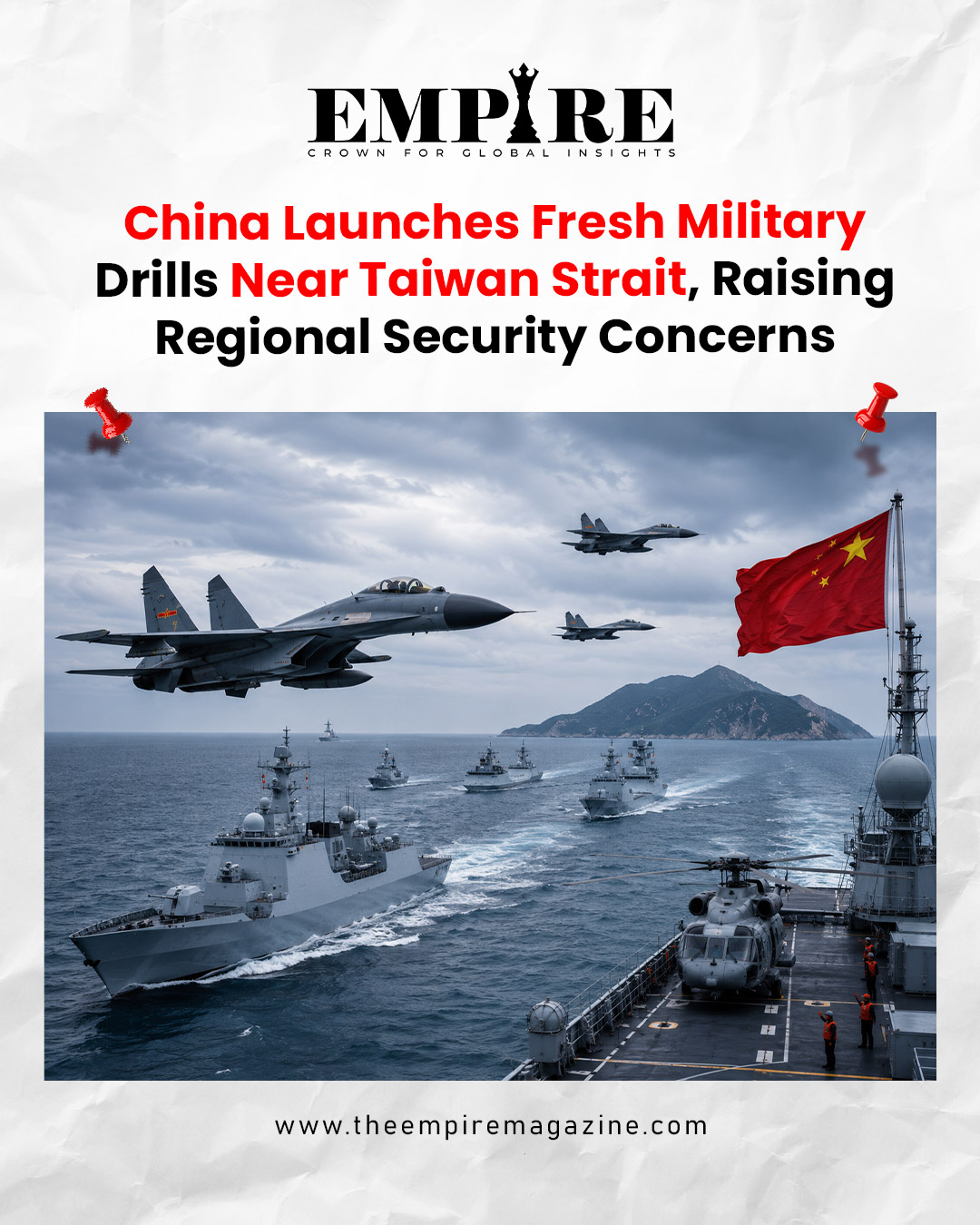
China military drills near Taiwan Strait have heightened regional security concerns, impacting global trade, diplomacy, and Indo-Pacific stability. China military drills near Taiwan Strait have once again intensified regional security concerns, raising fears of geopolitical instability, trade disruptions, and increased military tensions across the Indo-Pacific. The latest exercises reflect Beijing’s growing military capabilities while prompting strong responses from Taiwan and the international community.
China Military Drills Near Taiwan Strait Raise New Tensions
China military drills near Taiwan Strait have once again placed one of the world’s most strategically sensitive regions under intense international scrutiny. The large-scale military exercises, involving naval vessels, combat aircraft, missile systems, and coordinated joint-force operations, demonstrate Beijing’s continued determination to reinforce its territorial claims over Taiwan while sending a clear geopolitical message to both Taipei and its international partners. Although Chinese authorities have described the exercises as legitimate military training aimed at safeguarding national sovereignty, governments across the Indo-Pacific view them as an increasingly assertive display of military power capable of destabilising regional peace. The Taiwan Strait remains among the busiest maritime corridors in the world, carrying trillions of pounds worth of global trade annually, making every escalation a matter of international concern rather than a purely bilateral issue. Defence experts believe these repeated military manoeuvres illustrate China’s evolving operational readiness and expanding military capabilities, while simultaneously increasing the risk of miscalculation between opposing forces operating in close proximity. As diplomatic channels struggle to ease tensions, the latest China military drills near Taiwan Strait have reignited discussions on regional security, freedom of navigation, international law, and the future balance of power across the Indo-Pacific.
China Military Drills Near Taiwan Strait Test Taiwan’s Defence
The latest China military drills near Taiwan Strait prompted Taiwan’s armed forces to immediately activate enhanced surveillance measures and deploy naval ships, fighter aircraft, missile defence systems, and coastal monitoring units to track every movement of the People’s Liberation Army. Taiwanese officials reiterated that while the island remains committed to maintaining peace and stability, it will continue strengthening its defence capabilities against any form of military coercion. President Lai Ching-te’s administration described the exercises as intimidation tactics designed to pressure Taiwan politically while influencing public confidence in the government’s ability to safeguard national security. Military analysts note that every Chinese exercise provides Taiwan with valuable intelligence on Beijing’s command structures, operational planning, logistics, and combat readiness, enabling its defence planners to refine their own response strategies. Over recent years, Taiwan has significantly expanded investments in asymmetric warfare capabilities, including advanced missile systems, unmanned aerial vehicles, cyber defence infrastructure, and reserve force modernisation, recognising that technological superiority and strategic resilience may prove more decisive than numerical strength. These developments underline how the continuing China military drills near Taiwan Strait are shaping Taiwan’s long-term national security strategy while reinforcing the importance of international cooperation in preserving stability across the region.
China Military Drills Near Taiwan Strait Trigger Global Response
The renewed China military drills near Taiwan Strait have drawn swift reactions from governments across the world, reflecting growing concerns over the security of the Indo-Pacific region. The United States reaffirmed its commitment to maintaining peace and stability in the Taiwan Strait, stressing the importance of freedom of navigation and adherence to international law. Washington also continued surveillance operations in the region while strengthening strategic coordination with allies, including Japan, Australia, and South Korea. Japan, whose southwestern islands lie close to Taiwan, expressed serious concern over the military exercises, warning that any escalation could directly affect its national security and economic interests. The European Union called for restraint from all sides and encouraged dialogue to prevent further deterioration of cross-strait relations. Regional organisations such as ASEAN reiterated the need for peaceful dispute resolution, recognising that prolonged military tensions could undermine regional economic growth and maritime security. Security experts believe the increasing frequency of China military drills near Taiwan Strait is encouraging countries to deepen defence partnerships, expand joint military exercises, and enhance intelligence sharing, ultimately reshaping the strategic architecture of the Indo-Pacific.
China Military Drills Near Taiwan Strait Threaten Global Trade
The economic implications of the latest China military drills near Taiwan Strait extend far beyond East Asia, with analysts warning that prolonged instability could disrupt some of the world’s busiest maritime trade routes. Nearly half of the global container fleet passes through waters surrounding Taiwan, making the Taiwan Strait a critical artery for international commerce. Any interruption to shipping operations could delay the movement of consumer goods, industrial equipment, energy supplies, and raw materials, affecting businesses and consumers across continents. Financial markets have also responded cautiously whenever tensions escalate, with investors closely monitoring geopolitical developments for signs of prolonged disruption. Insurance costs for commercial vessels could increase if military activities continue near major shipping lanes, potentially raising transportation expenses and contributing to higher prices for global consumers. Economists argue that while short-term military exercises may not immediately halt trade, repeated demonstrations of military force create uncertainty that discourages investment and complicates long-term business planning. Consequently, the continuing China military drills near Taiwan Strait are becoming not only a regional security issue but also a significant concern for the global economy.
China Military Drills Near Taiwan Strait Impact Semiconductor Industry
Another major consequence of the China military drills near Taiwan Strait lies in their potential impact on the global semiconductor industry. Taiwan remains the world’s leading producer of advanced semiconductor chips, supplying essential components used in smartphones, automobiles, artificial intelligence systems, medical equipment, and defence technologies. Any military escalation that disrupts production or transportation from Taiwan could send shockwaves through global supply chains, similar to—but potentially more severe than the shortages experienced during the COVID-19 pandemic. Technology companies across the United States, Europe, and Asia have already begun diversifying supply chains and investing in domestic semiconductor manufacturing to reduce dependence on a single geographic region. Governments are likewise introducing incentive programmes to encourage chip production within their own borders, recognising semiconductors as a strategic national asset. Nevertheless, industry experts caution that Taiwan’s sophisticated manufacturing ecosystem cannot be replicated overnight, meaning any disruption would have immediate and far-reaching consequences. As a result, the latest China military drills near Taiwan Strait have reinforced concerns about the vulnerability of global technology supply chains and the urgent need for greater resilience in critical industries.
For more business and retail insights, read more on The Empire Magazine
Previous article: https://theempiremagazine.com/food-poisoning-safety-standards/
Magazine Feautures | Podcasts: Empire Global Talks
Follow The Empire Magazine on Facebook | Instagram | LinkedIn | YouTube
The Empire Magazine | Crown for Global Insights