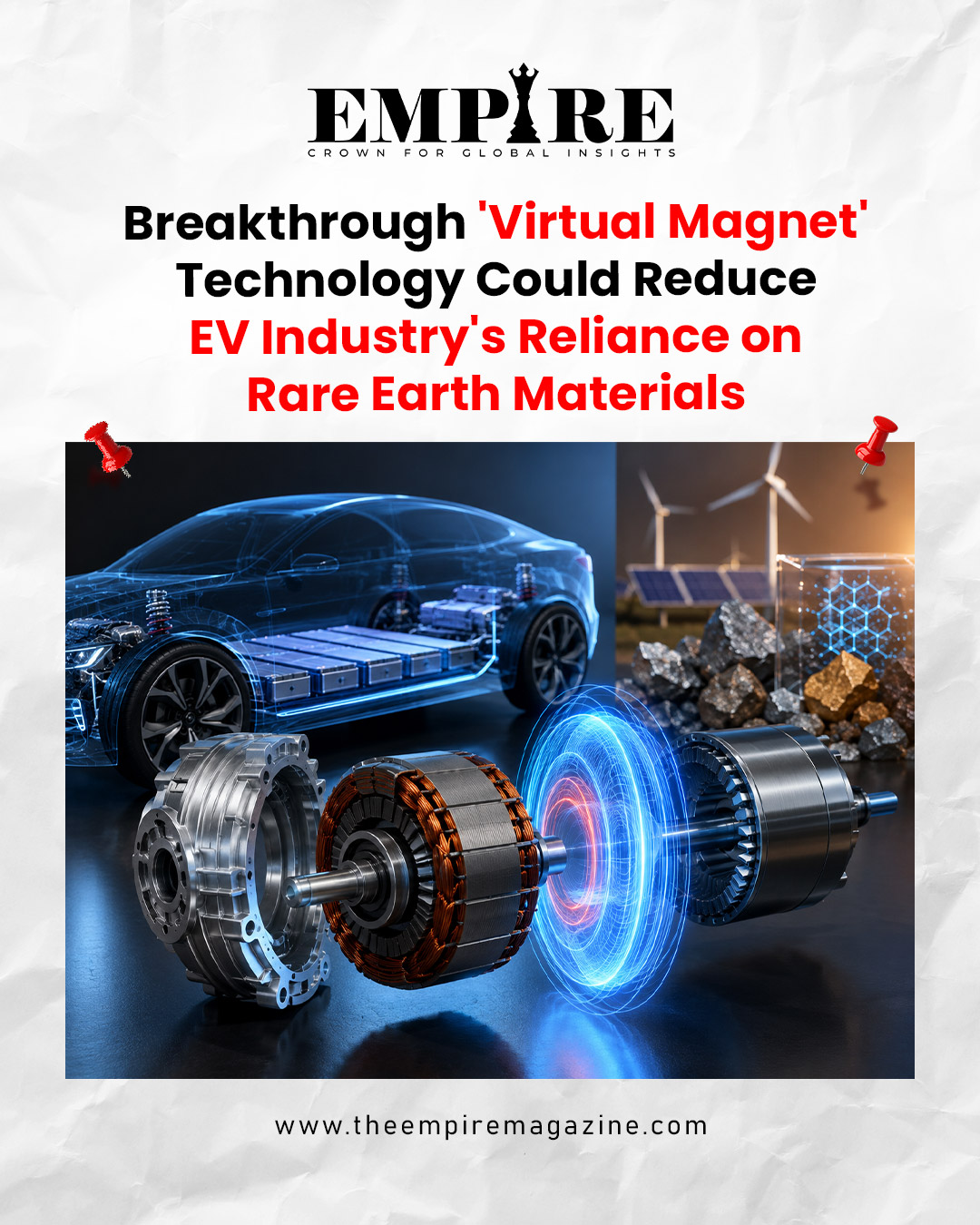
Discover how Virtual Magnet technology could reduce rare earth dependence in EVs, lower costs, strengthen supply chains, and reshape electric mobility. Virtual Magnet Technology is an innovative motor control system that recreates magnetic performance through advanced software and electronics instead of relying on rare earth permanent magnets. The technology could reduce EV manufacturing costs, strengthen supply chains, improve sustainability, and help the electric vehicle industry reduce its dependence on critical rare earth materials.
Breakthrough Virtual Magnet Technology Could Reduce EV Industry’s Reliance on Rare Earth Materials
The electric vehicle (EV) industry is racing toward a cleaner future, but one major challenge continues to cast a shadow over its growth, the dependence on rare earth materials. These elements, particularly neodymium and dysprosium, are essential for manufacturing the powerful permanent magnets used in electric motors. However, global supply chains remain vulnerable due to geopolitical tensions, mining constraints, environmental concerns, and price volatility. As governments and automakers push for mass electrification, reducing reliance on these critical materials has become one of the industry’s highest priorities.
A groundbreaking innovation known as Virtual Magnet Technology could now offer a practical solution. Instead of relying on traditional permanent magnets, this revolutionary technology creates the same magnetic performance through advanced software, electronics, and intelligent motor control systems. Experts believe the innovation has the potential to transform the EV industry by making electric motors more sustainable, affordable, and resilient against supply chain disruptions.
For manufacturers, the implications are enormous. Lower production costs, greater design flexibility, improved sustainability, and stronger supply security could significantly accelerate EV adoption across global markets. As countries compete to build domestic electric vehicle ecosystems, innovations like Virtual Magnet Technology may redefine how future electric motors are designed and manufactured.
The Growing Challenge of Rare Earth Materials in EV Industry
The modern EV industry relies heavily on permanent magnet synchronous motors because they offer exceptional efficiency, compact size, and strong torque output. These motors depend on rare earth elements that are difficult and expensive to extract. While these materials are not technically scarce, economically viable reserves remain concentrated in only a handful of countries. This concentration has created supply chain vulnerabilities that affect manufacturers worldwide. Any disruption, from export restrictions and geopolitical disputes to mining regulations can rapidly increase costs and delay production. At the same time, mining rare earth materials consumes significant energy, generates hazardous waste, and raises environmental concerns that contradict the sustainability goals of electric mobility. As EV demand continues to surge globally, automakers are searching for technologies that reduce dependence on critical minerals without sacrificing vehicle performance. The search has intensified because future electric vehicle production is expected to multiply several times over the coming decade, placing additional pressure on already stretched supply chains. Virtual Magnet Technology has therefore emerged as one of the most promising innovations capable of addressing this strategic challenge while supporting long-term growth for the EV industry.
Virtual Magnet Technology Makes Electric Motors Smarter
Unlike conventional motors that depend on physical permanent magnets, Virtual Magnet Technology recreates the magnetic characteristics electronically through advanced motor control algorithms and high-performance power electronics. Instead of embedding rare earth magnets inside the motor, sophisticated software continuously controls electric currents to generate highly efficient magnetic fields that closely replicate permanent magnet behaviour. This intelligent approach allows engineers to achieve comparable levels of torque, responsiveness, and efficiency while dramatically reducing or even eliminating rare earth material requirements. Recent advances in semiconductor technology, artificial intelligence, and real-time computing have made these complex control systems increasingly practical for commercial vehicles. The technology also enables dynamic optimisation based on driving conditions, allowing motors to adapt continuously for better efficiency across different speeds and loads. As processors become faster and power electronics more efficient, Virtual Magnet Technology could outperform conventional motor systems in certain applications while offering manufacturers greater flexibility in motor design and production.
Virtual Magnet Technology Brings Multiple Benefits
The introduction of Virtual Magnet Technology could reshape every stage of electric vehicle manufacturing. One of its greatest advantages is cost reduction. Rare earth magnets represent a significant portion of electric motor expenses, and reducing their use could lower overall production costs while protecting manufacturers from volatile commodity prices. Supply chain resilience is another major benefit. By decreasing dependence on a limited number of rare earth suppliers, automakers can diversify sourcing strategies and minimise geopolitical risks. Environmental sustainability also improves considerably because fewer rare earth materials mean reduced mining activity, lower carbon emissions, and less ecological damage associated with extraction and refining processes. Engineers also gain greater design flexibility, allowing them to optimise motor architecture without being constrained by permanent magnet placement. Maintenance may become simpler in certain configurations, while future software updates could further enhance motor performance without requiring hardware modifications. Collectively, these advantages position Virtual Magnet Technology as a breakthrough capable of improving affordability, sustainability, and long-term scalability across the rapidly expanding EV industry.
Challenges Before Virtual Magnet Technology Adoption
Despite its immense promise, Virtual Magnet Technology still faces several technical and commercial hurdles before widespread adoption becomes a reality. Developing sophisticated motor control software requires extensive research, testing, and validation to ensure consistent reliability under diverse operating conditions. High-performance electronic controllers must respond instantly to changing vehicle demands while maintaining safety standards expected by global automotive manufacturers. Integrating these advanced systems into existing manufacturing processes will also require substantial engineering investment and workforce training. Automotive companies must demonstrate that virtual magnetic systems can match or exceed the durability of traditional permanent magnet motors throughout the vehicle’s lifespan. Regulatory certification, consumer confidence, and compatibility with current EV platforms will further influence commercial adoption. Initial implementation costs may remain relatively high until production scales increase, although long-term savings could outweigh early investments. Nevertheless, history shows that transformative automotive technologies often face similar challenges before achieving mainstream acceptance, and continuous innovation is steadily addressing these barriers.
Virtual Magnet Technology Could Shape Future Mobility
As global governments continue introducing stricter emission regulations and ambitious electrification targets, the importance of reliable and sustainable motor technology will only increase. Virtual Magnet Technology aligns perfectly with these long-term objectives by supporting cleaner manufacturing, reducing reliance on environmentally intensive mining, and strengthening domestic supply chains. Countries investing heavily in electric vehicle manufacturing could particularly benefit from technologies that reduce exposure to international mineral markets. The innovation may also extend beyond passenger vehicles into commercial trucks, electric buses, industrial automation, aerospace systems, robotics, renewable energy equipment, and marine transportation. Because the underlying concept relies on intelligent electronic control rather than expensive physical materials, ongoing improvements in computing power could continuously enhance performance over time. As artificial intelligence becomes increasingly integrated into automotive engineering, Virtual Magnet Technology may evolve into a foundational component of next-generation intelligent mobility solutions, helping create electric vehicles that are both technologically advanced and economically sustainable.
Why Virtual Magnet Technology Matters for Global EV Growth
The future of electric mobility depends not only on increasing battery capacity or expanding charging infrastructure but also on creating resilient technologies that overcome material shortages and environmental challenges. Virtual Magnet Technology represents one of the most exciting innovations currently emerging in electric motor development because it directly addresses one of the industry’s most pressing vulnerabilities, its dependence on rare earth materials. By replacing physical magnets with intelligent electronic control, the technology offers manufacturers an opportunity to reduce costs, improve sustainability, strengthen supply chain security, and accelerate innovation simultaneously. While further research and commercial validation remain necessary, the direction is clear: software-driven engineering is becoming just as important as mechanical design in shaping tomorrow’s vehicles. For consumers, this could ultimately translate into more affordable electric cars, faster technological progress, and a cleaner transportation ecosystem. As the EV industry enters its next phase of evolution, Virtual Magnet Technology has the potential to become a defining breakthrough that reshapes electric mobility and supports a more sustainable automotive future for generations to come.
For more business and retail insights, read more on The Empire Magazine
Previous article: https://theempiremagazine.com/pfizers-prostate-cancer/
Magazine Feautures | Podcasts: Empire Global Talks
Follow The Empire Magazine on Facebook | Instagram | LinkedIn | YouTube
The Empire Magazine | Crown for Global Insights