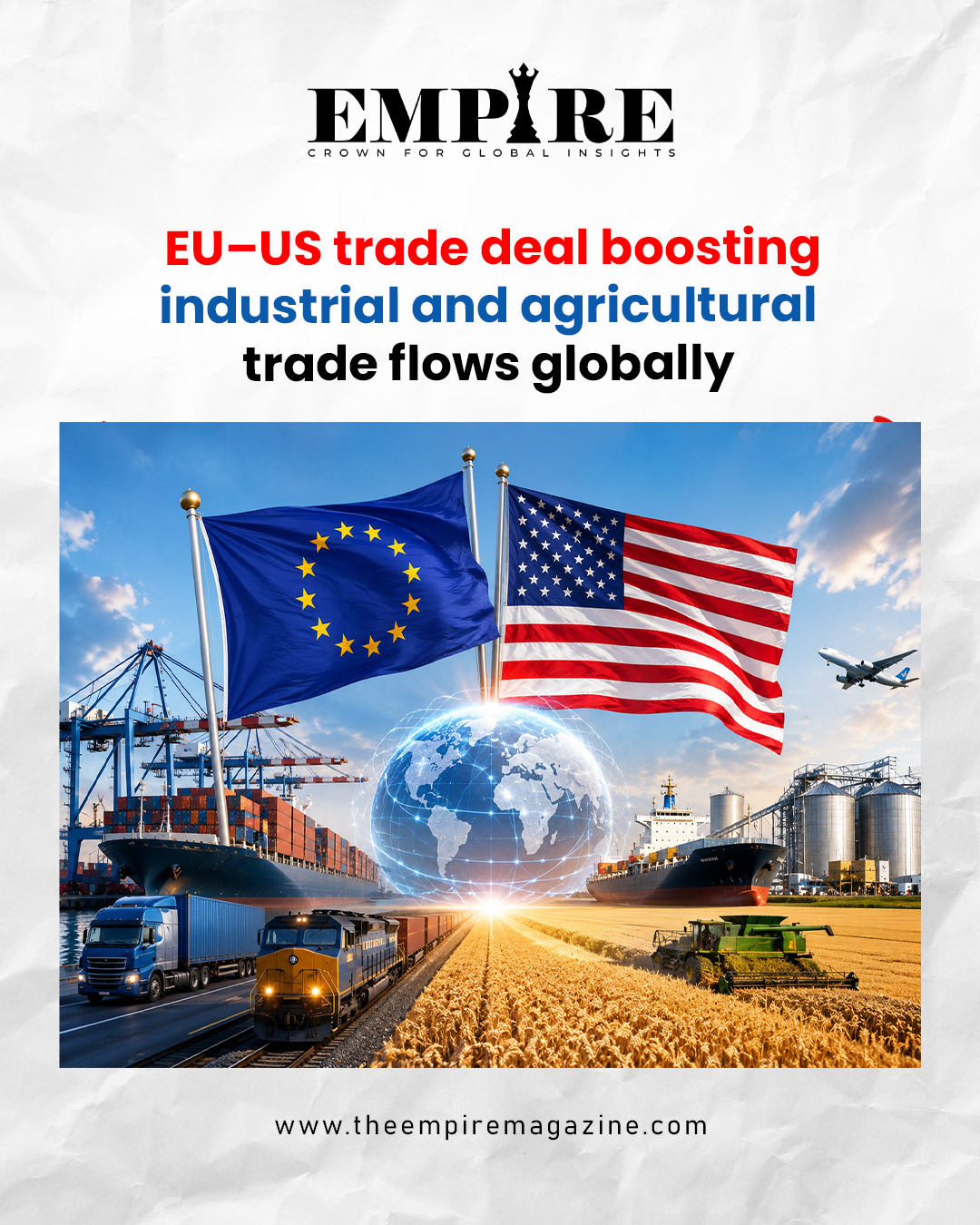
The EU–US trade deal is strengthening industrial and agricultural trade flows, reducing tariffs, improving supply chains, and reshaping global commerce. The EU–US Trade Deal is expected to strengthen industrial and agricultural trade by reducing trade barriers, improving supply chains, and increasing market access for businesses. The agreement marks a significant step toward deeper transatlantic economic cooperation while creating new opportunities for exporters, manufacturers, farmers, and global investors.
EU–US Trade Deal Boosts Industrial and Agricultural Trade Flows Globally
The world’s two largest advanced economies are once again moving closer through stronger economic cooperation. The EU–US Trade Deal has emerged as one of the most significant developments in international commerce, promising to reshape industrial manufacturing, agricultural exports, and global supply chains. As geopolitical tensions, inflationary pressures, and supply chain disruptions continue to challenge businesses worldwide, the renewed trade understanding between the European Union and the United States signals a shared commitment to economic stability and sustainable growth. For businesses, manufacturers, exporters, and consumers alike, the agreement represents much more than tariff reductions. It reflects a strategic partnership designed to strengthen resilience, encourage innovation, improve food security, and create new opportunities for cross-border investments. The deal is expected to enhance competitiveness while supporting industries that have experienced uncertainty over the past few years. With transatlantic trade already accounting for one of the largest bilateral economic relationships in the world, experts believe this renewed momentum could influence global trade policies, encourage investment flows, and set new standards for industrial cooperation in the years ahead.
EU–US Trade Deal Strengthens Global Economic Partnership
The EU–US Trade Deal represents a renewed effort to deepen one of the world’s most valuable economic relationships. Together, the European Union and the United States account for nearly one-third of global GDP and a substantial share of international trade, making every policy shift between them significant for the wider global economy. In recent years, both regions have experienced supply chain disruptions, geopolitical uncertainty, inflation, and changing industrial priorities that highlighted the importance of dependable trading partners. By reducing trade barriers, encouraging regulatory cooperation, and promoting smoother cross-border commerce, the agreement seeks to reinforce economic confidence while helping businesses expand internationally with fewer obstacles. Beyond trade volumes, the partnership also reflects shared values around innovation, sustainable manufacturing, technology development, and high-quality production standards. Companies operating in sectors such as automobiles, aerospace, pharmaceuticals, chemicals, machinery, and advanced manufacturing are expected to benefit from improved market access and stronger investment opportunities. Financial markets have also viewed the renewed cooperation positively, as investors generally favour predictable trade policies that encourage long-term economic growth. For governments on both sides of the Atlantic, the agreement is not merely about increasing exports but about creating a stronger, more resilient economic alliance capable of responding collectively to future global challenges, ensuring that businesses and consumers alike benefit from a more stable international trading environment.
EU–US Trade Deal Accelerates Industrial Trade Growth
The EU–US Trade Deal is expected to deliver substantial gains for industrial trade by reducing long-standing trade barriers and improving cooperation across manufacturing sectors. Industries such as automotive, aerospace, steel, machinery, pharmaceuticals, chemicals, renewable energy equipment, and advanced technology manufacturing stand to benefit from easier market access and greater regulatory alignment. Businesses that previously faced higher compliance costs due to differing technical standards may now experience smoother cross-border operations, enabling them to expand production and serve customers more efficiently. Small and medium-sized enterprises (SMEs), which often struggle with complex international regulations, could also find new opportunities to enter overseas markets with reduced administrative burdens. The agreement encourages companies to invest in modern manufacturing facilities, digital transformation, automation, and research-driven innovation, strengthening competitiveness on both sides of the Atlantic. Furthermore, stronger industrial cooperation is likely to attract higher foreign direct investment as global corporations seek to leverage the stability of the transatlantic market. Analysts believe that this renewed momentum in industrial trade will not only create employment opportunities but also reinforce the resilience of global manufacturing networks that have faced repeated disruptions in recent years. As industries continue adapting to technological change and sustainability goals, the EU–US partnership provides a framework for long-term industrial growth while maintaining high-quality production standards and encouraging responsible business practices.
EU–US Trade Deal Opens New Agricultural Opportunities
Agriculture remains one of the most closely watched aspects of the EU–US Trade Deal, as both regions are among the world’s leading producers and exporters of agricultural products. The renewed trade cooperation is expected to improve market access for farmers and agribusinesses by addressing tariffs, simplifying export procedures, and promoting greater transparency in food trade regulations. Products including dairy, wine, olive oil, grains, fruits, processed foods, meat products, and specialty agricultural goods could experience stronger trade flows as businesses gain improved access to consumers across the Atlantic. For farmers, the agreement presents opportunities to diversify export destinations and reduce dependence on regional demand, helping improve income stability during periods of market volatility. Consumers may also benefit from increased product availability, enhanced competition, and greater access to premium-quality agricultural products. However, agricultural trade between the EU and the US continues to require careful balancing of food safety standards, environmental regulations, and sustainability commitments, all of which remain important priorities for policymakers. The agreement therefore aims to encourage economic growth while preserving consumer confidence and maintaining rigorous quality standards that define both markets. By supporting agricultural innovation, modern farming practices, and climate-resilient food production, the partnership has the potential to strengthen global food security while creating lasting opportunities for rural communities and international agribusinesses.
EU–US Trade Deal Improves Global Supply Chains
One of the most significant outcomes of the EU–US Trade Deal is its potential to build stronger and more resilient global supply chains. The disruptions experienced during the COVID-19 pandemic, geopolitical conflicts, rising freight costs, and shortages of essential industrial components exposed vulnerabilities within international trade networks. In response, businesses across Europe and the United States have increasingly prioritised supply chain diversification, strategic sourcing, and regional cooperation. The renewed trade partnership supports these objectives by promoting smoother customs procedures, enhancing regulatory cooperation, and encouraging greater transparency across cross-border logistics. Manufacturers will be better positioned to source raw materials, intermediate goods, and finished products from trusted partners, reducing the risks associated with overdependence on single markets. Sectors such as semiconductors, clean energy technologies, medical equipment, automotive components, pharmaceuticals, and critical minerals are expected to benefit significantly from stronger transatlantic coordination. Improved supply chain efficiency can also help businesses lower operational costs, shorten delivery times, and respond more effectively to changing consumer demand. As companies continue investing in digital logistics, artificial intelligence, and smart manufacturing systems, the agreement provides a stable policy framework that supports long-term planning and operational resilience. In an increasingly uncertain global economy, dependable supply chains have become a strategic advantage, making this aspect of the trade deal particularly valuable for industries worldwide.
EU–US Trade Deal Influences Worldwide Markets
The EU–US Trade Deal is expected to have far-reaching implications beyond Europe and North America, influencing trade patterns, investment decisions, and economic policies across the globe. As the European Union and the United States together account for a substantial share of global trade and investment, closer economic cooperation between them sends a strong signal of confidence to international markets. Financial institutions, multinational corporations, and exporters often view such agreements as indicators of long-term economic stability, encouraging fresh investments and expansion into new markets. Developing economies that supply raw materials, intermediate goods, and industrial components to European and American manufacturers could also experience indirect benefits through increased demand and higher production volumes. At the same time, the agreement may encourage other nations to pursue similar bilateral or regional trade partnerships to remain competitive in an evolving global marketplace. International organisations have consistently highlighted that open, rules-based trade contributes to stronger economic growth, improved productivity, and greater resilience against global shocks. As digital commerce, green technologies, and advanced manufacturing continue to transform international business, the EU–US Trade Deal could become a benchmark for future trade agreements that prioritise innovation, sustainability, and secure supply chains. Its influence therefore extends well beyond tariff reductions, shaping how countries approach economic cooperation in an increasingly interconnected world.
EU–US Trade Deal Faces Challenges and Policy Questions
While the EU–US Trade Deal presents considerable opportunities, its successful implementation will depend on addressing several complex policy and regulatory challenges. Trade negotiations between two major economies often involve balancing commercial interests with domestic priorities, environmental commitments, labour protections, and consumer safety standards. Differences in agricultural regulations, food safety requirements, digital governance, industrial subsidies, and climate policies continue to require careful negotiation to ensure that businesses on both sides compete under fair and transparent conditions. Political changes within either region could also influence the pace of implementation, as trade agreements often require continued legislative and regulatory support over many years. Certain industries may express concerns about increased competition, while labour groups and environmental organisations are likely to monitor how the agreement impacts employment, sustainability, and responsible business practices. In addition, global geopolitical developments, including shifting supply chains and emerging economic alliances, may require periodic revisions to maintain the agreement’s effectiveness. Nevertheless, policymakers have emphasised that constructive dialogue and regulatory cooperation remain essential for ensuring that the partnership delivers balanced economic benefits. Successfully overcoming these challenges will determine whether the agreement achieves its broader objective of strengthening transatlantic commerce while supporting inclusive and sustainable economic growth.
Future Outlook of the EU–US Trade Deal
Looking ahead, the EU–US Trade Deal is positioned to become a cornerstone of global economic cooperation at a time when businesses are seeking greater certainty in an increasingly unpredictable trading environment. Beyond immediate gains in industrial and agricultural trade, the partnership lays the groundwork for collaboration in emerging sectors such as artificial intelligence, clean energy, digital services, biotechnology, semiconductor manufacturing, and advanced research. Governments on both sides have expressed a shared commitment to strengthening innovation ecosystems, promoting sustainable industrial development, and enhancing resilience against future economic disruptions. Businesses are expected to benefit from improved investment confidence, greater access to international markets, and stronger regulatory cooperation that supports long-term strategic planning. The agreement may also accelerate the adoption of green technologies and digital trade standards, enabling companies to remain competitive in rapidly evolving global markets. As economic relationships continue to shift in response to technological advancements and geopolitical changes, stronger transatlantic cooperation can provide stability while encouraging responsible and inclusive growth. Although further negotiations and policy refinements are likely in the coming years, the overall direction of the partnership reflects a mutual recognition that collaboration, rather than protectionism, offers the most sustainable path toward shared prosperity in the global economy.
EU–US Trade Deal marks a significant milestone
The EU–US Trade Deal marks a significant milestone in strengthening one of the world’s most influential economic partnerships. By promoting industrial growth, expanding agricultural trade, improving supply chain resilience, and encouraging cross-border investment, the agreement has the potential to generate lasting benefits for businesses, consumers, and governments alike. At a time when the global economy continues to navigate inflationary pressures, geopolitical uncertainty, and technological transformation, renewed cooperation between the European Union and the United States demonstrates the importance of stable, rules-based international trade. While implementation will require continued dialogue and careful management of regulatory differences, the broader vision remains clear: creating a more connected, resilient, and competitive global trading system. As industries adapt to new economic realities and sustainable development becomes an increasingly important priority, the EU–US Trade Deal is likely to play a defining role in shaping the future of international commerce. Its success could influence the next generation of global trade agreements, reinforcing the value of strategic partnerships in driving innovation, economic resilience, and shared prosperity across international markets.
For more business and retail insights, read more on The Empire Magazine
Previous article: https://theempiremagazine.com/indias-upi-greece/
Magazine Feautures | Podcasts: Empire Global Talks
Follow The Empire Magazine on Facebook | Instagram | LinkedIn | YouTube
The Empire Magazine | Crown for Global Insights